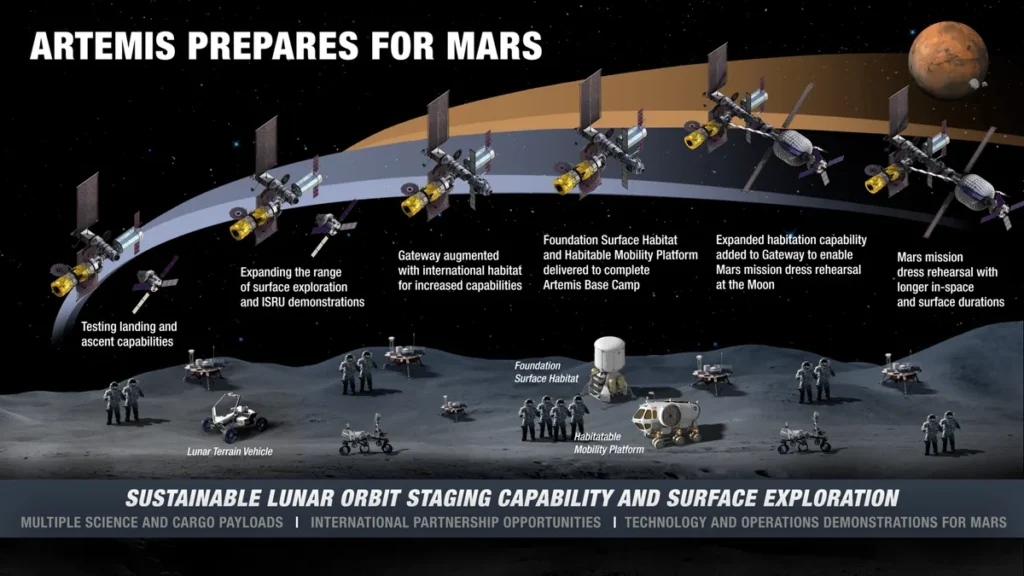
NASA named its latest astronaut candidate class, NASA Class 24, in September 2025 to prepare crew for future missions to low Earth orbit, the Moon, and Mars.
The Human Spaceflight Mission Directorate oversees NASA’s human spaceflight and space-enabling work in low Earth orbit, around the Moon, and further out. NASA works with private firms like SpaceX, which is building the Starship vehicle to transport many astronauts to Mars.
Understanding NASA’s Moon to Mars approach aids forecasters in anticipating launch schedules, aligning mission monitoring, and assessing how global and industry partners affect deep-space missions. NASA sees a Moon Base as the first human outpost near the lunar South Pole, where crews would live and conduct operations, and where both crewed and robotic missions would construct infrastructure to sustain a lasting lunar presence and prepare for Mars trips.
Studying the Moon lays the groundwork for future Mars and deeper space flights by offering a testbed for technologies needed on long journeys, like making fuel and oxygen from lunar soil to cut dependence on Earth supplies. Expedition 75 started on July 26, 2026, and is scheduled to conclude in spring 2027, with crew members carrying out experiments such as in-space manufacturing, augmented reality, AI-assisted health monitoring, and bioprinting of human tissue in weightlessness.
More than a dozen nations with launch capability take part in space endeavors, and projects like the International Space Station show effective teamwork, while countries including China, which is building a big space station, and the United Arab Emirates, aiming for Mars, stay active. NASA plans to launch its Mars Sample Return effort in the late 2020s to bring Martian dirt and rock back to Earth for thorough geological and chemical study.
NASA aims to send humans to Mars in the late 2020s or early 2030s, provided it can solve the related technical and logistical hurdles. NASA has identified major obstacles for crewed Mars flights, including shielding against radiation because Mars lacks a magnetic field, building habitats with local resources, and maintaining life‑support loops that recycle air and water.
The Orion spacecraft offers launch‑abort protection and seats four astronauts for trips beyond low Earth orbit, such as voyages to the Moon or Mars. The United States pledges to keep the International Space Station operating through 2030, and cooperation among nations is expanding, as shown by Australia and Bangladesh establishing space agencies that launch their satellites on U.S. rockets.


Join the discussion