Key facts
- EarthSky reports Mercury reaches greatest western elongation at 0 UTC on November 21, 2026, equivalent to 6 p.m. CT on November 20.
- EarthSky advises looking for Mercury in the sunrise direction shortly before sunrise as the sky brightens.
- CNET says the viewing window for Mercury is only about 30 minutes before sunrise because the sun closely follows Mercury over the eastern horizon.
- EarthSky says this morning apparition favors the Northern Hemisphere, while Southern Hemisphere observers might glimpse Mercury using binoculars along the eastern horizon.
EarthSky reports Mercury reaches greatest western elongation at 0 UTC on November 21, 2026, equivalent to 6 p.m. CT on November 20, placing the planet low in the eastern dawn for U.S. mid-northern observers.
National Geographic reports Mercury reaches greatest western elongation on November 20, 2026, and describes the viewing around that date as exceptional. CNET reports western elongation on November 20, 2026, calls it the single best day to view Mercury, and says Mercury will be easily visible just before sunrise for the rest of the month. National Geographic adds that viewing on the mornings just before, during, and after November 20 will be exceptional. National Geographic describes greatest western elongation as the time when Mercury is farthest from the sun and therefore especially visible late in the month.
EarthSky says Mercury will shine at magnitude -0.6 on the morning of November 21, 2026. After November 21, the planet edges back toward the sunrise and brightens a little more, reaching magnitude -0.9 before slipping away around mid-December in the morning twilight. EarthSky describes this as a long Northern Hemisphere morning apparition in which Mercury edges back toward the sunrise while becoming slightly brighter but facing increasing twilight competition.
Through a telescope on and around November 21, 2026, Mercury appears 62 percent illuminated and 6.64 arcseconds across, according to EarthSky. That phase and size detail helps observers using small scopes or binoculars to identify the planet’s phase and size.
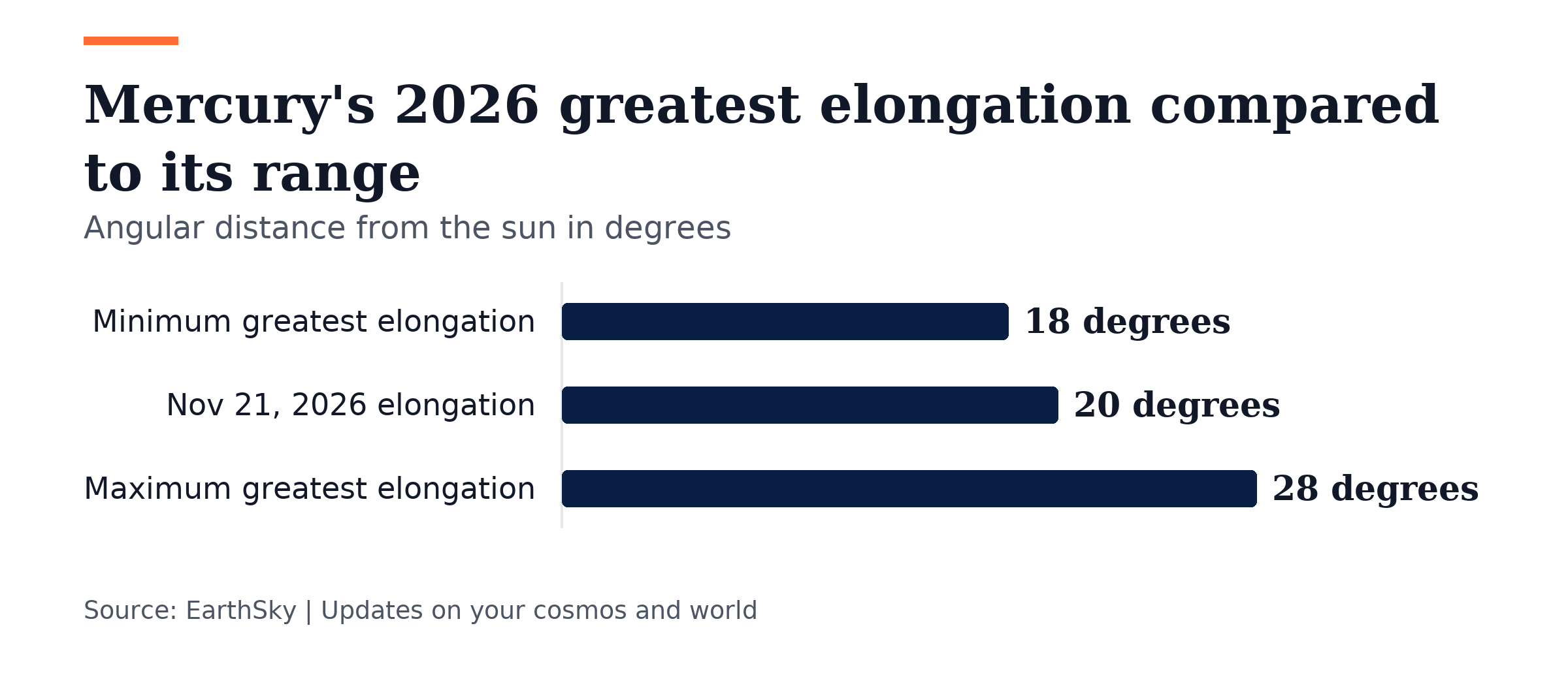
EarthSky reports Mercury will be 20 degrees from the sun on the sky’s dome at greatest elongation. EarthSky notes Mercury’s greatest elongations vary from about 28 degrees maximum to 18 degrees minimum on the sky’s dome. The source explains that elongation distances are not equal. Visibility depends on the season and the observer’s location, with autumn mornings generally favorable.
For both hemispheres, spring evenings and autumn mornings are best for Mercury elongations, EarthSky explains, because the ecliptic, the sun’s apparent path across the sky, makes a steep slant in autumn mornings. In autumn the ecliptic makes a steep slant, nearly perpendicular, to the horizon in the morning, and this seasonal geometry makes the November morning apparition especially favorable for Northern Hemisphere observers. EarthSky contrasts this with autumn evenings, when the ecliptic makes a narrow angle to the horizon. The source says Mercury then stands higher above the horizon and farther away from the solar glow.
EarthSky notes Mercury orbits the sun every 88 days and passes between Earth and the sun about every 116 days, last reaching inferior conjunction on November 4, 2026. Mercury has been speeding ahead of Earth in orbit since that conjunction and officially emerged in the morning sky during the second week of November 2026. EarthSky links this orbital motion to Mercury’s return to the eastern predawn sky after passing between Earth and the sun. EarthSky places this emergence after Mercury’s November 4 inferior conjunction, when the planet began moving ahead of Earth in orbit and returned to the eastern predawn sky.
EarthSky advises looking in the sunrise direction shortly before sunrise as the sky brightens. Bright Venus is also in the morning twilight but higher in the sky than Mercury, and EarthSky identifies Venus as a nearby marker along with the star Spica. Mercury is bright but nowhere near as bright as Venus, which rises earlier and appears farther from the sunrise point than Mercury. This helps observers distinguish the two planets in the dawn sky.
EarthSky’s bottom line is to look east at dawn on November 21, 2026, for Mercury with bright Venus and Spica nearby. The Note article states that on November 21, 2026, Mercury will reach its greatest western elongation and be well-positioned for dawn observation. National Geographic advises looking above the southeast horizon before sunrise near bright Venus, which sits just above Mercury, and to lower optical aids before the sun rises.
This morning apparition favors the Northern Hemisphere, EarthSky says, while Southern Hemisphere observers might glimpse Mercury using binoculars along the eastern horizon. EarthSky says autumn mornings put Mercury higher in the sky and farther from sunlight.
CNET reports the viewing window lasts only about 30 minutes before sunrise because the sun closely follows Mercury over the eastern horizon. The Note article warns never to point a telescope or binoculars at the sun because accidental viewing can cause serious eye damage, and says observation is safe once it starts to get bright. Observers need a clear low eastern-southeastern sky with few clouds. CNET reports a four-planet alignment from November 14 to 25, 2026, in which Mercury, Venus, Mars, and Jupiter line up before sunrise, with Jupiter and Mars right next to each other.

The Note article sets the focus period for seeing the four planets around November 13 to 22, 2026, with the planets spread from the eastern to the southern sky rather than clustered together. The article, written by a persona called Professor Kuro-suke, describes this as a chance to see Mercury, Venus, Mars, and Jupiter together before sunrise, though they appear spread out across the eastern and southern sky rather than clustered together.
The Note article ranks naked-eye visibility, saying Venus is very easy to spot, Jupiter easy, Mars relatively easy, and Mercury difficult due to low altitude. The article recommends starting with Venus and Jupiter, trying Mars next, and treating Mercury as the final challenge under clear skies with an unobstructed view low in the east-southeastern sky.
The Note article predicts Venus will reach approximately magnitude -4.9 on November 30, 2026, making it overwhelmingly bright in the dawn sky. The article calls Venus the Queen of the Dawn Sky and the Morning Star, advising observers to look for an exceptionally bright star-like light low in the east-southeastern sky. Professor Kuro-suke said, “Venus shines like a jewel in space, meow!”
The Note article says Mercury will be visible in the low east-southeastern sky around November 14, 2026, but its low altitude makes it difficult to observe. For the Tokyo area, the article gives observing times starting around 5:20 a.m. with a recommended time around 5:40 a.m., and says observers need a spot where they can see all the way to the horizon.
The Note article recommends November 21 as the date to try if observers missed Mercury around November 14, and recommends around November 21 as the best time to be sure to find Mercury at greatest western elongation. Mercury is difficult to observe except just before sunrise or just after sunset because it orbits closest to the sun and does not appear very far from it.
CNET reports Mercury was at eastern elongation during October 2026 and starts November too close to the sun to see safely. CNET says Mercury and Venus are the most difficult planets to see in November due to their proximity to the sun. The source uses this to explain why Mercury is difficult to observe early in the month before moving toward its November 20 western elongation.
EarthSky recommends the Old Farmer’s Almanac for U.S. and Canada, Timeanddate.com worldwide, and Stellarium as an online planetarium for precise sun and Mercury rising times. These tools help U.S. mid-northern observers plan their viewing window for the dawn apparition.
The Note article recommends smartphone stargazing apps such as Stellarium, Star Walk 2, and Sky Tonight, but warns that a phone’s orientation sensor may have errors. Observers can set date, time, and location in an app to check where planets and constellations appear. They should not rely solely on the app and should verify against actual bright planets and sky direction.

Join the discussion