Astrobiology Web reported Nov. 21, 2026 that MAIC-2 v2.3, the Mars Atmosphere-Ice Coupler, had been released.
MAIC-2 is a computationally efficient zonally-averaged program, meaning it averages data around latitude circles rather than modeling each longitude, that simulates Mars surface temperature, how water moves through its atmosphere and ice buildup on the surface across spans from 10^5 to 10^7 years, Astrobiology Web said. Full General Circulation Models give detailed Martian atmospheric simulations, but their computing cost makes them impractical for studies of orbital change across millions of years. MAIC-2 closes that gap with zonally-averaged parameterizations built on a Local Insolation Temperature scheme and a mass balance engine that uses free-convection and instantaneous mixing physics.
Astrobiology Web said the v2.3 release rebuilds the code in fully modular Fortran so it is easier to maintain and runs on its own, without outside numerical libraries or specific data formats. The release keeps MAIC-2’s role as a computationally efficient tool while making upkeep and deployment simpler.
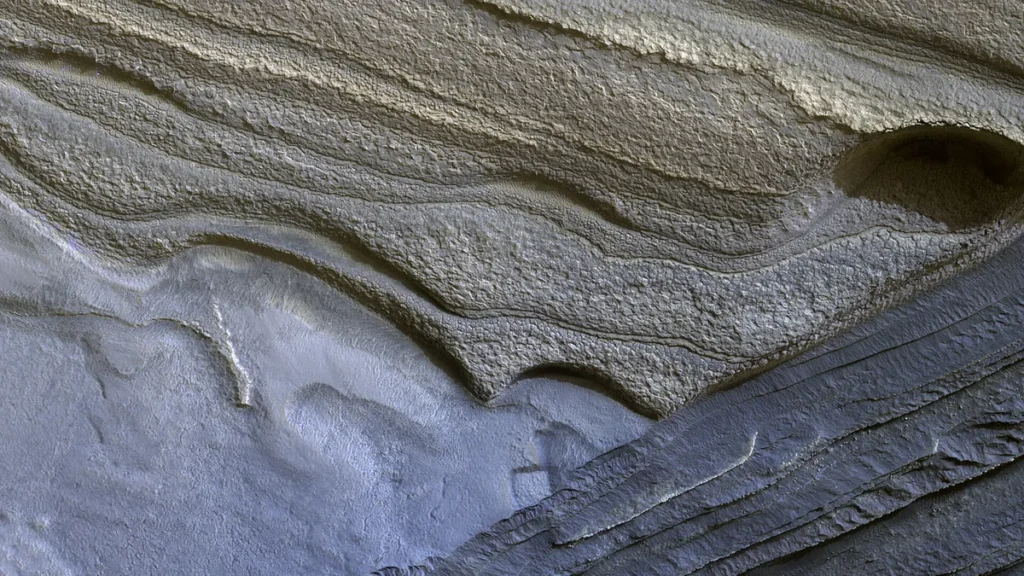
Astrobiology Web said a 20-million-year transient run showed the code captures the main traits of Mars’ polar layered deposits. Researchers can use the open-source code to examine how changes in Mars’ orbit shape surface climate across long periods. The arXiv preprint arXiv:2611.23643 [astro-ph.EP] by Ralf Greve, Björn Grieger and Oliver J. Stenzel runs 12 pages with 6 figures.




Join the discussion