Key facts
- M74 requires dark skies because surface brightness rather than apparent magnitude determines whether the galaxy will stand out.
- Observers rate M74 among the most difficult Messier objects to see since its low surface brightness and magnitude of about 10 make it appear as a faint smudge in small telescopes.
- Astronomy Magazine's daily observing column for Saturday, October 31, 2026, recommends M74, also known as the Phantom Galaxy, as a Halloween sky target.
- The best time to look for M74 on Halloween night is after dark but before the Moon rises.
Astronomy Magazine’s daily observing column for Saturday, Oct. 31, 2026, recommends M74, also known as the Phantom Galaxy, as a Halloween sky target in the eastern sky after dark and before moonrise.
The best time to look for M74 on Halloween night is after dark but before the Moon rises, and Astronomy Magazine sets this as the observing window for the night. Sunset on Oct. 31, 2026, occurs at 5:59 P.M. local time from 40° N 90° W, and moonrise follows at 11:08 P.M. local time from the same coordinates. The Moon is in a waning gibbous phase at 58 percent illumination at 10 P.M. local time, which defines the end of the dark-sky observing window. Astronomy Magazine also lists sunrise at 7:28 A.M. and moonset at 1:33 P.M. on the same date for the observing location, giving observers the full daily timing for the Halloween session.
sky-tonight.com places the start of twilight at 18:33 local time on Oct. 31, 2026, when M74 sits 23 degrees above the horizon toward the northeast. The page tracks M74’s position throughout the night. By 9 P.M. local daylight time, M74 sits in eastern Pisces and climbs to 45 degrees in the east, giving observers a practical reference point after dark.
Observers can star-hop to M74 just over 1 degree northeast of 4th-magnitude Eta Piscium. A second option uses brighter 3rd-magnitude Beta Arietis, also called Sheratan, by skimming 6.6 degrees southwest of it. Astronomy Magazine provides both pointing directions, using Beta Arietis as a brighter reference star in Aries.
Astrofoto Guru lists M74’s coordinates as right ascension 1h 36m 42s and declination plus 15 degrees 47 arcminutes 0 arcseconds as target information for the Phantom Galaxy in Pisces. AstroPlanner gives right ascension 01h 36m 43s and declination plus 15 degrees 46 arcminutes 48 arcseconds. AstroPlanner uses the coordinates to compute moonless windows and field-of-view fit for imaging sessions.
Published estimates for M74’s apparent magnitude range from ninth magnitude to 10.0. Astronomy Magazine describes it as ninth magnitude, while Astrofoto Guru lists 9.4 and classifies difficulty as Advanced. LiveEarthViewer and sky-tonight.com list 10.0, and sky-tonight.com notes that a small telescope can show it. All the guides agree the galaxy is faint and spread over a large area, so its low surface brightness matters more than the magnitude figure alone.
Estimates for its distance run from 24 million to 32 million light-years. Astronomy Magazine uses 24 million light-years to explain why the galaxy appears large but faint. LiveEarthViewer cites about 31 million light-years, with source estimates spanning 29 million to 33.2 million light-years. sky-tonight.com and other references give about 32 million light-years, and sky-tonight.com pairs the figure with the discovery history.
sky-tonight.com gives M74’s distance as approximately 32 million light-years and its apparent magnitude as 10.0, listing 95,000 light-years alongside those figures and noting that a small telescope can show it. At about 31 million light-years away, M74’s 6.7 arcminute span corresponds to roughly 60,400 light-years across. LiveEarthViewer notes the light reaching Earth tonight set out 31 million years ago.
Its apparent diameter ranges from 6.7 arcminutes to 11 arcminutes. Astronomy Magazine describes it as roughly 11 arcminutes across and big because it is nearby. Astrofoto Guru lists 10 arcminutes by 9 arcminutes, while other guides give 6.7 arcminutes.
M74 is a low surface brightness face-on spiral galaxy. Astrofoto Guru summarizes the target this way in its about section, and the same description appears across multiple guides. Astronomy Magazine describes it as a face-on spiral with a bright core surrounded by fainter arms.
M74’s light spreads over a large area, lowering its surface brightness and making the galaxy harder to see than its magnitude suggests, which explains the phantom nickname. Astronomy Magazine links the low surface brightness directly to the galaxy’s large apparent size and relative proximity, which makes it a challenging visual target.
Astronomy Magazine describes the spiral arms as asymmetric with a much longer western arm, while other guides describe two symmetric spiral arms. LiveEarthViewer describes two symmetric grand-design arms traced by dust lanes, and other references say one arm narrows at the end. LiveEarthViewer attributes the symmetric-arms description to a cited source, while Astronomy Magazine instead notes an asymmetry between western and eastern arms. The arms contain bright star-forming regions.
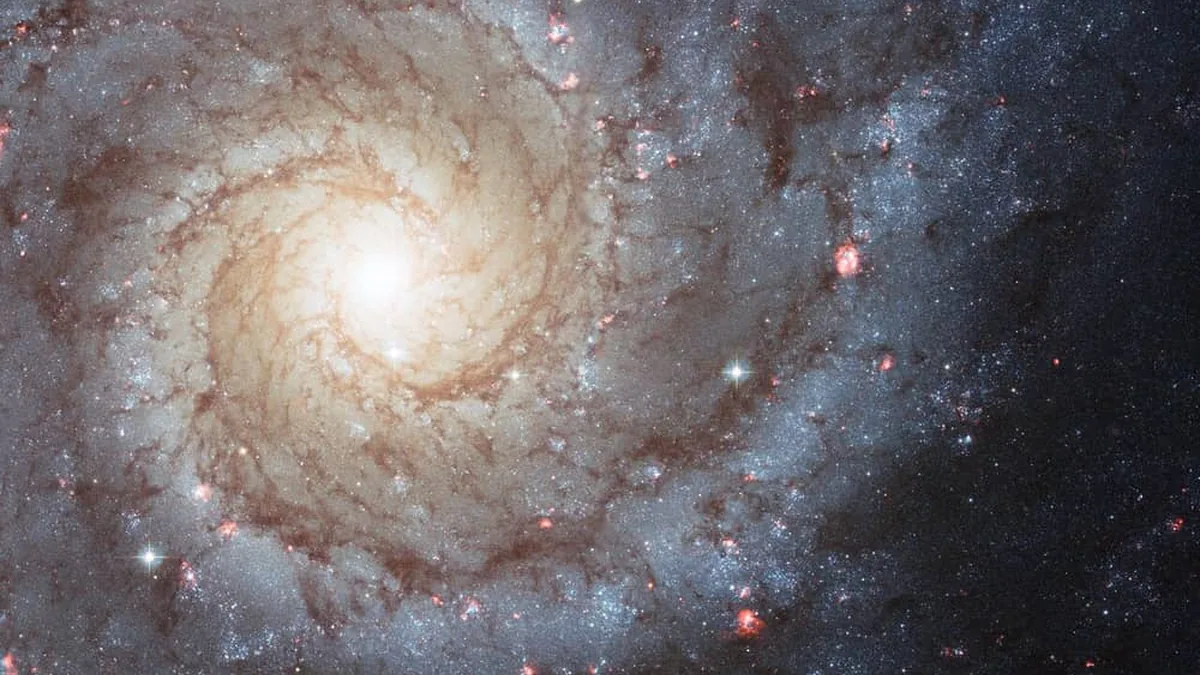
Pink H II regions along the arms consist of hydrogen clouds illuminated by ultraviolet light from hot young stars. Astronomy Magazine describes the arms as mottled with bright regions of star formation. LiveEarthViewer attributes the H II region description to a cited source.
In August 2022, ESA/Webb selected M74 as the first target for its Picture of the Month series. The James Webb Space Telescope captured an infrared image of M74 in 2022 that reveals detailed dust lanes and star-forming regions. AstroPlanner describes the image as breathtaking, while LiveEarthViewer notes the August 2022 selection and other guides record JWST observation in July 2022. The galaxy lies almost face-on, making it a favorite for studying spiral arm formation.
Pierre Méchain discovered M74 in 1780, and Charles Messier later added it to his catalog. Messier listed it as a permanent celestial object not to be confused with transient objects. sky-tonight.com pairs these figures with the discovery history.
Observers rate M74 among the most difficult Messier objects to see because its low surface brightness and magnitude of about 10 make it appear as a faint smudge in small telescopes. AstroPlanner and other references call it the most difficult Messier object for amateur astronomers, noting the face-on orientation spreads the light so thin it can be nearly invisible even in a large telescope. LiveEarthViewer attributes the difficulty finding to its source marker, and the same difficulty echoes across guides.
M74 requires dark skies because surface brightness rather than apparent magnitude determines whether the galaxy will stand out. At magnitude 10.0, most observers cannot see M74 in binoculars, so the object requires a telescope. LiveEarthViewer’s instrument rule says anything fainter than about magnitude 9.0 with spread light wants a telescope. Astronomy Magazine says the spiral arms show up best in telescopes with apertures of 8 inches or larger, and a nebula filter can improve the view of the arms.
Astrofoto Guru rates M74 as an advanced observing target, listing this alongside magnitude 9.4, angular size 10 by 9 arcminutes, and best months September through December. M74 is best placed for observing from September through December, according to Astrofoto Guru. The same guide lists an observing session for tonight from 8:00 P.M. to 5:00 A.M. LiveEarthViewer’s Oct. 11 guide said M74 is visible at midnight around the middle of October.
The galaxy rises above the horizon from every latitude between 74 degrees south and 90 degrees north, and it offers a city-based planner for how high the galaxy climbs.
Mars and Jupiter shine in western Leo to the upper right of Regulus on Halloween night. Brighter Jupiter sits halfway between Mars and the blue-white star. Astronomy Magazine’s same column notes that Mars approaches Leo on Oct. 30.
The switch from daylight saving time to standard time happens at 2 A.M. on Nov. 1, 2026, when clocks move back one hour. Astronomy Magazine includes this time-change note on the same Halloween column, and it affects local time conversions for observers after the observing night.
Early on Nov. 1, the waning gibbous Moon will appear in Cancer just west of the Beehive Cluster, whose stars spread across nearly 100 arcminutes of sky. Astronomy Magazine describes this as an early-morning sight after Halloween.

Join the discussion