Key facts
- Telescope Advisor and Vito Technology's Star Walk guide both describe the Moon on October 31, 2026 as a waning gibbous that rises late in the evening.
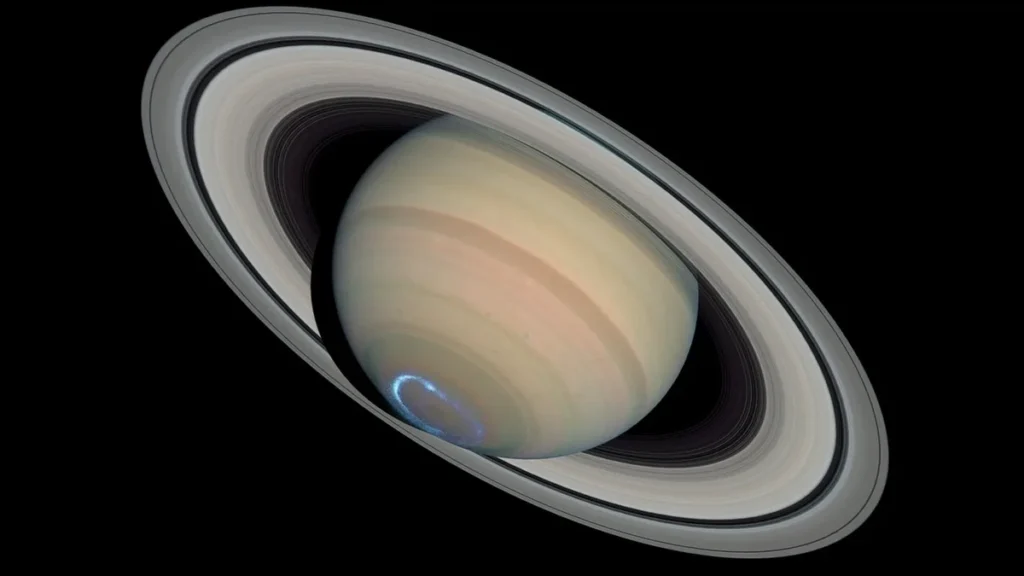
- Telescope Advisor states that Saturn's rings are tilted 7.5 degrees on Halloween night 2026 and show plainly through any telescope of 60 millimeters or more at 50 times magnification.
- Telescope Advisor reports that the waning gibbous Moon on October 31, 2026, is five nights past the October 26 Hunter's Moon and rises later in the evening.
- Telescope Advisor states that the late moonrise leaves early hours reasonably dark on Halloween night 2026 for the Pleiades, the Double Cluster, and the Andromeda Galaxy.
You can spot Saturn’s rings, occasional Taurid fireballs, and four naked-eye planets after dark on Halloween night, Oct. 31, 2026, Telescope Advisor and Vito Technology’s Star Walk guide say.
Telescope Advisor calls Saturn the headline of Halloween night, saying the planet shines at magnitude 0.3 (a brightness scale on which lower numbers indicate brighter objects) on Oct. 31, 2026, and outranks every star in its part of the sky. The source ties the planet’s visibility to its Oct. 4, 2026, opposition and calls it the headline because Saturn remains near peak visibility shortly after opposition. Vito Technology’s Star Walk guide places Saturn at magnitude 0.5 in Cetus, already above the horizon when darkness falls.
Telescope Advisor sets the bar at a 60-millimeter telescope and 50 times magnification for a plain view of Saturn’s rings on Halloween night. The rings tilt 7.5 degrees on that night. Star Walk adds that a telescope reveals Saturn’s rings along with Jupiter’s dark cloud bands. Telescope Advisor presents the rings as the telescope highlight of the night and says a single eyepiece view persuades more people to take up astronomy than anything else.
The rings remain at near-opposition quality throughout the evening, according to Telescope Advisor.
The Moon arrives as a waning gibbous on Oct. 31, 2026, five nights past the Oct. 26, 2026, Hunter’s Moon, and rises later in the evening. Telescope Advisor and Star Walk both describe the late moonrise, while Star Walk notes more than half the lunar disk will be illuminated from the night of Oct. 31 into Nov. 1, 2026. Telescope Advisor uses the late moonrise to explain why early hours stay reasonably dark for faint deep-sky targets before the orange rising Moon becomes a spectacle for late-night viewers.
Telescope Advisor says the early darkness suits the Pleiades, the Double Cluster, and the Andromeda Galaxy. Star Walk adds that binoculars can reveal Andromeda’s bright central glow under a reasonably dark sky at northern and tropical latitudes. After the early dark window, the orange rising Moon becomes its own spectacle for late-night viewers, according to Telescope Advisor. These targets stand best before the Moon climbs high enough to wash out faint light.
Telescope Advisor notes that brilliant Venus hangs low in the west during the opening couple of hours after sunset on Oct. 31, 2026. The planet serves as an early-evening naked-eye target before setting, complementing Saturn in the evening sky. Telescope Advisor presents Venus as part of the night’s observing targets alongside Saturn, the Moon, and Algol.
Telescope Advisor describes Taurid fireball season as active on Halloween night, bringing occasional slow, brilliant meteors. A few lingering Orionids may also appear. The source presents these meteors as part of the supporting cast for Halloween night observing alongside Saturn and Venus. Star Walk calls the shower famous for sudden outbursts and bright bolides, though the Taurids are usually less active.
The bright meteors carry the name Halloween fireballs.
Star Walk details the Southern Taurids reaching increased activity on Oct. 12-13, 2026, and peaking on Nov. 4-5, 2026, while the Northern Taurids peak on Nov. 11-12, 2026. Halloween night falls between the two branch peaks, but observers may still spot bright Taurid meteors if the sky is clear. Observers on Oct. 31 sit between those peaks, and the source notes bright meteors can still appear under clear conditions.
The Orionid meteor shower peaked on Oct. 21-22, 2026, and stays active until Nov. 7, 2026, according to Star Walk. The meteors move quickly and often leave glowing trails, though Halloween night itself brings no peak. Lingering Orionids may still be visible on Oct. 31 if the sky is clear, but the bright Moon rising in the evening may hide many faint meteors.
Star Walk reports Jupiter at magnitude minus 2.0 rising later and visible best before dawn in Leo near Regulus, while Mars shines nearby at magnitude 0.9 with a reddish glow. Observers can see all three planets without a telescope on Halloween night. Telescopic views can reveal Saturn’s rings and Jupiter’s dark cloud bands, and under good conditions Jupiter’s Great Red Spot may be visible when it faces Earth.
Star Walk describes the Great Red Spot as a giant storm resembling a cyclops eye, visible when it turns toward Earth. Saturn’s rings and Jupiter’s cloud bands both reward a telescope look on the night of Oct. 31, 2026. The guide treats the spot as a telescopic feature.
Telescope Advisor calls Algol in Perseus the Demon’s Head, a spooky naked-eye target for Halloween night. Star Walk places the star in the same constellation and traces the name to the Arabic Al-Ghul, meaning ghoul.
The star sits in Perseus as a triple-star system, Star Walk says, ranging from magnitude 2.1 to 3.4. Beta Persei Aa2 passes in front of Beta Persei Aa1 during the eclipse. One eclipse runs about 10 hours, while the pattern comes back every 2 days, 20 hours, and 49 minutes. At its brightest, the star shines three times more intensely than when faintest.
Star Walk says observers can follow each eclipse with the naked eye by comparing Algol with nearby stars. The dimmer Beta Persei Aa2 passes in front of the brighter Beta Persei Aa1, causing the brightness change that made the star famous in folklore.
Greek tradition knew Perseus and Medusa’s Head, with Algol representing part of Medusa’s head and earning the title the first star of the Gorgon. Hebrew folklore called it Satan’s Head, while 16th-century Latin called it the Spectre’s Head. Star Walk records these names alongside the star’s reputation for dimming and brightening.
Star Walk directs northern mid-latitude observers to the Witch’s Broom Nebula in the early evening. The timing matters because Cygnus sinks lower later at night. The nebula forms the western section of the Veil Nebula, created by a stellar explosion thousands of years ago, with thin strands that look like broom bristles. A low-magnification telescope helps, and an O III filter can make the faint strands stand out.
Star Walk gives the Skull Nebula, NGC 246, a magnitude around 11. The guide says observers should catch it at its highest point in the local sky. The object fits a Halloween observing list for telescope users.
Star Walk calls the Phantom Galaxy, M74, one of the most challenging Messier objects. Its low surface brightness makes it a difficult deep-sky test. Observers seeking a difficult deep-sky test can add it to the night’s list.
Star Walk says Dark Matter Day falls each year around Oct. 31. The guide presents the Andromeda Galaxy as a way to end Halloween skywatching and links it to the occasion. The guide says the faint glow of Andromeda comes from ordinary matter, mainly stars, and that astronomers infer unseen mass by comparing visible matter motions with expected gravity.
Binoculars reveal the galaxy’s bright central glow when the sky is reasonably dark. Star Walk presents this as a way to end Halloween skywatching and links it to Dark Matter Day. The faint glow comes from ordinary matter, mainly stars, while astronomers infer unseen mass by comparing visible matter motions with expected gravity.
Star Walk describes four targets better placed for southern skies or specific hemispheres. The Coalsack Nebula covers about 5° by 7°, lying mainly in Crux and extending into Centaurus and Musca. The Ghost Nebula, Sh2-136, sits around 1,200 light-years away in Cepheus and is best viewed high overhead from August through November.
The Tarantula Nebula spans nearly 1,000 light-years in Dorado and is best observed from the Southern Hemisphere with binoculars. Star Walk says the Owl Nebula, M97, shows up in 20×80 binoculars or a small telescope when the sky is very dark. A telescope 10 inches in diameter improves the odds of seeing its owl-like eyes. Star Walk places the Owl Nebula in Ursa Major and describes it as best from the Northern Hemisphere.
Star Walk recommends following the lunar terminator with binoculars or a telescope. There, lengthened shadows highlight crater walls and mountain ridges. The terminator is the line between day and night on the Moon.
Telescope Advisor calls Halloween night tailor-made for sidewalk astronomy because Saturn stays well up during prime trick-or-treat hours. The source notes the planet is four weeks past its Oct. 4 opposition. After the early evening stays dark enough for deep-sky targets, the orange rising Moon becomes its own spectacle for late-night observers.
The two guides paint Halloween night, Oct. 31, 2026, as a mix of bright planets, occasional fireballs, and deep-sky targets for observers with clear skies. Telescope Advisor emphasizes Saturn and the Moon, while Star Walk adds the Taurid branches, Algol’s eclipses, and a spread of nebulae and galaxies.

Join the discussion