Key facts
- Because Phobos orbits Mars faster than the planet rotates, the tidal bulge it raises on Mars lags behind and slows Phobos, driving the moon inward at about 0.79 inch (2 centimeters) per year.
- JAXA launched the $578 million Martian Moons eXploration (MMX) mission on Monday from Tanegashima Space Center aboard an H3 rocket.
- When Phobos reaches the Roche limit about 3,400 miles (5,470 km) from Mars’s surface, the planet’s tidal forces will rip it apart into boulders, rocks, and dust that spread into a ring around Mars.
- As Phobos approaches the Roche limit, the hundred meters or so of regolith on its surface could be stripped off in as little as a week and spread into a ring around Mars.
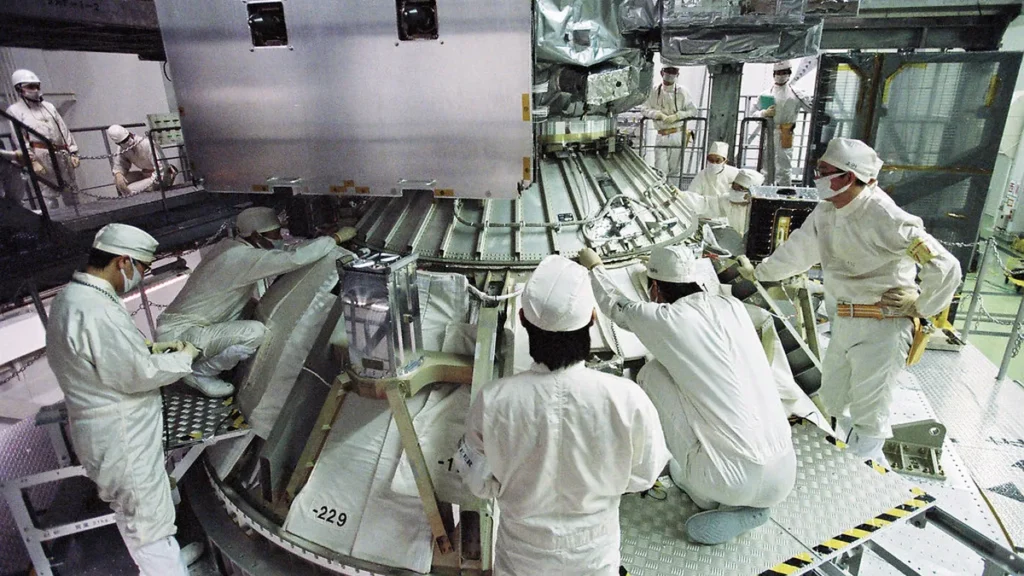
JAXA launched the $578 million Martian Moons eXploration mission on Monday, Oct. 19, 2026, launching from Tanegashima Space Center on an H3 rocket to begin a five-year expedition to land on Phobos, collect samples and return them to Earth.
JAXA’s MMX mission aims to test whether Phobos began as an asteroid captured into orbit around Mars billions of years ago. Japan’s science minister Yoshihiro Seki called the mission the world’s first sample return from the Martian moons.
The spacecraft weighs nearly 9,900 pounds, with two-thirds of that mass propellant. It separated from the H3 rocket about 71 minutes after liftoff and reached more than 24,000 mph for the 10-month voyage to Mars. Yasuhiro Kawakatsu, JAXA’s project manager, reported that MMX established contact, deployed its solar panels and was in a stable condition soon after separation. JAXA president Hiroshi Yamakawa declared the launch a success and said a long journey of five years had just started.
Astronomy Magazine reports that Phobos is the larger and nearer of Mars’s two moons. The moon spans 13.8 miles (22.2 kilometers) across and circles Mars at an average distance of 5,827 miles (9,377 kilometers), finishing one lap every seven hours, 39.2 minutes, faster than Mars itself spins. NASA gives different dimensions, 17 by 14 by 11 miles, and notes that the moon circles Mars three times daily.
Asaph Hall, an American astronomer, found Phobos in 1877 with the 26-inch Great Equatorial refractor at the United States Naval Observatory in Washington, D.C. He named the moon for the Greek god of fear and panic, twin brother of Deimos and son of Ares.
Phobos has no atmosphere and might be a captured asteroid, though some scientists dispute that idea. Both moons look like C-type rock akin to blackish carbonaceous chondrite asteroids, and eons of meteoroid strikes have ground their surfaces to powder.
Mars Express, operated by ESA, found Phobos’s density at 1.9 grams per cubic centimeter, below Earth’s Moon at 3.3 grams per cubic centimeter and Jupiter’s moon Themisto at roughly 2.6 grams per cubic centimeter. The low density indicates Phobos is porous, likely contains large voids and is probably a rubble pile. The moon’s makeup looks like carbonaceous chondrite meteorites, including ones that landed at Tagish Lake, Canada, in 2000, and its rubble breaks easily.
NASA’s Mars Global Surveyor shows Stickney Crater spanning about 6 miles (9.7 kilometers), covering roughly half the moon’s surface. Astronomy Magazine puts the crater at 5.6 miles (9 kilometers), almost half the moon’s diameter, and says the old impact broke up much of Phobos’s interior. The moon shows scars from thousands of meteorite strikes, and billions of years of meteoroid impacts have churned the surface into a layer of fine dust about 100 meters deep.
Temperatures on Phobos swing from 25°F (-4°C) in sunlight to -170°F (-112°C) in darkness. The difference probably comes from fine dust that cannot hold heat.

Phobos is drifting closer to Mars, and Mars will eventually destroy it. Astronomers have long known about the inward spiral, which happens because Phobos raises a tidal bulge on Mars that lags behind the moon and gradually saps its orbital energy. That tide pushes Phobos inward at about 0.79 inch (2 centimeters) per year. NASA reports that Phobos is closing in on Mars by six feet (1.8 meters) every hundred years and faces either impact with Mars in 50 million years or breakup into a ring.
Published studies disagree on when Phobos will break apart or hit Mars, with estimates spanning 20 million to 75 million years from now; NASA puts the timing at 50 million years for either impact or breakup. Some studies cite 25 million to 75 million years. Black and Mittal built a numerical geotechnical model that puts the finale between 20 million and 40 million years from now.
At the Roche limit, the point where Mars’s tides overpower the moon’s gravity, roughly 3,400 miles (5,470 kilometers) from the surface, the planet will tear Phobos into boulders, rocks and dust that form a ring. The moon’s self-gravity and tensile strength currently resist those stresses, but as Phobos draws nearer they increase until Martian gravity wins.
Fragments that miss the ring will drop onto Mars and hit hard enough to leave fresh craters. After the ring phase, rocky rubble left behind will plummet along slanting paths and leave a string of elongated craters along Mars’s equator. Close to the Roche limit, Mars could strip roughly a hundred meters of regolith, or loose surface material, from Phobos in as little as a week, adding it to the ring.
Black and Mittal project that the Martian ring will endure for between 1 million and 100 million years. At first the ring might match the mass density of Saturn’s rings today, though it would look dark like Jupiter’s dusty rings, sit thinner and more diffuse, and circle closer to Mars than other planetary rings. If Phobos breaks apart, Mars would join the gas giants as a ringed planet.
Deimos spans 7.8 miles (12.6 kilometers) and circles Mars at an average distance of 14,580 miles (23,460 kilometers). That keeps it outside the danger zone where Phobos faces destruction.
Mittal says four forces decide Phobos’s fate. They are the tidal pull from Mars, centrifugal force on the moon, Phobos’s own gravity and the moon’s strength.
Scientists disagree over the origin of Phobos’s grooves. A 2015 NASA study led by Terry Hurford at Goddard Space Flight Center called the grooves tidal stretch marks on the Mars-facing side. Astronomy Magazine reports that a 2018 computational study instead blamed boulders from the Stickney impact that rolled over the surface.
Join the discussion