Key facts
- Don Han, Psyche navigation lead at JPL, said thrusters will operate nearly 90 percent of the time until reaching the asteroid, pausing only for necessary engineering activities.
- Steve Snyder, Psyche propulsion operations lead engineer at JPL, said the spacecraft will thrust at full power for three months, then throttle to half power as it moves farther from the Sun.
- Closest approach occurred at exactly 3:28 PM EDT (12:58 AM IST on May 16), placing the probe at 1.3 Mars radii and inside the orbits of Phobos and Deimos.
- The Mars gravity assist saved fuel by providing a sudden kinetic energy boost that Psyche's four Hall-effect ion thrusters would otherwise take years to generate.
NASA’s Psyche spacecraft resumed electric propulsion thrusting on Sept. 28 and is accelerating toward the metal-rich asteroid Psyche after a successful Mars gravity assist on May 15, 2026.
The May 15 flyby added momentum and shifted the spacecraft’s direction toward the main asteroid belt, saving fuel by providing a sudden burst of kinetic energy that the thrusters would otherwise need years to create. The flyby used Mars‘s mass to add speed and tilt the trajectory 3 degrees toward the asteroid’s orbital plane. A trajectory correction maneuver lasting 12 hours took place on February 23, 2026, before the flyby.
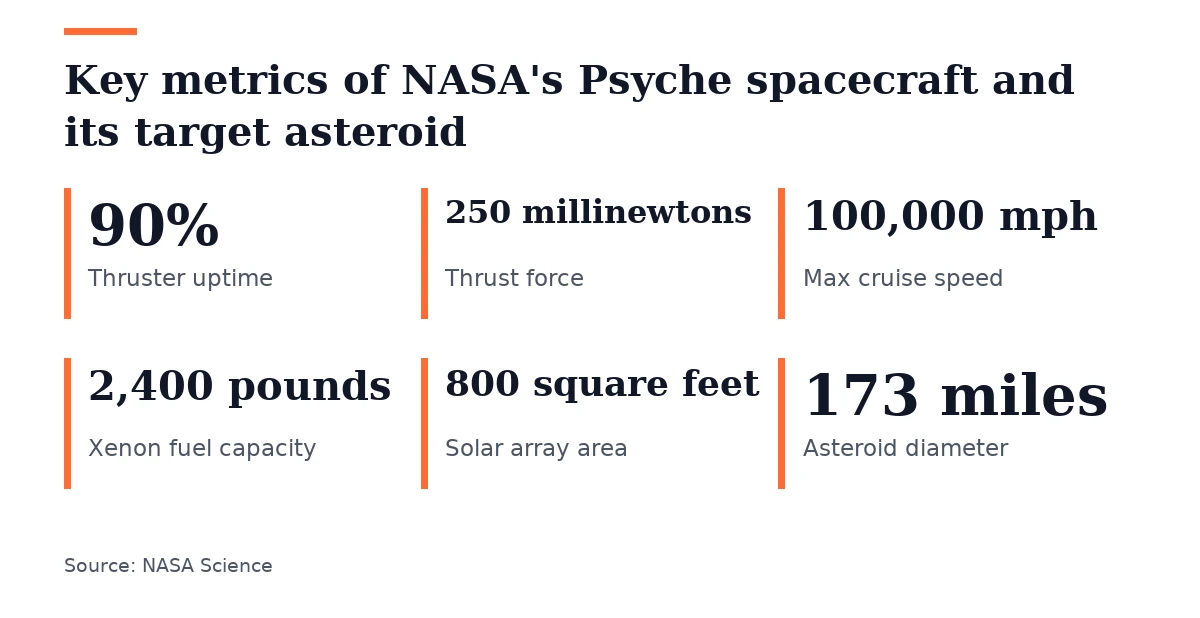
The spacecraft’s solar-powered propulsion system uses the Hall effect to expel charged xenon ions, creating thrust and a bright blue glow. Xenon is an inert gas. The craft’s four thrusters operate one at a time. It generates as much as 250 millinewtons of force, about like holding one AA battery, and that small push adds up over the trip through interplanetary space.
When cruising at top speed, the spacecraft will move faster than 100,000 mph (160,900 kph) compared with an observer on Earth. Don Han, Psyche’s navigation lead at JPL, said the thrusters will run for nearly 90 percent of the time before the spacecraft reaches the asteroid, stopping only for needed engineering work. Steve Snyder, Psyche’s propulsion operations lead engineer at JPL, said the craft will operate at full power for three months, then reduce to half power farther from the Sun because solar-electric propulsion relies on sunlight.
Since Sept. 28, the spacecraft has used propulsion nearly all the time, stopping weekly to contact Earth controllers and stay on course for a main asteroid belt rendezvous by summer 2029. Hall-effect thrusters push out xenon ions, and the ions’ swirling motion creates a slight torque that can disrupt spacecraft pointing if left unmanaged. The spacecraft offsets the torque with reaction wheels. Controllers order the craft to shut down its thruster, turn, and fire a different thruster at low power the other way to dump stored momentum.
Steve Snyder said no one has previously measured Hall thruster torque against power level and operating time over such a long stretch in space, calling Psyche an excellent laboratory. Earth cannot detect the torque because it is too slight, so the flight gives engineers one-of-a-kind propulsion data. The Jet Propulsion Laboratory runs the mission for NASA, with Caltech managing the lab. Han called the post-flyby phase a push for maximum thrust time during cruise.
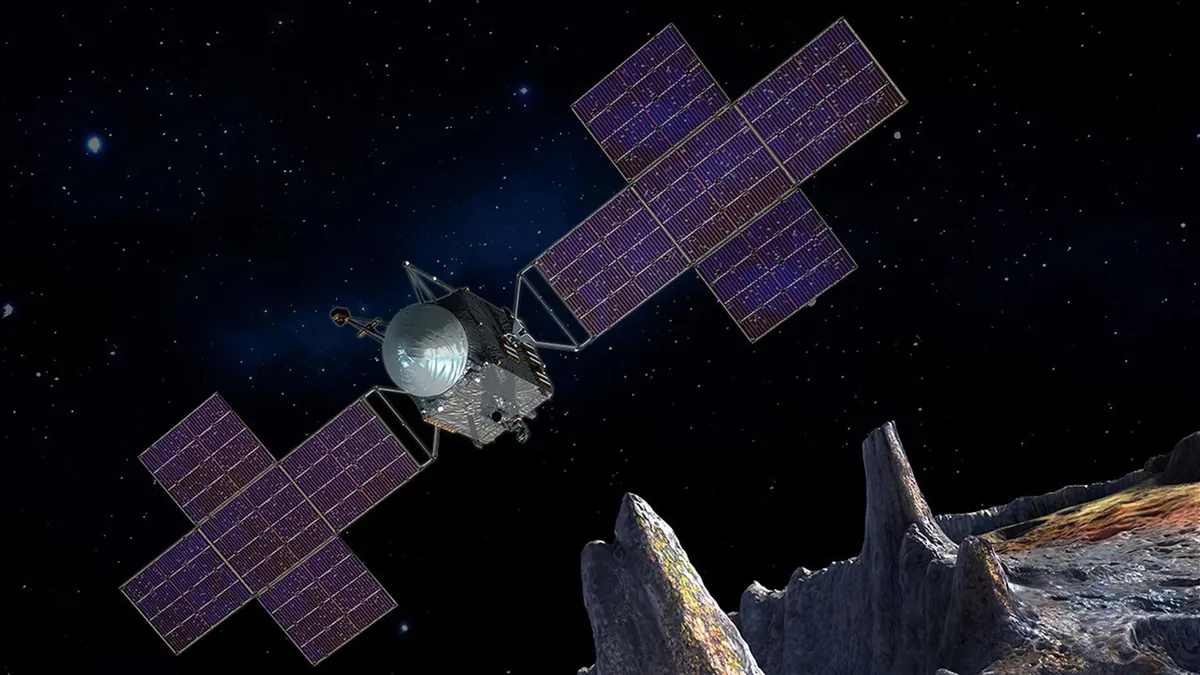
At launch, the spacecraft carried nearly 2,400 pounds (1,090 kilograms) of xenon across seven fuel tanks, and it has consumed roughly one third of that supply during the three years since leaving Earth. NASA said the leftover xenon can carry the craft to the asteroid and support two years of science work in orbit. Two five-panel, cross-shaped solar arrays covering 800 square feet (75 square meters) of sunlight generate electricity for the batteries and propulsion systems.
The spacecraft finished its Mars gravity assist on May 15, 2026, coming within 2,800 miles (4,500 km) of the Martian surface while moving at 12,333 mph (19,848 kph) relative to the planet. Closest approach came at 3:28 PM EDT, or 12:58 AM IST on May 16. The spacecraft stood at 1.3 Mars radii, inside the paths of Phobos and Deimos. Controllers verified the pass by studying Doppler shifts in radio signals from Earth through the Deep Space Network. Sarah Bairstow, mission planning lead at NASA JPL, said shortly before the maneuver that the craft was exactly on target.
Jim Bell’s multispectral imager team at Arizona State University took thousands of Mars photos during the flyby to calibrate the instrument, with the first raw images arriving on May 7 after a colorized crescent view of Mars on May 3. The magnetometer measured Mars’s leftover magnetic field, and the gamma-ray and neutron spectrometer followed changes in cosmic-ray flux to calibrate its sensors before studying Psyche. The craft’s cameras searched for a theoretical Martian dust torus made by micrometeorite hits on Phobos and Deimos.
The spacecraft’s Deep Space Optical Communications system, its laser communications array, had previously sent data at 2 Mbps beyond Mars orbit and faced additional stress tests during the encounter with Mars. The craft gauged how Mars’s atmosphere responded to solar winds and surface-bound neutrons, work made possible by the thin atmosphere. Lindy Elkins-Tanton, the mission’s principal investigator from UC Berkeley, said the teams behind the imager, magnetometer, and gamma-ray and neutron spectrometer put in extra hours and every instrument produced strong results.
The spacecraft snapped daily time-lapse pictures while nearing Mars, combining them into one eye-like image shaped by the approach angle, and it also recorded a month-long time-lapse during the flyby. Hannah Zigo of Arizona State University’s multispectral imager operations team said only about 4 percent of Mars was lit during the high-phase crescent approach, letting the team watch the atmosphere glow around the planet. Mars orbiters such as the Mars Reconnaissance Orbiter, Mars Odyssey, ESA’s Mars Express, and the ExoMars Trace Gas Orbiter also gathered supporting data from above the planet.
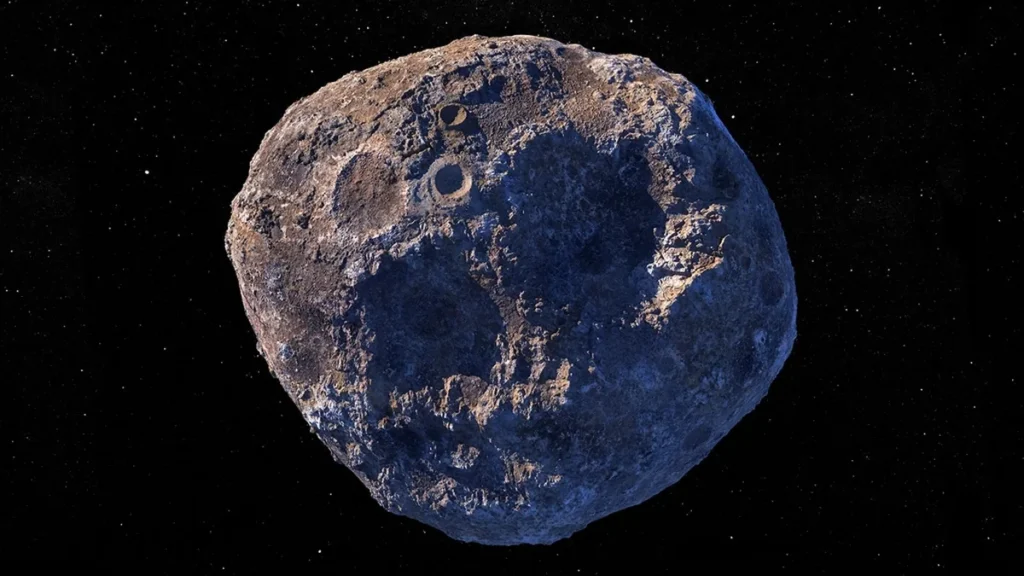
The spacecraft left Earth on October 13, 2023, riding a SpaceX Falcon Heavy rocket to start a 2.2-billion-mile (3.6-billion-km) trip. With its solar panels open, the robotic probe spans about the area of a tennis court. Maxar Technologies built it, and NASA JPL manages the mission. The target asteroid spans roughly 173 miles (280 kilometers) at its widest point, and scientists think it formed as the partial core of a planetesimal. Radar data indicate the body contains large amounts of iron and nickel, and researchers think it is the stripped core of a young planetesimal that lost its outer layers in violent cosmic collisions.
Italian astronomer Annibale de Gasparis found 16 Psyche in 1852, naming it for the Greek goddess of the soul. Officials at NASA say the mission is strictly about science, not mining, even though some headlines have put the asteroid’s value at $10 quadrillion.
After Mars, the craft begins Cruise 2, about 29 months of continuous solar-electric xenon thruster firing deeper into the asteroid belt. After the assist, the spacecraft has roughly 39 months of travel left before entering orbit around the asteroid in August 2029. The probe is set to enter orbit around the asteroid in August 2029, then spend 26 months on science operations before ending in October 2031. The goal is to circle the asteroid for 26 months, charting its surface features, magnetic field, and exact elemental makeup across four different orbits labeled A, B1, D, C, and B2.
Lindy Elkins-Tanton said the flyby gave the team a chance to calibrate instruments and rehearse procedures for meeting a planet before reaching Psyche. She added that Mars helped only by adding speed and changing the trajectory’s tilt so the spacecraft could line up with the asteroid.

Join the discussion