Key facts
- Dawn ended in 2018 after running out of fuel and remains in a long-term Ceres orbit.
- Dawn first orbited Ceres in 2015 after reaching Vesta in 2011.
- A new study found water ice may mask salt deposits on Ceres.
- Caltech researchers used Dawn data and computer models to study how surface water ice and salt deposits evolve on Ceres.
Caltech researchers used Dawn data from the spacecraft’s 2015 to 2018 Ceres orbit and computer models to study how surface water ice and salt deposits evolve on the dwarf planet, finding that water ice may mask salt deposits.
Dawn first orbited Ceres in 2015 after reaching Vesta in 2011, making it the first spacecraft to orbit two deep-space destinations and the first to visit a dwarf planet. The mission ended in 2018 after running out of fuel, and Dawn remains in a long-term Ceres orbit that prevents impact and protects organics and subsurface liquid. No dedicated Ceres mission is currently planned.
Ceres is the largest object in the main asteroid belt and holds about 25 to 30 percent of the belt’s total mass. Giuseppe Piazzi discovered it in 1801, and it was reclassified as a dwarf planet in 2006. Ceres’ large size and differentiated interior mainly drove the reclassification, unlike most asteroids.
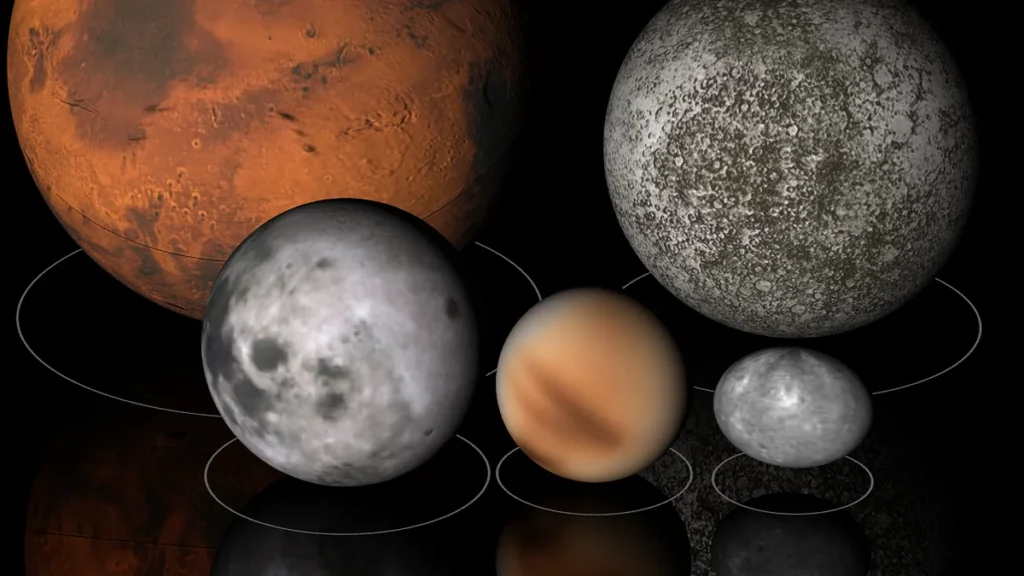
The world is about 960 km across, roughly a quarter of the Moon’s size, and is about 25 percent water. It has a layered interior like rocky planets and Pluto, with a core, mantle, and crust. It is a 4.5-billion-year-old embryonic planet whose growth was likely stunted by Jupiter before it settled in the asteroid belt around 4 billion years ago with solar-system leftovers. Ceres shares the dwarf-planet designation with Pluto but is often treated as an asteroid because it orbits in the main belt. Its diameter and high water content make it scientifically compelling despite its small size.
This differentiated interior is relevant to understanding how Ceres distributes salts and ice inside it, and scientists think the dwarf planet may have hosted a subsurface ocean in the past. Alicia Neesemann said analysis of all Dawn data made a past subsurface ocean seem likely. “A salty subsurface brine pocket lowers the freezing point of water, so that water could still ascend to the surface,” Neesemann said.
Because salty brine pockets lower water’s freezing point, water can ascend to Ceres’ surface, a process connected to cryovolcanic and hydrothermal activity and subsurface brines beneath Occator. Cryovolcanism on Ceres occurs at temperatures well below zero and uses water and salt-water mixtures, contrasting with classic volcanism at high silicate-based temperatures, and cryovolcanic eruptions could have reached Ceres’ surface. Cryovolcanic activity began around 9 million years ago and is likely still ongoing, with pingo-like hills and water rising through fractures pointing to ice volcanism, once not expected on asteroid-belt dwarf planets.
Ceres’ high water content helps explain its internal history and potential for brines and cryovolcanism. Impact heat and subsurface impact melt likely enabled brine eruptions, since large impacts generate heat that creates subsurface melt, helping brines rise in cryovolcanic eruptions. Carol Raymond said, “The impact heat subsided after a few million years.”
Occator Crater is about 92 km wide, and sources dispute its impact age: one gives a range of a few million to 20 million years ago, while another calls it a 22-million-year-old crater. Dawn gravity data found a subsurface brine reservoir beneath Occator at about 50 km depth, and the spacecraft also identified an extensive slushy brine reservoir 25 miles deep beneath the crater. The low-density anomaly is interpreted as salty water that rose through impact-created fractures and erupted as salty material left behind when brine evaporated, and the impact may have fractured Ceres’ crust, allowing brine to reach the crater floor and evaporate into a bright salty crust. Dawn detected bright spots of sodium carbonate in Occator from 2015 to 2018. Sodium carbonate is a compound of oxygen, carbon, and sodium, while brines may still be rising to Ceres’ surface, suggesting the dwarf planet’s activity is not solely from ancient impact melting and that salty liquid may still exist inside.
Dawn detected hydrohalite, a salt found in Earth’s marine ice, at Cerealia Facula, the first such finding outside Earth. Although surface salts dehydrate over hundreds of years, Dawn still measured water present at the site. Occator is the youngest crater of its size on Ceres and links to bright carbonate deposits such as Cerealia Facula. The crater holds Ceres’ brightest salt deposits, which stand out against darker terrain like city lights.

Ceres has enough mass to retain water molecules, and NASA found permanently shadowed regions on Ceres able to trap water ice for a billion years. “The conditions on Ceres are right for accumulating deposits of water ice,” said Norbert Schorghofer. These regions act as cold traps below minus 240 degrees Fahrenheit (minus 151 degrees Celsius), on crater floors or pole-facing walls where they receive indirect sunlight while remaining cold enough for ice stability.
They cover about 695 square miles (1,800 square kilometers), less than 1 percent of the northern hemisphere’s surface area, and are colder than most lunar or Mercurian cold traps. About 1 of every 1,000 water molecules on Ceres reaches a cold trap during a 1,682-day year, enough to build thin but detectable ice deposits over roughly 100,000 years. Chris Russell said Ceres may be a volatile-rich world not dependent on current external sources, supporting the idea that Ceres may have formed with a greater reservoir of water.
Landslides expose surface ice on Ceres, which then evaporates and leaves bright salty spots, and mass wasting, the shifting of surface material, adds fresh ice to the surface, feeding the evaporation cycle that produces the salt-rich bright deposits Dawn observed. Ice mixed with salt sublimates more readily, meaning ice turns directly to vapor, and can migrate to colder areas, creating icy colder regions and warmer salt-richer regions. Water ice may hide salt deposits, and they could be 30 to 50 percent more abundant than thought.
Dawn’s hydrogen-sensing instrument detected hydrogen concentrations in Occator Crater interpreted as water ice, and the same crater holds Ceres’ brightest salt deposits, which stand out against darker terrain like city lights. Impact gardening continually bombards Ceres’ surface like the Moon’s regolith, with ongoing meteorite impacts pulverizing the surface even as scientists consider a future sample-return mission. PSI research published July 21, 2021, found Ceres’ crust is rich in water ice, with impact-excavated icy crust fragments scattered across the surface providing clues about interior and evolution. The Occator impact excavated crust as deep as 10 km (6 miles), and hydrogen enhancements in the crater and ejecta support an ice-rich crust and a differentiated icy outer shell with a subcrustal ocean.
Ice may have survived in Ceres’ shallow subsurface for roughly 20 million years after Occator formed. “We think that ice has survived in the shallow subsurface during the roughly 20 million years following the formation of Occator,” said Tom Prettyman. Impact patterns suggest impacts delivered ice elsewhere, while sunlight-driven sublimation removes surface ice over time. Microorganisms in a deep brine pocket would not survive ascent to the surface, because Neesemann said any microbes at 50 km depth would be mechanically destroyed or chemically altered during ascent and exposure.
Ceres’ ocean-world status makes it an attractive target for future missions and broadens implications for icy-body evolution, and smaller water-rich bodies may not have differentiated, but Ceres could be habitable. Unlike Enceladus and Europa, Ceres does not have internal tidal heating; gravitational interactions with massive planets heat those moons, while asteroids and dwarf planets generally are not. Future missions Europa Clipper and JUICE will study Jupiter’s icy moons, including Ganymede, Callisto, and Europa, while Ceres awaits another mission.
A potential NASA JPL Ceres sample-return mission would use an orbiter and lander, with the orbiter taking higher-resolution images than Dawn to test landing safety on bright deposits. Ceres gravity is 5.7 times less than the Moon’s but higher than Bennu or Ryugu.
Join the discussion