Key facts
- Before this work, an H2-rich proto-atmosphere may have existed in chemical disequilibrium with the magma ocean, and the chemical coupling between them was poorly constrained.
- Atmosphere-magma redox exchange buffers the redox changes driven by magma-ocean solidification, keeping the coupled system from becoming extremely oxidized or extremely reduced.
- The coupled evolution may have added to early Earth's water inventory while preserving a reducing, H2-rich atmosphere, the authors say.
- Earth's mantle is more oxidized than those of other differentiated rocky bodies, and the cause of that oxidation is still debated, the group states.
Tatsuya Yoshida, Kirara Arima, Naoki Terada, Takeshi Kuroda, and Kiyoshi Kuramoto posted a preprint on giant impacts, Earth’s magma ocean (molten rock layer) and a hydrogen-rich atmosphere to arXiv’s astro-ph.EP server on Oct. 28, 2026.
The submission arrived at 09:20:14 UTC under the identifier 2610.38503 and carries the arXiv DOI arXiv.2610.38503. A report on the paper was published on Oct. 31, 2026, and a comment on the submission notes publication in The Planetary Science Journal with a related Planetary Science Journal DOI, 10.3847/PSJ/aeb09d. The paper is filed under Earth and Planetary Astrophysics. The paper’s title describes how Earth’s early hydrogen-rich proto-atmosphere and an oxidized magma ocean evolved together, emphasizing efficient water production from dissolved hydrogen transport and atmospheric buffering that sets the magma ocean’s oxidation level.
The authors propose that giant impacts during Earth’s final accretion likely created global magma oceans. Those magma oceans then serve as the setting for the proposed iron chemistry and oxidation changes, according to the abstract.
They propose that Fe2+ disproportionation at lower-mantle pressures, followed by segregation of metallic iron into the core, could have oxidized the magma ocean. Lower-mantle pressure is the specific condition under which the disproportionation is modeled, and the resulting metallic iron is removed into the core as it forms.
Before this work, an H2-rich proto-atmosphere may have existed in chemical disequilibrium with the magma ocean, and the chemical coupling between them was poorly constrained. The authors state that how an H2-rich atmosphere and an oxidized magma ocean chemically coupled was not well understood, and their work targets that gap.
The researchers built a coupled atmosphere-interior evolution model covering boundary-layer diffusion, melt redox reactions, partitioning of oxides and H2O between phases, cooling through the proto-atmosphere, and core removal of disproportionation-produced iron. The model couples an atmosphere to a planetary interior and follows planetary cooling through the proto-atmosphere while tracking oxide components and H2O as they partition between coexisting phases.
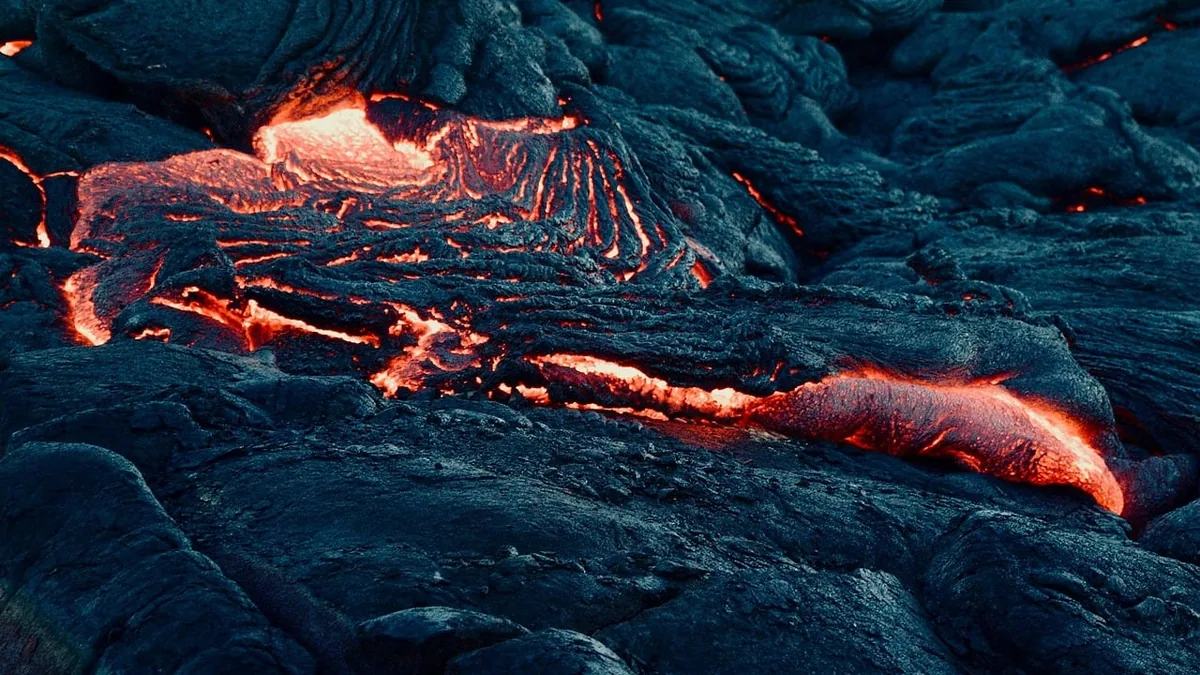
Buoyant overturn of dense, surface-cooled melt renews the boundary layer, making dissolved-H2 transport and H2O production more efficient. Surface cooling makes melt dense, driving buoyant overturn that renews the boundary layer between atmosphere and magma ocean. The authors say this overturn controls how fast dissolved-H2 transport and H2O production proceed, allowing chemical equilibration within about 10^4 years if the magma ocean reaches the lower mantle.
Atmosphere-magma redox exchange buffers the redox changes driven by magma-ocean solidification, keeping the coupled system from becoming extremely oxidized or extremely reduced. The buffering acts on the redox evolution driven by magma-ocean solidification, and the authors say it prevents the coupled system from reaching extreme oxidation or extreme reduction.
The coupled evolution may have added to early Earth’s water inventory while preserving a reducing, H2-rich atmosphere, the authors say. They connect water delivery to the same coupled atmosphere-interior evolution that preserves a reducing atmosphere, bearing on the origin of early Earth’s water.
A Nov. 21, 2024, entry describes the Moon-forming giant impact’s magma ocean as crucial to setting the initial conditions of core and atmosphere formation on Earth. The group also states that Earth’s mantle is more oxidized than those of other differentiated rocky bodies, and the cause of that oxidation is still debated. Its researchers study oxidation mechanisms spectroscopically.
Measurements of how iron oxidation in molten peridotite responds to atmospheric oxygen partial pressure imply that Earth’s earliest atmosphere was probably like Venus’s atmosphere today, the group says. The entry cites Sossi et al. 2020b for the first measurements of molten peridotite iron oxidation versus atmospheric oxygen partial pressure, and from those the group infers the earliest atmosphere likely resembled present-day Venus.
Southwest Research Institute modeling with the University of Arizona indicated on Sept. 1, 2026, that a giant impact could form an intact Moon within about five hours, with material strength and temperature central to the outcome. The study used simulations that include material strength, which earlier moon-formation work treated as unimportant, and it appeared in The Astrophysical Journal Letters in 2026.
Whether Theia was destroyed into a debris disk or left an intact Moon within hours depended on the pre-collision temperature of Earth and Theia, tying impact timing to thermal state, the researchers say. Dr. Adeene Denton led the work and says hotter colliding bodies are weaker, making moon formation temperature-sensitive.
Dr. Robin Canup, who was not involved, says the results may help date the Moon-forming impact. The close Earth-Moon compositional match remains an open question; one explanation is that Theia and proto-Earth formed in the same protoplanetary-disk region while Mars formed farther away. Denton calls Earth and Mars siblings and the Moon and Earth fraternal twins.


Join the discussion