Key facts
- Mark Peller, ULA president and CEO, said the company continually looks for chances to vertically integrate items it has historically bought from suppliers.
- Peller said producing the hardware internally lets ULA control its processes, keep quality high, improve efficiency and continue lowering rocket costs for customers.
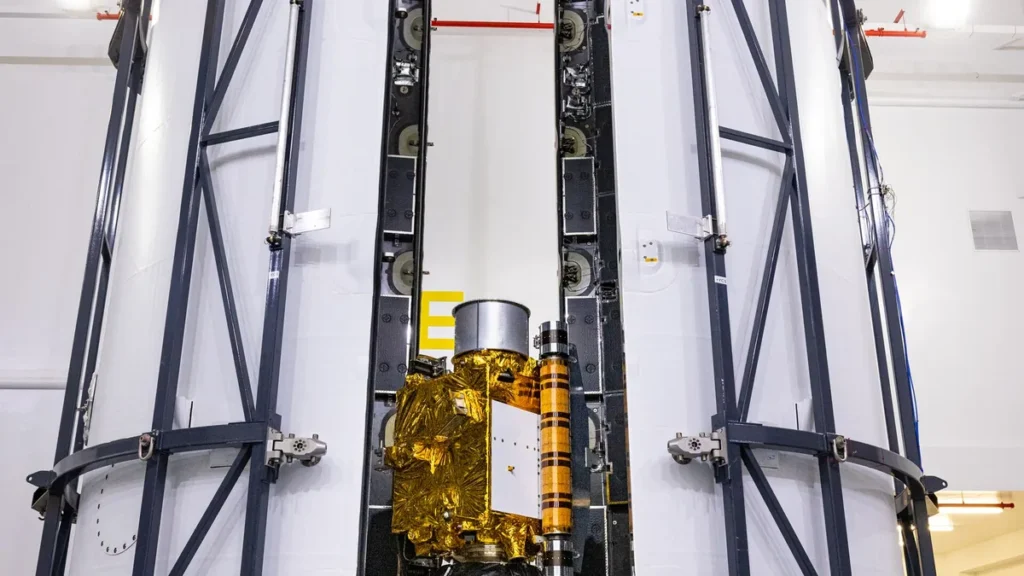
- The Vulcan payload fairing gives spacecraft a controlled, safe setting during ascent.
- It measures 5.4 meters (17.7 feet) across.
United Launch Alliance announced from its newsroom in Centennial, Colorado, on Nov. 4, 2026, that it will bring Vulcan payload-fairing and composite-structure production in-house under an agreement with Beyond Gravity USA. ULA expects the deal to close before the end of 2026, and plans to fly its first self-made fairing on a mission in 2027.
The agreement is expected to close before the end of 2026, after which Beyond Gravity’s work will move to ULA. ULA set a year-end deadline for completing the handover of fairing and composite structure production.
ULA will also build heat shields, payload attach fittings and interstage adapters under the agreement. The scope of the insourcing extends beyond the nose cone to other major composite components on the Vulcan rocket. ULA offers launch services for national security, NASA and commercial customers.
The Vulcan payload fairing gives spacecraft a controlled, safe setting during ascent, protecting payloads while they travel through the atmosphere on the way to orbit. The fairing is a two-piece sandwich composite shell built as a bisector, the physical design of the nose cone that encloses the satellite or spacecraft stack. It measures 5.4 meters (17.7 feet) across, a dimension that defines the size of the payload envelope the rocket can carry. ULA offers it in a 15.5-meter (51-foot) standard version and a 21.3-meter (70-foot) long version, letting customers choose between two fairing sizes depending on the spacecraft’s height and mission requirements.
The fairing splits apart with a debris-free horizontal and vertical separation system, a release mechanism designed to avoid creating fragments that could damage the spacecraft or other objects in orbit. ULA designs every fairing for off-pad payload encapsulation to improve payload safety and security and cut time on the pad. Encapsulating payloads away from the launch pad reduces the amount of time spacecraft spend exposed on the pad before liftoff.
Beyond Gravity has rented 400,000 square feet inside ULA’s Decatur, Alabama factory since 2017, operating inside ULA’s own Decatur facility for nearly a decade before this agreement moves the work fully under ULA. Over 300 Alabama-based Beyond Gravity workers will receive job offers from ULA when the agreement closes, offers intended to preserve the site’s workforce and experience through the transition.
ULA did not state whether compensation, benefits or duties would change for moving Beyond Gravity employees, or how many positions beyond the more than 300 mentioned it would offer. Financial terms of the deal were not made public. Unanswered questions include how the handover will proceed before the planned year-end closing and what the change means for Decatur’s long-term workforce size. The report flagged uncertainty over the execution timeline and future staffing levels at the Alabama site.
Barbara Frei-Spreiter, Beyond Gravity CEO, said the agreement helps the Decatur operation and its employees over the long term. She said the Decatur operation has built exceptional capabilities over the years and serves U.S. launches in a critical role, characterizing the deal as preserving the Alabama operation’s role in U.S. launch activities despite the change in ownership of the work. She emphasized the site’s existing expertise and national importance as part of the transition.
"This agreement marks an important step that supports the long-term success of the Decatur site and its employees," she said.
Barbara Frei-Spreiter, Beyond Gravity CEO, Yahoo! Finance
Mark Peller, ULA president and CEO, said the company continually looks for chances to vertically integrate items it has historically bought from suppliers, framing the deal as part of a broader strategy to control more manufacturing rather than relying on outside vendors. Peller said producing the hardware internally lets ULA control its processes, keep quality high, improve efficiency and continue lowering rocket costs for customers, tying the insourcing decision directly to cost and quality goals for ULA’s launch vehicle pricing.
"We are continually looking for opportunities to vertically integrate products we have historically purchased from a supplier," said ULA President and CEO Mark Peller.
Mark Peller, ULA President and CEO, United Launch Alliance
ULA said on Oct. 28, 2026 that it plans to fly Vulcan again on Nov. 13, nine months after a solid rocket booster problem disrupted its 2026 launch schedule. The return-to-flight date follows a lengthy grounding caused by booster hardware problems and is pending range approval. Liftoff will occur at Cape Canaveral Space Force Station in Florida. The return-to-flight launch will carry 40 satellites for Amazon’s Leo broadband network, the first of 38 Vulcan flights Amazon has reserved to deploy the bulk of its Leo network.
Vulcan’s solid rocket boosters experienced nozzle failures on two of its first four missions, most recently in February. The Space Force cleared Vulcan for national security launches in 2025 and later grounded it after the February booster incident, meaning the vehicle had only just entered operational military service when the anomaly forced a pause. ULA said engineers made major progress understanding the February booster anomaly and found several possible causes, which design and process changes to the nozzle have addressed. The company is addressing the booster problem with hardware and procedural changes before flying again.
"have identified several potential contributors, which have been mitigated through design and process improvements to the nozzle," ULA said.
ULA, Ars Technica
The November launch will use the upgraded nozzle while more testing and analysis continue alongside the flight. ULA said flying the upgraded nozzle provides useful flight data to confirm the fixes and helps all customers, framing the return-to-flight as a data-gathering step rather than just a routine launch.
The U.S. Space Force, ULA’s main customer, lost confidence in Vulcan after those failures. Space Force officials will examine Vulcan’s return-to-flight mission closely. The Pentagon views Vulcan as a critical launch vehicle for national security payloads. Vulcan holds a major share of the U.S. military’s national security launch portfolio for the rest of this decade, with the Pentagon giving the vehicle about half of its major launch assignments through the early 2030s.

Join the discussion