
Key facts
- Nick Burri, Mario Damiano, and Renyu Hu used the ExoReLR Bayesian retrieval framework to analyze Earth-sized exoplanet spectra between 0.25 and 1.8 μm.
- A higher fraction of clouds in an exoplanet atmosphere increases the signal-to-noise ratio needed to identify the correct dominant gas.
- Michael Zhang, the principal investigator for the PSR J2322-2650b study, stated that the planet's atmosphere contains molecular carbon, specifically C3 and C2.
- Roger Romani of Stanford University and the Kavli Institute for Particle Astrophysics and Cosmology Institute suggested that carbon crystals might float to the top of the atmosphere as the companion cools.
Nick Burri, Mario Damiano and Renyu Hu applied the ExoReLR Bayesian retrieval framework to Earth-sized exoplanet spectra, showing that reflected-light spectroscopy, which examines light bouncing off the planet and interacting with atmospheric gases, separates nitrogen-rich from oxygen-rich atmospheres, according to a study in The Astronomical Journal.
The researchers simulated spectra of Earth-like exoplanets between 0.25 and 1.8 micrometers, focusing on O2-O2 collision-induced absorption bands known as O4 bands. Without accounting for these bands, the retrieval model wrongly flagged an oxygen-dominated atmosphere even though the true atmosphere was nitrogen-dominated. Adding the O2-O2 collision-induced absorption let the model retrieve the proper nitrogen-dominated, oxygen-rich answer without needing a precise planet mass estimate.
Researchers tested two observing setups modeled on the proposed Habitable Worlds Observatory, including a resolved-visible case and a broadband-visible case. They found that distinguishing the atmospheres requires a signal-to-noise ratio (the measured signal compared with background noise) reaching 20 at 0.75 micrometers, or roughly 14 near the 1.27-micrometer O4 band at near-infrared resolution of 70, for at least 95% accuracy. A higher fraction of clouds increases the signal-to-noise ratio needed to identify the correct dominant gas.
Cutting near-infrared coverage to 1.4 micrometers blocks accurate recovery of a nitrogen-dominated atmosphere and instead favors a false oxygen-dominated, carbon-dioxide-rich atmosphere regardless of signal-to-noise ratio. Going out to roughly 1.7 micrometers is necessary for solid atmospheric characterization. The model cannot identify the right atmospheric makeup without that coverage, even with strong signal-to-noise.
Oxygen by itself cannot serve as a dependable biosignature, since abiotic processes including carbon dioxide photolysis on dry planets around M-dwarf stars can generate it. Research led by Peter Gao in 2015 showed that dry planets around M-dwarf stars can build up high oxygen through abiotic processes, copying a biological origin. These stars rank as the galaxy’s most common stellar type and draw frequent exoplanet searches, yet their strong ultraviolet radiation makes the hunt for life more difficult.
Water vapor in an atmosphere can sharply cut abiotic oxygen output, so abundant oxygen together with water vapor points more strongly toward life. Research from 2026 led by Margaret Turcotte Seavey, with NASA Goddard Space Flight Center and Johns Hopkins University, employed the Atmos photochemical-climate model to show water vapor limits oxygen buildup by reacting with atomic oxygen and carbon monoxide to remake carbon dioxide. The study cited figures of 2.7% and 10% when describing oxygen accumulation limits. Hydroxyl radicals drive the remake of carbon dioxide out of atomic oxygen and carbon monoxide.
Life is not ruled out by helium-dominated atmospheres, since lab tests show varied organisms from bacteria to animals can survive and metabolize there. Helium ranks as the universe’s second-most abundant element and stays chemically inert, so it does not react with other substances. The preprint, posted on arXiv on Aug. 16, 2026, involved work by researchers from MIT, Wroclaw University of Science and Technology and JJ Scientific.
Helium-rich atmospheres could make biosignature gases easier to spot because low mean molecular weight and large scale heights boost spectral features during transmission. Researchers found helium escaping from LHS 1140 b, a super-Earth in the habitable zone of its star 48 light-years away, yielding strong evidence of an atmosphere on a rocky world in that zone.
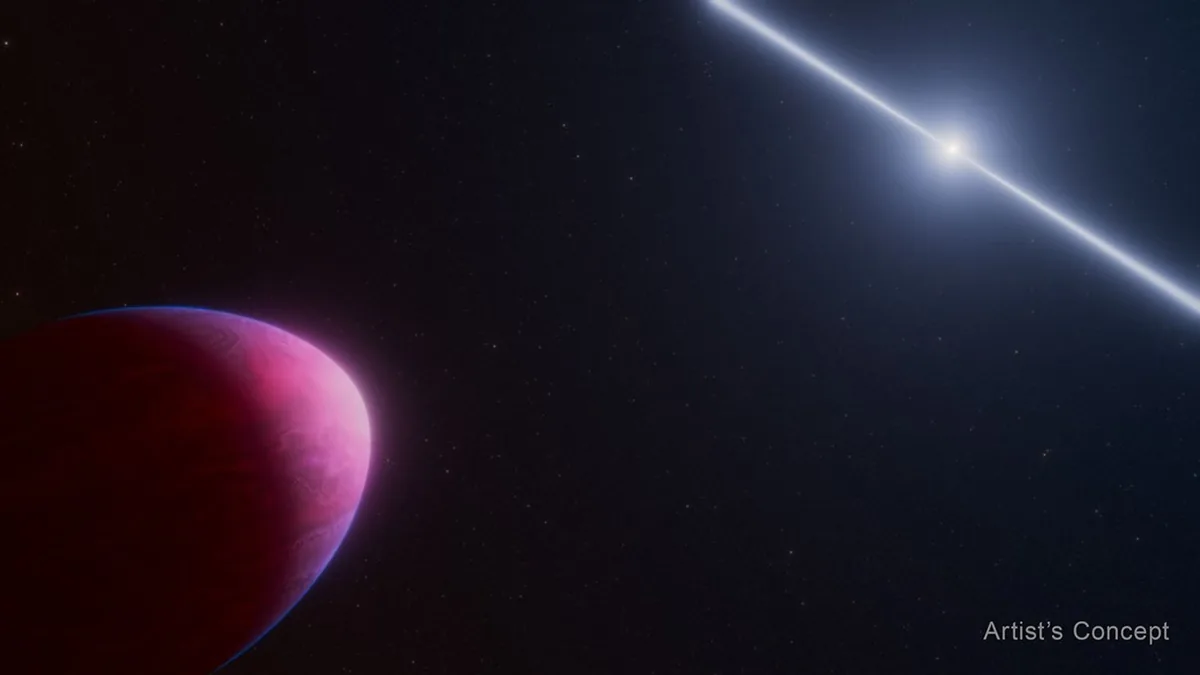
PSR J2322-2650b travels around a pulsar, with heat spanning 1,200°F to 3,700°F. No existing theory explains the carbon enrichment, so the makeup breaks standard planet-formation models.
Peter Gao of the Carnegie Earth and Planets Laboratory said the find startled the team once they reviewed their data. Michael Zhang of the University of Chicago, the principal investigator for the PSR J2322-2650b study, said the planet’s atmosphere contains molecular carbon, specifically C3 and C2. Roger Romani, affiliated with Stanford University and the Kavli Institute for Particle Astrophysics and Cosmology Institute, proposed that pure carbon crystals could rise to the atmosphere’s upper levels as the companion cools.
“We get a really pristine spectrum. And we can study this system in more detail than normal exoplanets,” said Maya Beleznay.



Join the discussion