Key facts
- Viasat's Ka- and L-band relay services use geostationary-orbit solutions to provide on-demand mission-data access and real-time telemetry, tracking and command at any point in a LEO spacecraft's orbit.
- The combined maximum ceiling across the three awards is $1.0656 billion, about 3.8 times the $278.5 million awarded to six providers in 2022.
- Viasat launched the Maxwell spacecraft on Oct. 20, 2026, at 7:04 a.m. ET from Cape Canaveral Space Force Station during the Bandwagon-5 rideshare mission with SpaceX.
- NASA's Ka-band service acquisition is called the Network Extension for User Continuity and Sustainability Ka-band service acquisition.
NASA selected Viasat Inc., Global Enterprise Solutions Inc., and Astranis Space Technologies Corp. on Nov. 4, 2026, to develop Ka-band space relay capability concepts as part of the SCaN program’s Communications Services Project.
The agency awarded the contracts as firm-fixed-price agreements under the Next Space Technologies for Exploration Partnerships-3 Broad Agency Announcement Appendix E. Such contracts set a fixed price the government pays regardless of the contractor’s costs. The agreements include options under which NASA can add money for flight demonstrations in orbit. NASA set maximum potential values of $460.9 million for Viasat Inc., $340.4 million for Global Enterprise Solutions Inc., and $264.3 million for Astranis Space Technologies Corp.
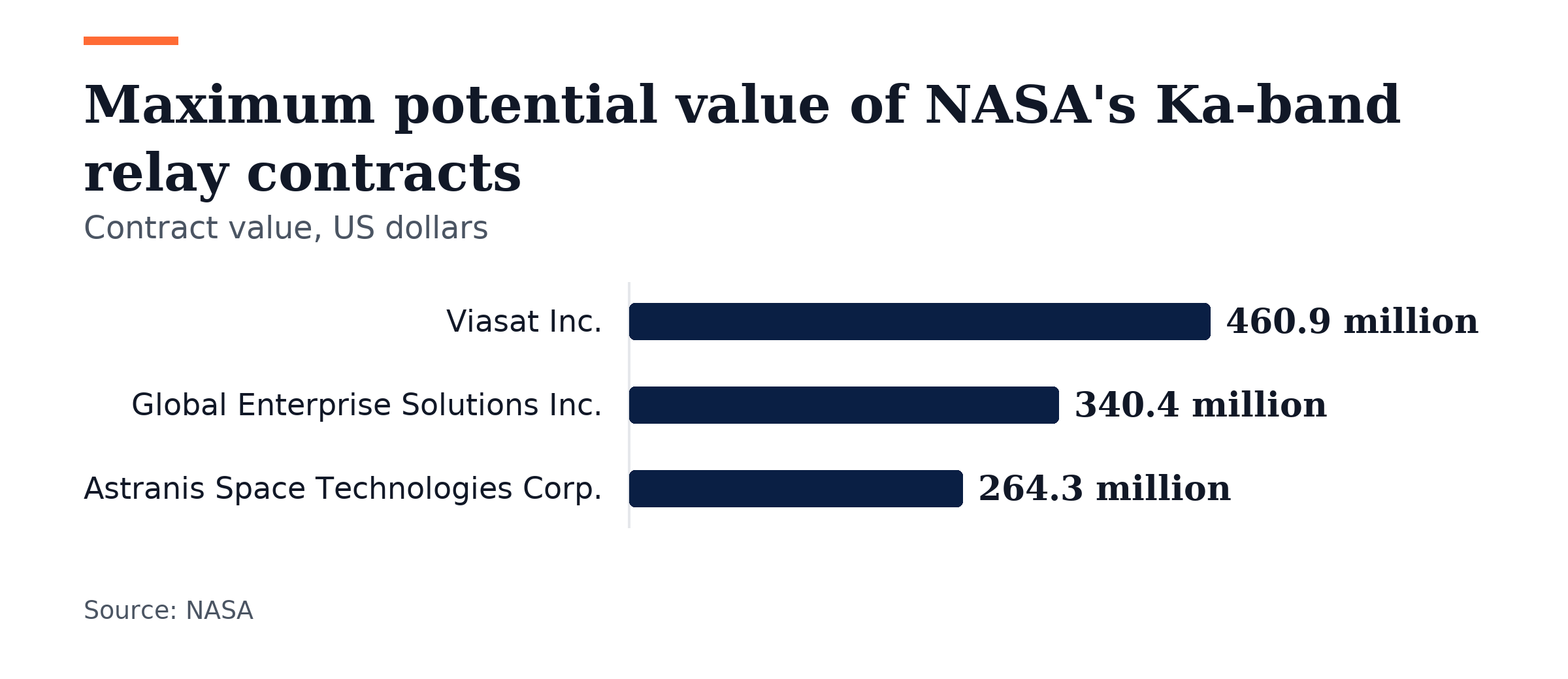
The combined ceiling across the three awards is $1.0656 billion, roughly 3.8 times the $278.5 million that six providers received in 2022. The figure is a ceiling on potential spending rather than guaranteed appropriations, since NASA chooses whether to exercise options. Viasat received the largest individual award among the three companies.
The initial period of performance runs from Nov. 4, 2026, to May 3, 2027, and priced options could extend the work through 2029. The Broad Agency Announcement details a first six-month phase for concept maturation and risk reduction, covering design reviews and interface studies along with compatibility analysis ahead of any flight demonstration.
An option allows up to two years to integrate systems, fly a demonstration, and verify and validate the capability, moving the concepts toward an in-orbit test with existing spacecraft. A third option covers up to six months of additional demonstration, anomaly resolution, and service validation before a potential long-term service commitment.
NASA plans to gradually retire the Tracking and Data Relay Satellite fleet and switch to commercial communications services for missions going forward. It relays information for the International Space Station, the Hubble Space Telescope, and other missions, with support for current missions expected to last into the mid-2030s. TDRS stopped onboarding new missions in late 2024, and the fleet has operated for decades as its satellites age out. NASA’s announcement gives no hard retirement date.
NASA needs Ka-band service for certain missions in orbit whose flight hardware cannot feasibly be modified or moved to a non-compatible commercial service. NASA’s solicitation says the agency plans to buy an end-to-end Ka-band relay service that works with legacy TDRSS users for at least 15 years. That backward-compatibility requirement is found in solicitation-related material rather than in NASA’s award announcement, so it has not been confirmed for the awards until NASA or a company verifies it.
Any new relay needs to communicate with legacy radios using their current frequencies, waveforms, and pointing behavior. NASA wants to buy full Ka-band relay services spanning space, ground, launch, operations, and integration while serving as one customer among many in a commercial marketplace.
The pattern echoes earlier moves in launch, cargo, and crew transport, where NASA shifted from building systems to purchasing services, trading direct control of the relay hardware for reduced upfront spending and quicker upgrade cycles. NASA calls its Ka-band service acquisition the Network Extension for User Continuity and Sustainability Ka-band service acquisition.
Viasat’s Ka-band and L-band relay services rely on geostationary-orbit satellites to give on-demand mission-data access and real-time telemetry, tracking and command throughout a spacecraft’s low Earth orbit (LEO). The services will offer LEO operators real-time, low-data-latency communications for time-sensitive operations, removing delays to downlink data to the ground. Viasat said its offerings serve fast-growing LEO operations that need to carry mission data to Earth and keep continuous contact for command and control. The services meet NASA mission needs and give government and commercial customers on-demand connectivity in low Earth orbit.
Viasat launched the Maxwell spacecraft on Oct. 20, 2026, at 7:04 a.m. ET from Cape Canaveral Space Force Station as part of the Bandwagon-5 rideshare mission with SpaceX. The launch moved Viasat’s demonstration work for NASA’s Communications Services Project forward and supports the agency’s shift away from the Tracking and Data Relay Satellite fleet. Two CSP contract awards worth $81 million support Viasat’s Maxwell demonstration mission, which includes on-orbit tests planned to run for five months through March 2027.
The company’s government space team will run the demonstrations through its Defense and Advanced Technologies segment, demonstrating real-time communications with low data latency for LEO operators. Viasat’s payloads include a space-qualified Ka-band terminal for reaching the ViaSat-3 satellite network plus an L-band terminal for linking with Viasat’s global L-band network.
The demonstrations will also use Viasat’s Real-Time Earth Ground-Station-as-a-Service for direct-to-ground links in S-, X-, and Ka-bands. During the demonstration, the ground station service handles direct-to-ground links and works with the GEO-based relay route through the satellite network.
Rocket Lab built the Maxwell spacecraft at its Long Beach, California, facility and provided a new L-band radio for the relay demonstration. A recent Rocket Lab mission, its 99th, carried an iQPS radar satellite and shows how steady launch cadence cuts the price of in-orbit demonstration flights. The spacecraft provides power, communications, propulsion, and attitude control for the mission demonstration, supporting telemetry, tracking and command applications through Viasat’s L-band network.
Viasat’s first NASA CSP demonstration flew on a Blue Origin New Glenn mission in November 2025, carrying its launch telemetry relay hardware. That flight established Viasat’s record under the program ahead of the Maxwell mission. John Reeves, Vice President of Space and Mission Systems at Viasat Government, said “Yesterday’s launch represents the culmination of years of innovation, engineering and collaboration across Viasat, NASA and our industry partners.”
Shattered said NASA’s award announcement ranks none of the three teams and provides no technical scoring, leaving only ceiling value, listing order, and public naming for comparison. Reviewed announcement material included no on-record executive statements from NASA or the three selected companies. Via Satellite identifies Global Enterprise Solutions Inc. as SES Space & Defense, yet NASA’s award announcement as retrieved does not confirm the connection, so the corporate identity remains unconfirmed in the official award text.
Both SES and Viasat received contracts in 2022 when NASA began the Communications Services Project to look at future commercial choices for TDRS. Those 2022 awards formed part of NASA’s effort to try out commercial satellite communications before the larger 2026 contest cut the field to three companies.
As of 2022, commercial providers supplied 63% of all direct-to-Earth services to NASA missions, based on a 2023 NASA SmallSat forum presentation that Shattered cited. Shattered said six providers together expected to spend about $1.5 billion over five years alongside the NASA awards. The private spending matched public funds, Shattered said, and showed industry putting its own money at risk. Shattered said the direct-to-Earth market had already become commercial while NASA depends on government satellites for relay, leaving a gap the new awards fill.
The August 2024 SCaN status paper set an initial demonstration rate of 90 Mbps in the forward direction and 375 Mbps on return, with projected future rates reaching 490 Mbps forward and 1 Gbps on return. Dated August 2024, the paper describes earlier demonstration planning, meaning its rates are not requirements under the Nov. 4, 2026 awards.
NASA’s Swift observatory re-entered the atmosphere on Nov. 4, demonstrating that orbital assets reach the end of life even when science value remains.


Join the discussion