Key facts
- The model does not reproduce every detail of the observed cloud exactly, but Hernández-Bernal called the result remarkable because scientists have far less information about Mars's atmosphere than about Earth's.
- Scientists have known about the Arsia Mons Elongated Cloud for decades.
- Traditional atmospheric simulations failed to reproduce the Arsia Mons Elongated Cloud, yielding either wide patches of haze or no trailing tail reaching thousands of kilometers.
Researchers led by Jorge Hernández-Bernal published a paper in Nature Geoscience on Oct. 7, 2026, proposing that the Arsia Mons Elongated Cloud on Mars forms when water vapor freezes directly into ice particles without condensing on dust or other material..
Hernández-Bernal, of LMD/CNRS/Sorbonne Université in Paris, led the study with co-authors A. Määttänen, A. Spiga and F. Forget. The paper, titled Homogeneous ice nucleation from water vapour suggested by elongated clouds on Mars, appeared in Nature Geoscience under DOI 10.1038/s41561-026-02089-9..
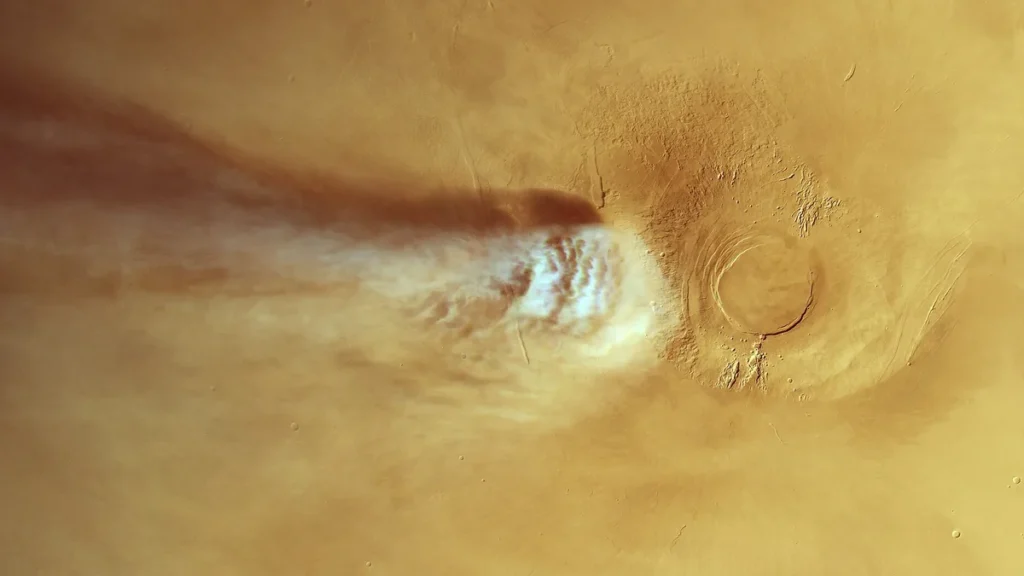
The Arsia Mons Elongated Cloud, or AMEC, is a water-ice formation up to 1,800 kilometers long that appears downwind of the 20-kilometer-high extinct shield volcano Arsia Mons every spring and summer morning on Mars. It evaporates before repeating the next day for months. Scientists have known about AMEC for decades, but earlier simulations using traditional cloud formation theories produced only wide haze patches or failed to create a trail reaching thousands of kilometers..
EarthSky gives the cloud’s maximum length as 920 miles, or 1,500 kilometers, while Universe Today, SciTechDaily, the New York Post and Autoevolution report 1,800 kilometers, about 1,120 miles. All outlets describe the same recurring water-ice formation downwind of Arsia Mons, but they do not agree on its maximum length in miles and kilometers..
AMEC is an orographic cloud, a type also found on Earth that forms when winds flow past uneven terrain such as a mountain or volcano. Westward winds strike Arsia Mons head-on and the volcano deflects them upward violently, generating gravity waves, standing atmospheric ripples that represent gigantic pressure shifts. The volcano’s bulk triggers a powerful orographic wave as westbound winds flow past it..
Winds hitting Arsia Mons generate gravity waves that lift moist parcels of air several kilometers in just a few minutes. This drives extreme adiabatic expansion, cooling that occurs when air rises and expands without exchanging heat. The process chills the atmosphere by about 30 degrees Celsius in 10 to 15 minutes to below minus 143 degrees Celsius..
The Martian atmosphere near Arsia Mons in summer is relatively dust-free, containing only 0.1 dust grains per cubic centimeter. That scarcity lets relative humidity soar to around ten million percent, more than 100,000 times typical Earth levels. With little dust available to absorb vapor quickly, humidity reaches levels far beyond those needed for normal cloud formation, enabling spontaneous nucleation instead of the usual condensation on airborne seeds..
Homogeneous nucleation has been theorized in textbooks for years but was long considered only a laboratory curiosity rather than a naturally occurring process. It requires extreme relative humidity and has been theorized for Earth’s and Venus’s upper atmospheres but never spotted there. AMEC is the only known natural example, though similar conditions could exist in Enceladus’s icy plumes or Earth’s polar mesosphere, the upper atmospheric layer near the poles..
Once the air is superchilled and supersaturated, water vapor molecules turn into hundreds of ice crystals in each cubic centimeter of air. Winds then carry the particles into a long, thin cloud trail stretching more than a thousand miles without dissipating..
Hernández-Bernal said cloud formation for AMEC appears to take place without needing any seed particles, comparing it to condensation droplets appearing in the middle of a room rather than on a window. Most clouds form when water vapor condenses onto particles such as salt, pollen, soot or dust, a process called heterogeneous nucleation, but AMEC appears to skip this middle step entirely..
“We call this homogeneous nucleation, and we’ve never seen it before in a planetary atmosphere,” Hernández-Bernal said. Although scientists understood homogeneous nucleation to be theoretically possible, the extreme humidity required made it seem like a lab-only result because scientists thought dust dominated cloud formation..

Existing theories could not explain a slender, brilliant water streak persisting across thousands of miles of open Martian desert..
The researchers combined Mars Express observations with the Mars Planetary Climate Model and specialized microphysics packages, software that simulates how tiny particles form and grow, to simulate the cloud. They used data from three cameras aboard the orbiter: the Visual Monitoring Camera, the High-Resolution Stereo Camera, and OMEGA..
Mars Express first revealed AMEC in 2018. Mars Express launched in 2003 and is Europe’s first planetary mission, orbiting Mars to study the atmosphere, climate, geology, surface mineralogy, and subsurface structure..
Mars Express is one of only two spacecraft orbiting Mars able to observe during the morning hours when the cloud is present, alongside ESA’s ExoMars Trace Gas Orbiter. It can monitor rapid changes over periods of only a few hours, giving it an unrivaled look at short-lived phenomena..
The model does not reproduce every detail of the observed cloud exactly, but Hernández-Bernal called the result remarkable because scientists have far less information about Mars’s atmosphere than about Earth’s. “We don’t have nearly as much information about Mars’s atmosphere as we do about Earth’s,” he said..
Colin Wilson, ESA Mars Express Project Scientist, said Mars Express can track how the cloud changes on timescales of mere hours, giving an unrivaled view of short-lived phenomena. Mars Express has continued observing the cloud since it first revealed the formation in 2018..
Scientists should not dismiss unlikely mechanisms when examining atmospheres on exoplanets and other planets. “We’ve not seen these conditions on Mars before, but our finding now strongly suggests that the planet’s humidity can indeed reach these extreme levels,” Hernández-Bernal said..
CNES provided support, directing it toward the Mars Express and ExoMars missions. Horizon 2020 grant agreement no. 835275 from the European Research Council funded the project Mars Through Time..


Join the discussion