Key facts
- Viasat Inc. announced on October 21, 2026 that the Maxwell spacecraft reached orbit under NASA's Communications Services Project (CSP).
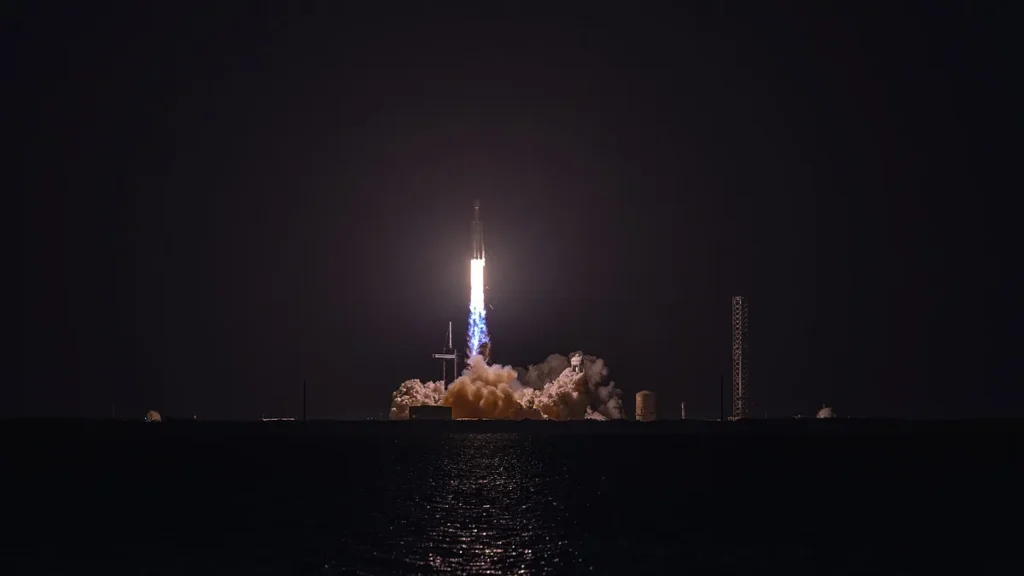
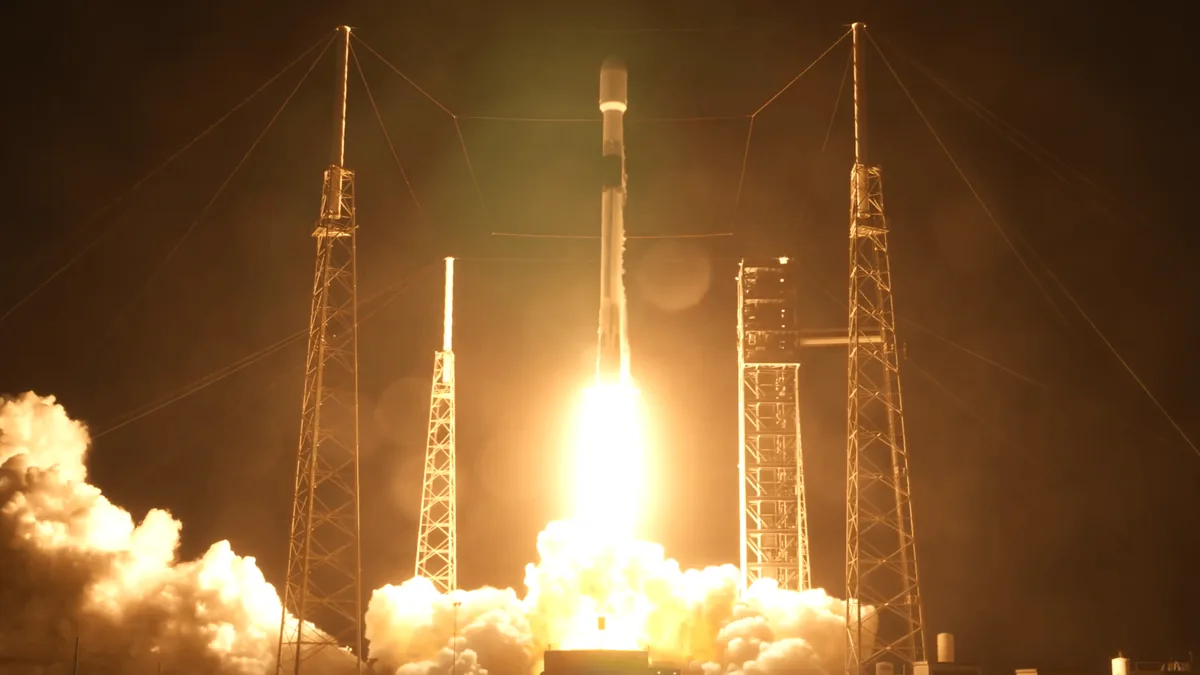
- The Maxwell spacecraft launched on October 20, 2026 at 7:04 a.m. EDT from Cape Canaveral Space Force Station aboard a SpaceX rideshare mission called Bandwagon-5.
- This flight marks Viasat's second demonstration under the NASA CSP program, following an initial launch telemetry relay demonstration during the Blue Origin New Glenn orbital flight in November 2025.
- Viasat's government space team began on-orbit operations for a demonstration campaign lasting five months through March 2027.
Viasat Inc. announced Oct. 21, 2026 that the Rocket Lab-built Maxwell spacecraft reached orbit under NASA’s Communications Services Project after launching at 7:04 a.m. EDT Oct. 20, 2026 from Cape Canaveral Space Force Station aboard a SpaceX Bandwagon-5 rideshare.
Two NASA CSP contract awards totaling $81 million support the effort as the demonstration advances NASA’s planned retirement of its legacy Tracking and Data Relay Satellite system. NASA is shifting orbital communications from government-owned relay infrastructure to commercial non-terrestrial networks.
Rocket Lab built the Maxwell spacecraft at its Long Beach, California facility under a partnership where Viasat selected Rocket Lab to provide low-latency relay spacecraft. The company manufactured the platform at its California site using its own subsystems. The Bandwagon-5 rideshare carried two NASA-funded commercial satellite communication demonstrations, with Viasat and SES Space and Defense as the partners preparing to test capabilities after launch.
This flight is Viasat’s second demonstration under NASA CSP, following an initial launch telemetry relay demonstration during the Blue Origin New Glenn orbital flight in November 2025. The earlier demonstration involved launch telemetry relay, while the current campaign tests broader relay services over months.
Viasat’s government space team began on-orbit operations for a demonstration campaign lasting five months through March 2027. The team, part of Viasat’s Defense and Advanced Technologies segment, will proceed with on-orbit testing and demonstrations over that period.
Maxwell includes a space-qualified Ka-band terminal for the high-capacity ViaSat-3 geostationary constellation plus an L-band terminal using Rocket Lab’s Frontier radio. The Ka-band terminal on Maxwell links to Viasat’s ViaSat-3 geostationary constellation, while Rocket Lab’s Frontier radio in the L-band terminal connects to Viasat’s global L-band network for telemetry, tracking and command support.
The spacecraft provides power, communications, propulsion, and attitude control for the demonstration. Rocket Lab built the vehicle using in-house components including solar panels, reaction wheels, star trackers, and flight and ground software. Rocket Lab also provided a new L-band radio to support telemetry, tracking and command applications through Viasat’s L-band network.
Direct-to-ground communications are part of the demonstration for S-, X-, and Ka-bands. The ground service supports S-, X-, and Ka-band downlinks through Viasat’s Real-Time Earth network. Those systems let operators receive critical mission data on demand and maintain continuous contact with spacecraft across a low Earth orbit path.
“the need for resilient, high-performance space-based communications to keep data flowing has never been greater,” said John Reeves, Vice President of Space and Mission Systems at Viasat Government. Reeves added that the demonstration will show new commercial services transforming low Earth orbit operations through continuous spacecraft access and control.
Viasat leadership said continuous links between satellites remove ground station delays for orbital operators. Removing latency supports continuous access and command and control for government and commercial missions. Viasat’s Ka- and L-band relay services will provide low Earth orbit operators real-time, low-latency communications for time-sensitive operations and remove ground downlink delays.
SES Space and Defense flew a second NASA demonstration on Bandwagon-5 using its O3b mPOWER fleet for medium Earth orbit and geosynchronous satellites. SES will use its O3b mPOWER fleet in medium Earth orbit for high-rate data and geosynchronous satellites for low-rate data between its demonstration spacecraft and ground stations.
NASA’s Space Communications and Navigation division awarded $278.5 million to industry through CSP in 2022, with the project managed at NASA’s Glenn Research Center in Cleveland. The award supported the gradual retirement of the Tracking and Data Relay Satellite system and the shift of future low Earth orbit missions to commercial alternatives through 2027.
Two demonstration spacecraft aboard SpaceX’s Bandwagon-5 rideshare will spend the coming weeks demonstrating advanced satellite communications capabilities for NASA science missions. NASA’s Communications Services Project will continue working with industry to test state-of-the-art relay capabilities through 2027.
Viasat’s five-month flight testing will test real-time, low-latency data transport across its HaloNet architecture to qualify commercial space-to-space links for future NASA exploration and commercial space missions. Viasat’s geostationary relay services let operators reach critical mission data on demand and support real-time telemetry, tracking and command for any low Earth orbit spacecraft path.
NASA uses high-rate data links to transmit information such as scientific discoveries and 4K imagery, plus low-rate signals to track spacecraft and send basic commands, both essential to maintaining reliable connections across the solar system. During the demonstration, Viasat will use intelligent autonomous technology to route data among the Maxwell spacecraft, its satellites in geosynchronous orbit, and its global network of ground stations.
“Yesterday’s launch represents the culmination of years of innovation, engineering and collaboration across Viasat, NASA and our industry partners,” said John Reeves, Vice President of Space and Mission Systems at Viasat Government. Reeves’s comment tied expanding low Earth orbit constellation operations, Earth observation, scientific missions and military space activities to the need for resilient communications.
Viasat completed its acquisition of Inmarsat in May 2023.



Join the discussion