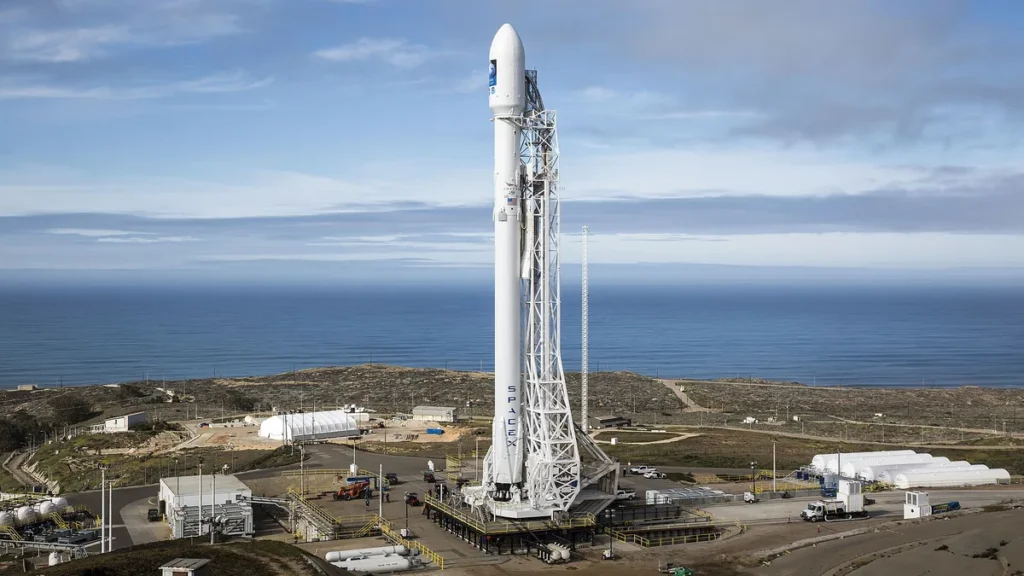
On February 8, 2024, SpaceX launched NASA’s PACE satellite aboard a Falcon 9 rocket from Space Launch Complex 40 at Cape Canaveral Space Force Station, placing it into a Sun-synchronous polar orbit at an altitude of 676.5 kilometers and an inclination of 98 degrees. The launch followed delays caused by unfavorable weather on February 6 and 7, ultimately proceeding at 1:33 a.m. EST (06:33 UTC).
Timeline: Key milestones in PACE’s launch
- August 2023: Booster B1081 flew the Crew-7 mission on August 26, 2023.
- February 2024: Initial launch date set for February 6, 2024.
- February 2024: Launch rescheduled to February 7, 2024.
- February 2024: Falcon 9 launched PACE on February 8, 2024.
The Falcon 9 launch employed a southbound trajectory to reach its polar orbit, enabled by the Autonomous Flight Safety System (AFSS) and a dogleg trajectory. This approach allowed SpaceX to conduct its 12th polar launch from Florida, the first NASA-procured mission from the site. Before PACE, SpaceX had flown 11 polar missions from Florida, most of them Transporter rideshare launches.
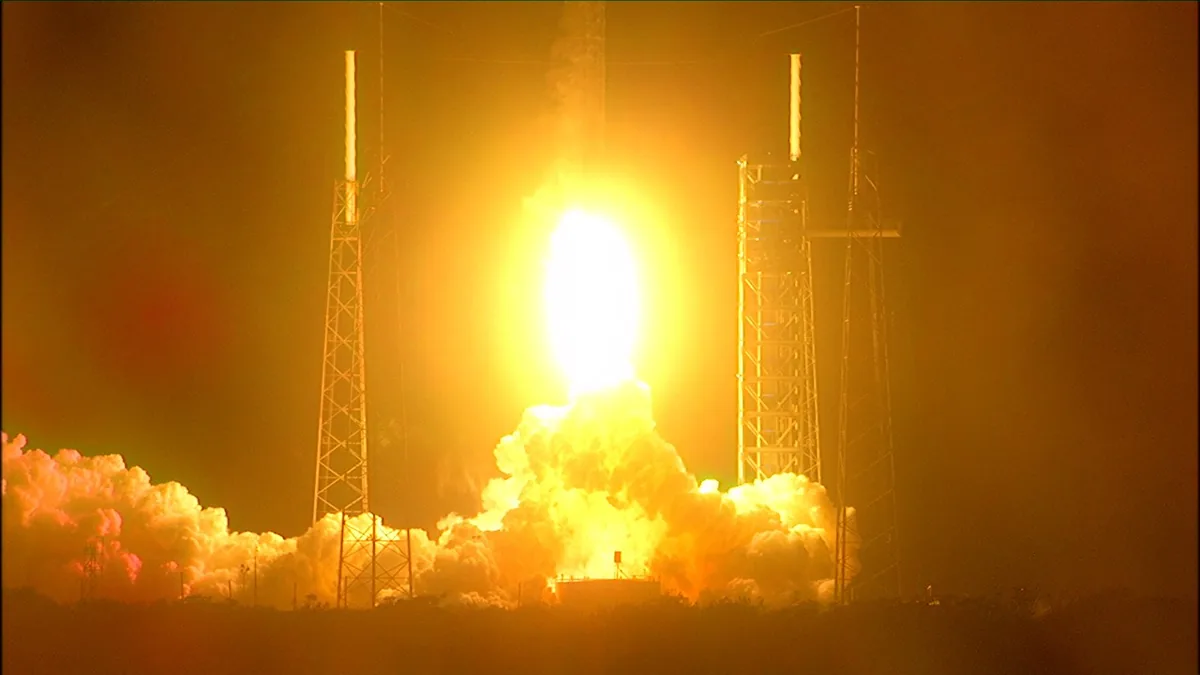
During the launch, booster B1081-4 performed a boostback burn after stage separation and landed at Landing Zone 1. The Falcon 9 fairings splashed down and were recovered by SpaceX’s support ship Bob. The second stage delivered PACE to its target orbit, with spacecraft separation occurring 13 minutes after liftoff. Booster B1081 had previously flown Crew-7 in August 2023, CRS-29, and Starlink 6-34, with a 49-day turnaround between its last mission and PACE.
The PACE project, authorized in 2015, faced challenges including parts failures on the HARP2 instrument and disruptions from the COVID-19 pandemic. The Trump administration’s 2018 NASA budget proposal marked PACE for cancellation, but Congress restored funding. The mission’s launch date was initially set for February 6, 2024, then pushed to February 7 before the successful February 8 liftoff.
Weighing 1,694 kilograms and measuring 1.5 meters by 1.5 meters by 3.2 meters, PACE is powered by a single solar panel generating 1 kilowatt of power. Designed for a three-year primary mission with a ten-year orbit-maintenance capability, the satellite carries three science instruments: the Ocean Color Instrument (OCI), SPEXone, and HARP2. The OCI, built by NASA’s Goddard Space Flight Center, observes ultraviolet to near-infrared wavelengths at five-nanometer intervals. SPEXone and HARP2, polarimeters measuring sunlight’s polarization, study aerosol-cloud interactions.
PACE extends a legacy of ocean color observations, beginning with the first satellite launched in 1978. Jeremy Wardell, PACE project scientist, highlighted the mission’s data potential: “There are thousands and thousands of unique pieces of information for every pixel on Earth we’re going to collect.” The satellite’s instruments will provide high resolution for studying atmospheric and oceanic particles linked to global warming.
NASA’s Launch Services Program managed the mission under an $805 million cost cap, with the launch itself priced at $80.4 million. The PACE spacecraft was built by NASA Goddard, which also developed the OCI. HARP2 was constructed by the University of Maryland, Baltimore County, while SPEXone was developed by a Dutch consortium led by the Netherlands Institute for Space Research, Airbus Defence, and Space Netherlands.
PACE’s Contribution to Climate Science
NASA Administrator Bill Nelson emphasized PACE’s role in advancing climate science, stating it would reveal how atmospheric and oceanic particles influence global warming. Karen St. Germain, director of NASA’s Earth Science Division, noted that combining PACE data with the Surface Water and Ocean Topography mission would advance ocean science. Marjorie Haskell, PACE program executive, praised the team’s collaboration, while Jeremy Wardell called the mission a discovery effort leveraging cutting-edge technologies.



Join the discussion