
Key facts
- NASA's twin ESCAPADE spacecraft will each perform a powered Earth flyby with an engine burn on November 7 and November 9, 2026, the first such maneuver by an agency spacecraft on a Mars mission.
- Each trans-Mars injection burn will last about 9 minutes and will combine with Earth's gravity to slingshot the spacecraft toward Mars.
- ESCAPADE launched on November 13, 2025, aboard a Blue Origin New Glenn rocket from Launch Complex 36 at Cape Canaveral Space Force Station in Florida.
- The first ESCAPADE spacecraft will conduct its Earth flyby and trans-Mars injection burn around 5 a.m. EST on November 7, 2026, and the second will do so around 6 a.m. EST on November 9, 2026.
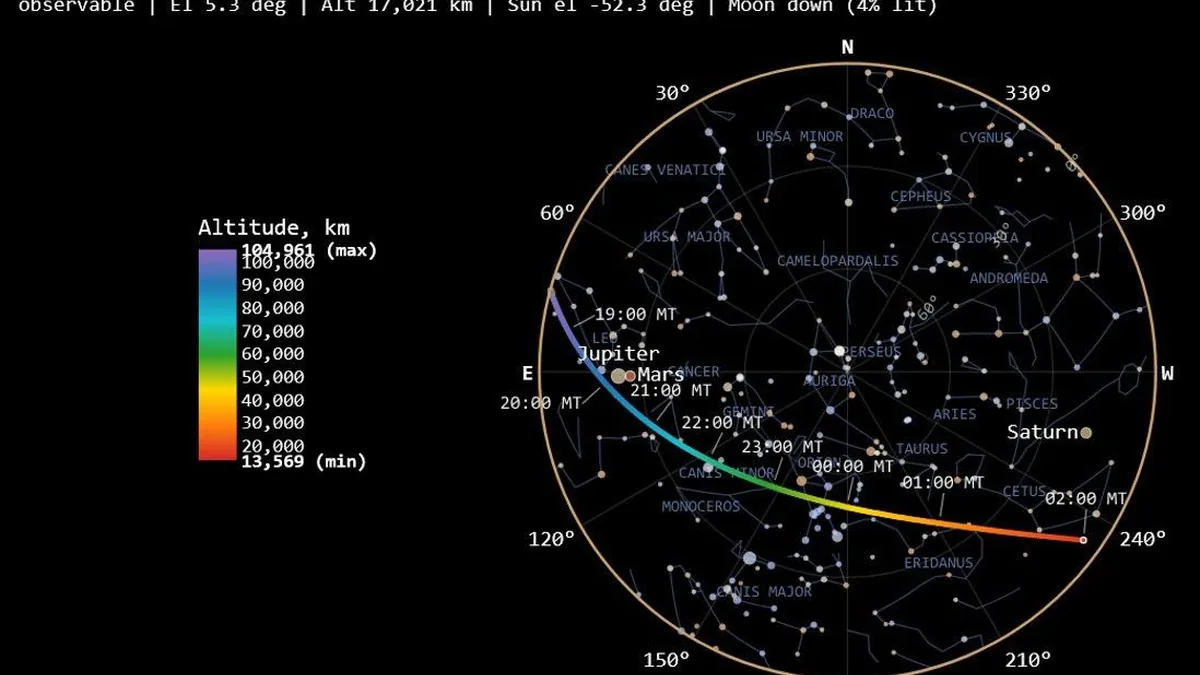
NASA’s twin ESCAPADE spacecraft will each fly past Earth and fire an engine over southern Australia on November 7 and November 9, 2026, in the first powered gravity assist by an agency spacecraft for a Mars mission.
NASA Science says the first spacecraft will begin its burn at 4:51 a.m. EST (8:51 p.m. AEDT) on November 7, and the second will start at 5:51 a.m. EST (9:51 p.m. AEDT) on November 9, each over southern Australia. The release describes the trans-Mars injection burn as lasting about nine minutes and combining with Earth’s gravity to send the spacecraft toward Mars. It reports the speed increase as roughly 6.3 miles per second to 6.7 miles per second, or from Mach 30 to Mach 31. Universe Today gives the same change in metric terms, from about 10.14 km/s to 10.78 km/s.
ESCAPADE launched on November 13, 2025, aboard a Blue Origin New Glenn rocket from Launch Complex 36 at Cape Canaveral Space Force Station in Florida. NASA says Earth and Mars were on opposite sides of the Sun at launch, so the craft did not travel directly to Mars. Instead, it looped around the Earth-Sun Lagrange point 2 and returned toward Earth for the gravity-assist departure. Lagrange point 2 sits about 930,000 miles, or 1.5 million kilometers, from Earth in the anti-sunward direction, the same general vicinity as the James Webb Space Telescope.
All earlier Mars missions, among them Viking, Pathfinder, Curiosity, Perseverance and MAVEN, launched during a roughly three-week window that opens every 26 months when Earth and Mars line up well. Past Mars missions grouped together in 2020, 2022 and 2024 due to that cycle. The L2 loiter strategy lets future Mars missions launch at almost any time, wait in space for favorable planetary geometry, and then depart. That makes the traditional 26-month launch cycle optional in principle. Advanced Space LLC intended for ESCAPADE to remain at Lagrange point 2 for about a year until planetary geometry became favorable.
The powered flyby is called an Oberth maneuver, named after Austro-Hungarian physicist Hermann Oberth, who described the concept in 1927 in his treatise Ways to Spaceflight. It fires an engine at periapsis, the closest point to Earth in the spacecraft’s orbit, when the vehicle is moving fastest. Since kinetic energy rises with the square of velocity, the same burn adds much more orbital energy at peak speed than at slower moments.
Controllers made contact with both ESCAPADE spacecraft by 10:35 p.m. EST on November 13, 2025, the day of launch. NASA says recent solar activity that triggered widespread auroras on Earth caused a slight launch delay to prevent solar storms from harming post-launch spacecraft commissioning. New Glenn also flew a Viasat Inc. space communications technology demonstration that sent launch telemetry from the rocket’s second stage to an operations center on Earth via Viasat’s geostationary satellite network.
The sources disagree on how closely the spacecraft will approach Earth. Tech Times says the Blue spacecraft will come within approximately 373 miles, or 600 kilometers, while Universe Today and NASA Science state the nearest point will fall between 965 and 1,770 kilometers, or 600 to 1,100 miles above the planet’s surface. Each spacecraft is about the size of a standard refrigerator, so it will appear faint and hard to see without a telescope.
Before each burn, the spacecraft should be visible over the western United States until about an hour prior to the engine firing, when it drops below the horizon. NASA Science says the first craft will likely be brightest between midnight and 1 a.m. Pacific Standard Time on November 7, and the second between 1 and 2 a.m. Pacific Standard Time on November 9. They will seem to drift slowly across the sky, taking several hours to pass from east to west overhead. People watching can find coordinates for the spacecraft through NASA’s Jet Propulsion Laboratory Horizons System based on their viewing location.
ESCAPADE’s unconventional route took it through a distant region of Earth’s magnetotail. The spacecraft became the first to directly explore that portion of Earth’s magnetic environment, stretched away from Earth by the solar wind. NASA Science says mission scientists observed interesting activity and structure there and plan to share those findings soon. Before the Earth flyby, both spacecraft will travel through Earth’s distant magnetotail once more, giving instruments a calibration opportunity against a well-studied space environment before reaching Mars.
Several days after the November burns, the team will run multiple trajectory correction maneuvers. The goal is to verify and adjust the path for a precise Mars rendezvous in September 2027. NASA Science says the spacecraft will have a 10-month cruise to Mars, arriving on September 7 and September 9, 2027.
If a spacecraft’s engines fail to ignite during the November flyby window, that vehicle will miss its trans-Mars injection opportunity. The next viable window will not open for approximately two years. Tech Times says a single spacecraft could keep the mission going, but the core science advantage of simultaneous dual-point magnetospheric measurements would be compromised.
Tech Times reports that the Gold spacecraft’s propulsion system produced lower thrust than expected during late 2025 trajectory corrections, delaying a critical maneuver. A replacement maneuver was completed on January 6, 2026.
ESCAPADE will be the first multi-spacecraft mission to fly in formation around Mars. NASA calls the configuration the “String of Pearls.” Universe Today calls the twin spacecraft Red and Blue. Science Phase A will last about six months, with the two spacecraft flying the same orbit at different distances from one another.
Science Phase B will last about five months, during which Blue drops to about 7,000 kilometers and Red climbs to about 10,000 kilometers. NASA says the initial science campaign will start in June 2028. The twin spacecraft will follow each other in the same string-of-pearls orbit to study how space weather conditions change over short timescales.
Flying two spacecraft at once lets the mission take simultaneous two-point measurements spaced by two to 30 minutes of arc along the same orbital path. That separation tells spatial differences apart from temporal changes in Mars’ magnetic and plasma environment. Tech Times says MAVEN has tracked atmospheric loss at Mars beginning in 2014, but only from one location at a time. That single-satellite limit is what ESCAPADE’s two-point measurements are meant to remove.
When Blue and Gold reach Mars in September 2027, the pair will fly elliptical science orbits between 100 miles and 6,200 miles, or 160 and 10,000 kilometers, above the planet’s surface. ESCAPADE will study how the solar wind acts on Mars’ hybrid magnetosphere and causes atmospheric escape.
The solar wind is a million-mile-per-hour stream of particles from the Sun. Mars lost its internal dynamo roughly 4 billion years ago. That left isolated patches of magnetized crust surrounded by a hybrid magnetosphere shaped by direct interaction between the solar wind and the ionosphere. Mars’ atmospheric pressure stands at 0.6 percent of Earth’s sea-level pressure, lower than the thicker ancient environment, after the planet’s global magnetic field disappeared and the solar wind stripped much of the atmosphere through sputtering.
Scientists postulate that ultraviolet radiation from the Sun drove Mars’ ancient atmosphere into space after the planet’s molten core cooled and it lost its protective magnetic field. Mars still holds crustal magnetic fields, also known as remnant fields. Iron-rich pieces of crust locked in the ancient magnetic orientation when the planet’s dynamo failed billions of years ago produced them.
NASA’s now-defunct Mars Global Surveyor supplied data for a color-coded map of Mars’ crustal magnetism. Blue marks weak magnetic strength on the map, while red marks strong.
Radiation on the Martian surface averages about 0.64 millisieverts per day, roughly the same as a chest X-ray every five days. Because Mars lacks a global magnetic field, future crews need detailed knowledge of how the radiation environment changes. ESCAPADE should yield more information about Mars’ ionosphere. Future astronauts will rely on that part of the upper atmosphere to send radio and navigation signals around the planet.
Nicky Fox, associate administrator of NASA’s Science Mission Directorate, said ESCAPADE fits NASA’s strategy to understand Mars’ past and present so the agency can send the first astronauts there safely. At Mars, ESCAPADE will study the present-day effects of the solar wind and solar storms in real time. The results should offer insights about Martian space weather and the conditions astronauts will face.
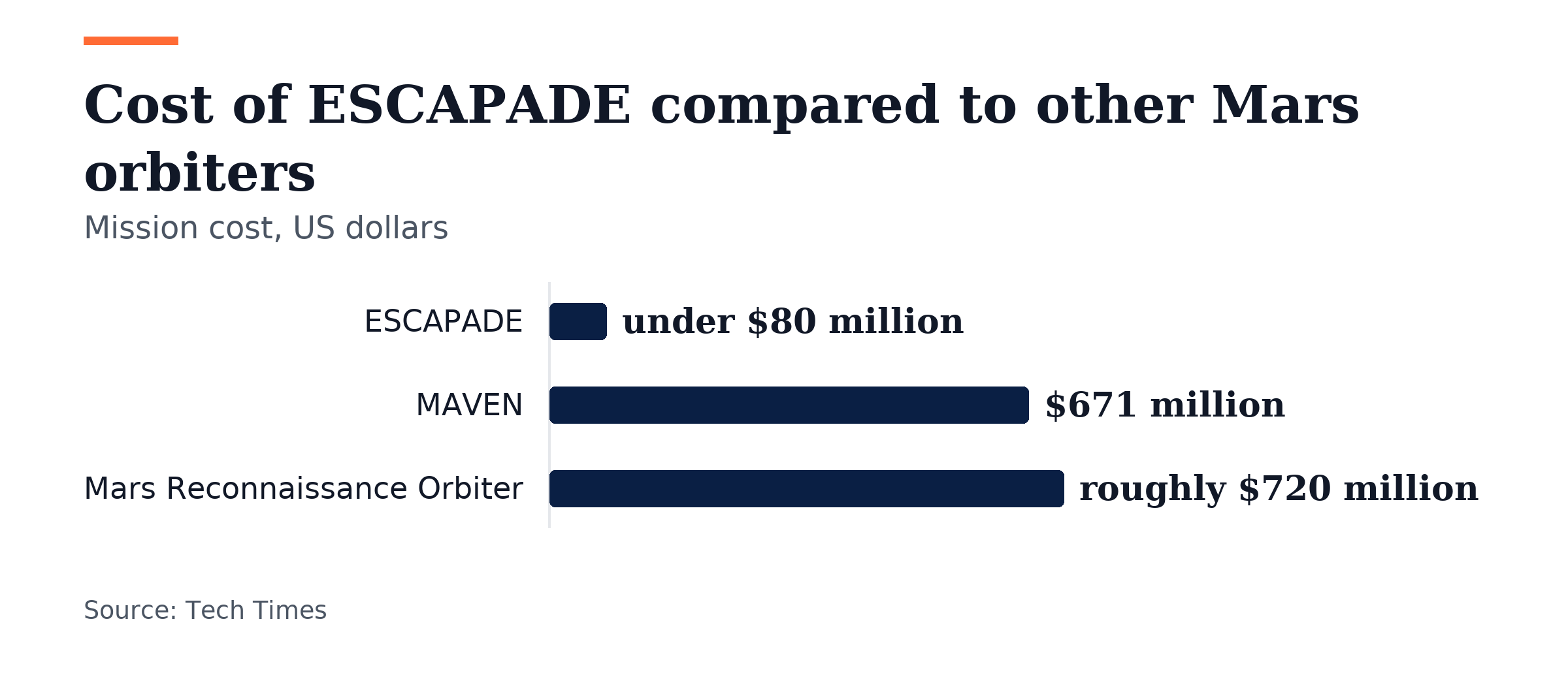
Principal investigator Robert Lillis puts the full ESCAPADE mission cost at under $80 million, roughly 10 percent of what a typical Mars orbiter costs. MAVEN cost $671 million, and the Mars Reconnaissance Orbiter cost roughly $720 million. Robert Lillis frames the risk choice as spending $800 million for a 95 percent chance of success versus $80 million for an 80 percent chance. He put it this way: “Instead of spending $800 million for a 95% chance of success, can we spend $80 million for an 80% chance?”
Rocket Lab constructed both ESCAPADE spacecraft under NASA’s SIMPLEx program, while the University of California, Berkeley leads the mission. NASA’s Heliophysics Division funds the mission, which is part of SIMPLEx. Goddard Space Flight Center, Embry-Riddle Aeronautical University, and Advanced Space provide support. The Launch Services Program at Kennedy Space Center in Florida arranged the Blue Origin launch under the Venture-class Acquisition of Dedicated and Rideshare contract.
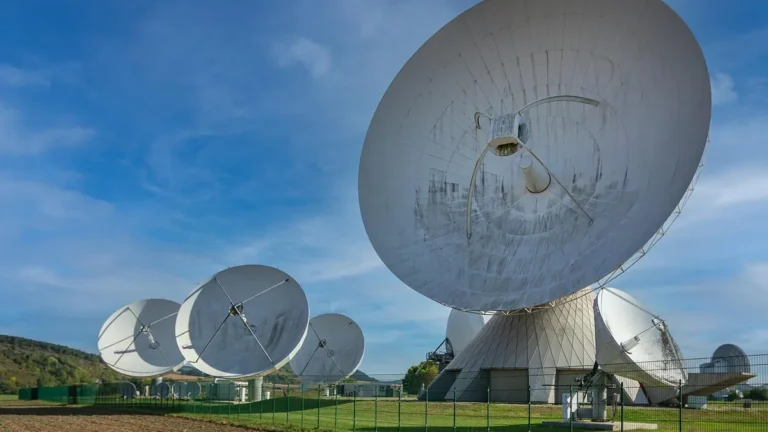
Rocket Lab finished both spacecraft in about 3.5 years, roughly half the time a standard planetary mission normally takes. NASA’s Deep Space Network will reach both spacecraft at the same time using Multiple Spacecraft per Aperture. The system contacts both probes through one antenna dish and cuts the DSN time needed to run two spacecraft in half.
Phys.org says the spacecraft took the Earth and moon images on July 3, 2026, from 363,250 miles, or 584,500 kilometers, away from Earth and 115,600 miles, or 186,000 kilometers, away from the moon. In the visible-light view, both bodies appear as crescents with about 8 percent of each face illuminated by the Sun. The thermal-infrared view shows Earth’s nightside glowing between minus 10 and 44 degrees Fahrenheit, with the moon’s nightside at minus 280 degrees Fahrenheit.
Chris Haberle processed the thermal-infrared images. They display Antarctica and part of Africa as visible temperature extremes on Earth.
Christopher Edwards, a professor of planetary science, senior research scientist Chris Haberle, and professor Michael Shafer led the students’ camera work on ESCAPADE, with professor David Trilling giving additional support. Edwards said the last time NASA received a unique view of Earth and the moon was when the Artemis II astronauts flew by. The NAU-made cameras may take true-color images of Mars from angles never seen before. They may also provide infrared data on how Mars’ polar caps evolve.
Once the nominal science mission ends, the ESCAPADE spacecraft should keep operating for many years. NASA will face decisions about the mission at that point.


Join the discussion