Key facts
- NASA’s ESCAPADE mission will perform the first-ever powered double Earth flyby, combining gravity assists with engine burns, to slingshot its twin spacecraft toward Mars.
- The twin ESCAPADE spacecraft, named Blue and Gold, will perform their powered flybys on November 7 and November 9, 2026, respectively, increasing their speed by over 1,000 miles per hour.
- The ESCAPADE spacecraft will study Mars’ magnetosphere and atmospheric loss by observing how the solar wind interacts with the planet’s environment in real time.
- ESCAPADE’s mission design demonstrates a low-cost approach to planetary exploration, costing $75 million compared to $582 million for NASA’s MAVEN orbiter.
On Nov. 7 and 9, 2026, NASA’s twin ESCAPADE spacecraft will execute a first-of-its-kind powered double Earth flyby, mixing gravity assists with engine burns to build speed for the trip to Mars. The maneuver, an Oberth maneuver that pairs an engine burn with a gravity assist, has not flown on a Mars-bound mission before. NASA expects the two spacecraft, named Blue and Gold, to add more than 1,000 miles per hour to their speed during the flybys.
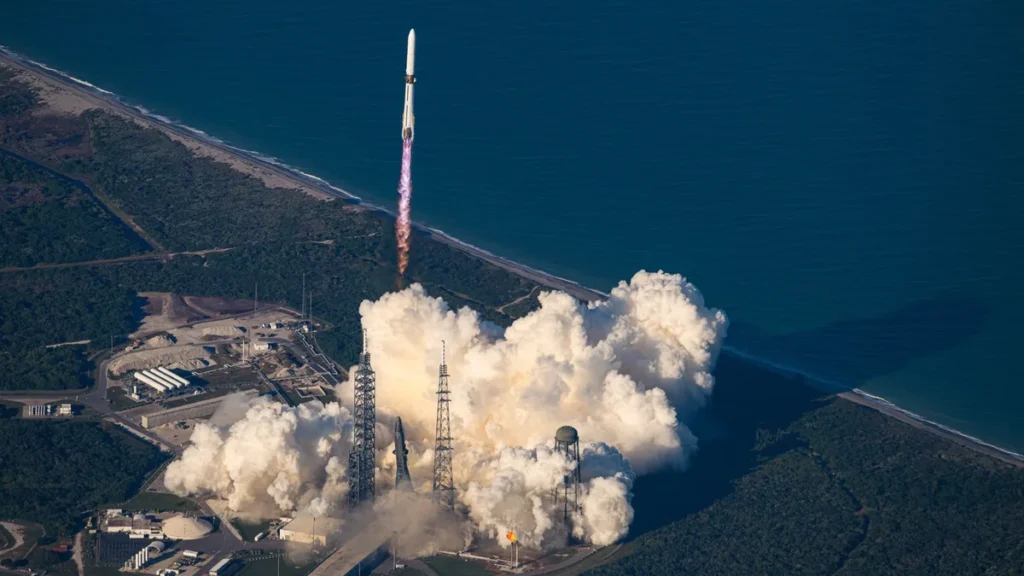
Nov. 13, 2025, 3:55 p.m. EST: ESCAPADE launches from Cape Canaveral on a Blue Origin New Glenn rocket. Nov. 7, 2026, 4:51 a.m. EST: Blue makes its closest approach to Earth, passing 600 miles overhead. Nov. 9, 2026, 5:51 a.m. EST: Gold makes its closest approach, passing 1,100 miles overhead. September 2027: the spacecraft are scheduled to arrive at Mars. June 2028: the first science phase begins in the string-of-pearls formation.
A gravity assist borrows a planet’s orbital motion to change a spacecraft’s direction and speed without burning fuel. ESCAPADE’s flybys are different: each spacecraft will fire its engines during the pass, turning an ordinary gravity assist into a powered flyby that delivers a larger velocity boost than a gravity assist alone could provide. NASA describes the burns as lasting about nine minutes each, raising the spacecraft’s speed from 6.3 miles per second to 6.7 miles per second. The speed gains from the two flybys are what allow the spacecraft to climb away from Earth and set course for Mars.
The need for such an unusual maneuver traces back to when ESCAPADE left Earth. The spacecraft launched on Nov. 13, 2025, aboard a Blue Origin New Glenn rocket from Cape Canaveral Space Force Station, at a moment when the two planets sat on opposite sides of the Sun. At that moment a direct transfer to Mars was impossible, so the mission could not follow the conventional path. Traditional Mars missions wait for a 26-month alignment window when the two planets align for a direct, fuel-efficient transfer.
Instead of waiting on the ground, ESCAPADE settled into a loiter orbit at the Earth-Sun Lagrange point 2, roughly 1 million miles (1.6 million kilometers) from Earth. This is the first time a Mars-bound mission has used an L2 loiter orbit to delay its departure.
While waiting at L2, the spacecraft drifted roughly 2 million kilometers into Earth’s magnetotail, the downstream part of Earth’s magnetic field that the solar wind drags outward. The solar wind is a stream of charged particles from the Sun that presses against Earth’s magnetic field and stretches it into the long tail. No spacecraft has directly studied this region before, so ESCAPADE returned the first direct measurements of how the solar wind reshapes the magnetotail. The observations came from farther out than any prior mission has reached, revealing behavior in how the solar wind couples with Earth’s magnetic field.
ESCAPADE was first booked as a rideshare on NASA’s Psyche mission, but a change to Psyche’s launch vehicle forced it onto a dedicated rocket. Delays due to weather, solar activity, and technical issues with the New Glenn rocket pushed the schedule back repeatedly before liftoff at 3:55 p.m. EST on Nov. 13, 2025, from Cape Canaveral Space Force Station.
The $75 million price tag underscores the mission’s low-cost design. ESCAPADE is part of NASA’s Small Innovative Missions for Planetary Exploration (SIMPLEx) program, a portfolio built for low-cost, high-risk missions that test new technologies and scientific approaches. The budget reflects heavy reliance on commercial partnerships: Rocket Lab built the spacecraft and Blue Origin provided the New Glenn launch. For context, NASA’s MAVEN orbiter cost $582 million, and ESCAPADE’s total is comparable to India’s Mars Orbiter Mission, which cost about $74 million.
The primary scientific target is Mars itself. ESCAPADE will study how the solar wind strips the planet’s atmosphere, a process that likely dried out Mars and left it with only a thin air layer. The spacecraft carry magnetometers, electrostatic analyzers, and Langmuir probes to measure the solar wind and the charged particles escaping the atmosphere. Because Mars lacks a global magnetic field, the solar wind reaches the atmosphere directly and erodes it over time.
The twin-spacecraft design lets scientists measure how the solar wind strikes the atmosphere and track atmospheric escape at two points at the same time, which a single probe cannot do.
After reaching Mars in September 2027, with Blue targeted to arrive on Sept. 7 and Gold on Sept. 9, the two craft will spend months trimming their orbits before science starts. In June 2028 they enter their first science phase, flying identical elliptical orbits of 170 by 8,400 km, separated by two to 30 minutes in a string-of-pearls alignment, so the two spacecraft follow one another like beads on a string. That phase runs about six months; afterward, Blue and Gold will diverge, with one climbing to roughly 7,000 km altitude and the other to about 10,000 km, so they can study different parts of the magnetosphere at the same time for about five months.
ESCAPADE carries the VISIONS camera system, developed by Northern Arizona University and UC Berkeley, which will shoot true-color and infrared pictures of Mars from vantage points closer orbiters cannot match. The cameras already got a test run: on July 3, 2026, during the loiter orbit, they photographed Earth and the Moon from 363,250 miles and 115,600 miles away, respectively. The thermal-infrared views showed Earth’s nightside glowing at temperatures between -10°F and 44°F while the Moon’s dark side dropped to -280°F, and the images served as calibration checks before Mars arrival. From orbit, the cameras will also study seasonal changes in the polar caps and auroral activity.
Skywatchers with telescopes will have a chance to spot the spacecraft during both flybys. Blue will make its closest approach at 4:51 a.m. EST on Nov. 7, 2026 (8:51 p.m. AEDT), passing 600 miles above Earth. Gold follows on Nov. 9, 2026, at 5:51 a.m. EST (9:51 p.m. AEDT), passing 1,100 miles up. Both spacecraft will be visible over the western United States and southern Australia during their passes.
The mission doubles as a testbed for future human exploration of Mars. Real-time measurements of space weather and solar wind impacts will help NASA design protections for astronauts, robots, and spacecraft on crewed missions. The atmospheric-loss data also bear on Mars’ past habitability, since the solar wind stripping that ESCAPADE measures likely removed much of the water that once covered the planet’s surface. ESCAPADE also shows that a Mars transfer can work without depending on the traditional 26-month launch window, and its $75 million cost and small-satellite design show that modest missions can reach Mars.


Join the discussion