Key facts
- Equivalent temperature describes the cloud's expansion energy and velocity rather than a true thermodynamic temperature, and it does not mean the equipment or its surroundings reached 9.7 picokelvin.
- At low temperature and high density the atoms form a Bose-Einstein condensate, a quantum state in which the ensemble acts as one entity and exhibits collective quantum behavior.
- The team trapped about 20,000 rubidium atoms, which Science's summary specifies as about 20,000 rubidium-87 atoms, using laser cooling and evaporative cooling in an optical dipole trap.
- MIT physicist and 2001 Nobel laureate Wolfgang Ketterle said the cloud's seven-second expansion equals roughly a 250-meter fall on Earth, where it would crash without a vacuum chamber 250 meters high.
Chinese researchers cooled a cloud of rubidium atoms aboard the Tiangong space station to an equivalent temperature of 9.7 picokelvin, which the research team calls a record low, on Nov. 6, 2026. The work appeared in Science as Wei Xiong et al., Quantum gases below 10 picokelvin in space, with a First Release paper published Nov. 5, 2026.
The figure is an equivalent temperature: it describes the cloud’s expansion energy and velocity after release, not a true thermodynamic temperature, and the equipment and its surroundings did not reach that temperature. It is about 10 trillionths of a kelvin, barely above absolute zero of minus 273.15 degrees Celsius, and roughly 14 orders of magnitude below room temperature.
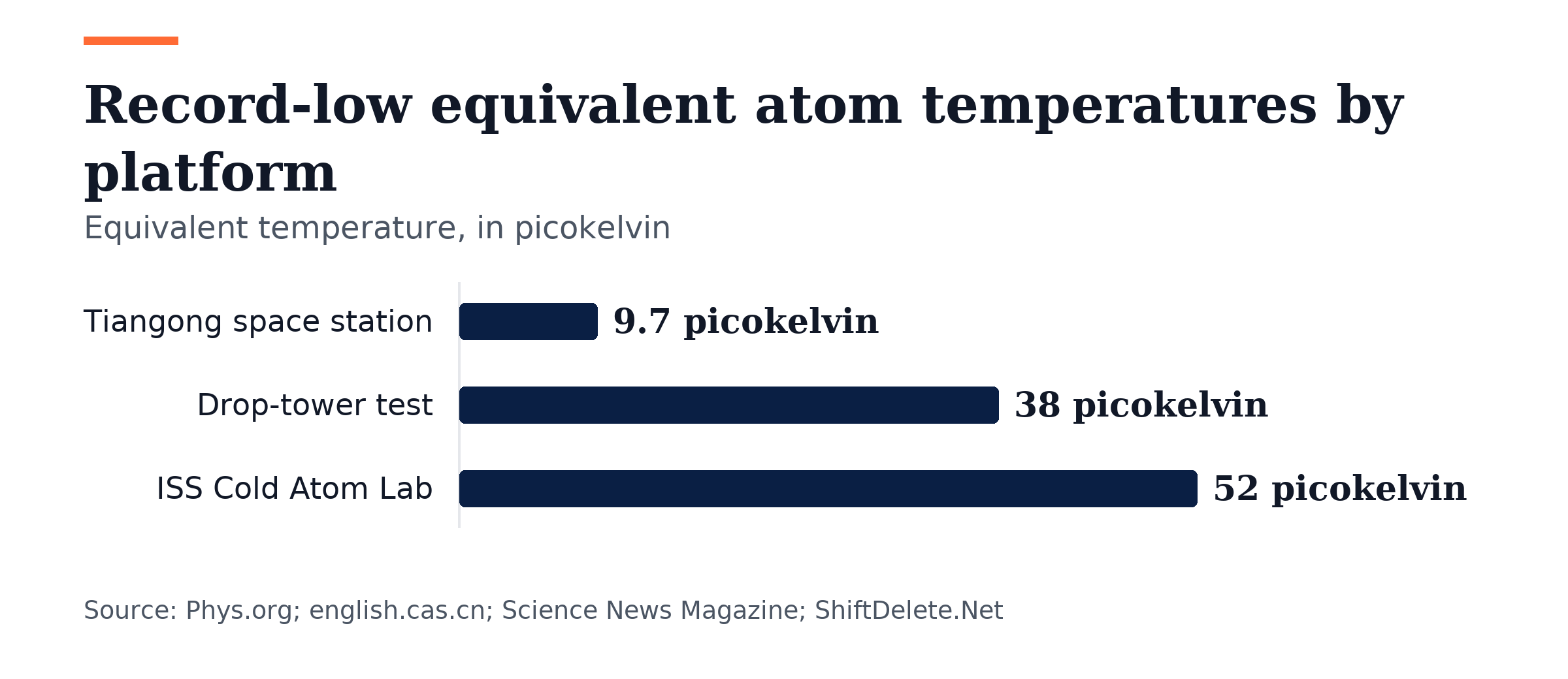
The earlier orbital benchmark was 52 picokelvin at the International Space Station‘s Cold Atom Laboratory, which used magnetic trapping and matter-wave lensing, while an Earth drop-tower test reached 38 picokelvin; the new result is four times lower. Researchers tracked the cloud’s free expansion for seven seconds, compared with two seconds in a drop tower and one second aboard the station.
On Earth, gravity makes atom clouds sag, limiting how weakly researchers can confine them and how long researchers can observe them after release. Microgravity aboard the station permits much weaker confinement and longer observation. Wolfgang Ketterle, the MIT physicist and 2001 Nobel laureate, said the seven-second expansion is roughly equal to a 250-meter fall on Earth, where the cloud would crash without a vacuum chamber 250 meters high. He described the achievement as “an excellent starting point to advance atomic thermometry and precision measurements.”
The team trapped about 20,000 rubidium-87 atoms using laser cooling and evaporative cooling in an optical dipole trap, which holds atoms with focused laser beams. A magnetic-field gradient improved the initial cooling, and the team then moved the atoms into a wider optical trap with weakened confinement to cut expansion energy, followed by non-adiabatic expansion. Because evaporative cooling in an optical trap is less efficient in microgravity, the team added magnetic-gradient support and precise optical and electronic controls.
An optical trap directly produced a Bose-Einstein condensate under microgravity conditions for the first time, rather than during brief drop-tower free fall. Phys.org reported the 7.0-to-12.9-picokelvin uncertainty range in its section on the three-dimensional expansion measurement.
At low temperature and high density, the atoms formed a Bose-Einstein condensate, a quantum state in which the ensemble acts as one entity and shows collective quantum behavior. The Chinese Academy of Sciences links the condensate to studying phenomena on scales larger than individual atoms. Researchers from Peking University, the Shanghai Institute of Optics and Fine Mechanics, and the Technology and Engineering Center for Space Utilization of the Chinese Academy of Sciences took part, with Xiong Wei and Jin Shengjie of Peking University as co-first authors.
Science News described the condensate as colder than any before, reached by atoms orbiting aboard Tiangong. The study authors said, “First, it aims to enable quantum simulation for exploring low-temperature physics in the unique environment of space.”
The experiment ran in the ultracold atom physics facility, also called the Cold Atom Physics Rack, inside Tiangong’s Mengtian laboratory module, which launched in 2022 after a project assessment that began in 2011. Engineers compressed a ground system of about 20 cubic meters and 10 tonnes into a spaceflight instrument of about 0.7 cubic meters and 0.5 tonnes, integrating lasers, precision optics, an ultrahigh-vacuum system and automated controls within tight power limits.
Prospects include quantum simulation of exotic phases, optical lattices built from shaped laser fields, and a space-based atom Mach-Zehnder interferometer, an instrument that splits and recombines atom waves, for precision tests such as the equivalence principle. Ernst M. Rasel of Leibniz University Hannover said atom interferometers gain from large numbers of ultracold atoms and long observation times, with sensitivity rising with the square of the time in the interferometer, and he identified orbit interferometers keeping atoms coherently split for several seconds as a next step. Such interferometers could support measurements of Earth’s gravity field and tests of fundamental physics including dark-matter models, though these remain directions for further research.
The record demonstrates that microgravity stretches the quantum-measurement window. ShiftDelete.Net framed the record as a temperature mark and a demonstration of microgravity’s longer measurement window, not consumer-product news. The Chinese Academy of Sciences stressed that the work is fundamental physics and space science rather than consumer-product news.



Join the discussion