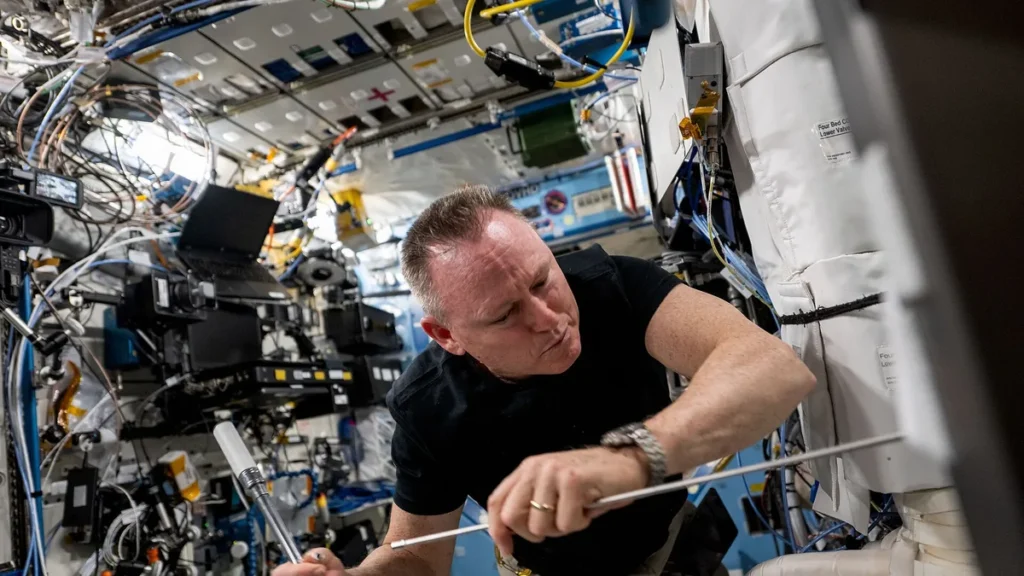
Expedition 75 crew members packed a U.S. Dragon cargo spacecraft aboard the International Space Station on Thursday, preparing the vehicle for departure.
NASA flight engineers Anil Menon and Jessica Watkins began loading payloads inside Dragon on Thursday, working together to start the cargo transfer. Later, Menon worked with Canadian Space Agency flight engineer Joshua Kutryk to rearrange and secure cargo inside the spacecraft, balancing its mass and center of gravity for a safe reentry and splashdown in the Pacific Ocean.
The astronauts are readying returning experiments such as bacterial DNA and 3D-printed blood vessels, plus specialized lighting hardware that tested natural daylight patterns to regulate crew sleep for over three years. Station crews tested the hardware aboard the station and are now sending it back with other return cargo. The returning specimens are part of the cargo, and crews are preparing them for the trip home. Final packing finishes the day before Dragon leaves, when critical research samples move into portable freezers and incubators for the ride home.
Dragon arrived at the station Oct. 15 with over 6,300 pounds of science, supplies, and hardware. The vehicle is now approaching departure as the station crew prepares return items, and a series of experiments it delivered is concluding as the stay nears its end.
NASA flight engineer Luke Delaney began his shift inside the Kibo laboratory module, where he set up the Life Science Glovebox for the MVP-Plant-02 study. The investigation explores how plants respond to disease in microgravity, or weightlessness, to help sustain crews on future exploration missions. Thursday’s research topics included space agriculture and superintelligence.
Delaney then cleaned cooling and ventilation systems inside two spacesuits in the Quest airlock; Menon and Kutryk wore those suits during spacewalks on Oct. 29 and Nov. 5. Station commander Pyotr Dubrov, working in the Roscosmos segment, studied manufacturing high-purity semiconductor crystals in microgravity before joining flight engineer Anna Kikina to practice superintelligence tools that transcribe crew audio reports for ground controllers. Flight engineer Sergey Teteryatnikov began his shift on orbital plumbing before documenting stowage availability and updating the inventory management system.



Join the discussion