Key facts
- Anil Menon and Joshua Kutryk installed the eighth and final International Space Station Roll-Out Solar Array on Nov. 5, 2026, completing a five-year power-system upgrade.
- NASA estimates the eight IROSAs will raise available station power by up to 30 percent, supporting operations through the station’s safe and controlled deorbit.
- The original arrays generated about 160 kilowatts before the first IROSA; the completed upgrade raises capacity to approximately 215 kilowatts.
- The spacewalk began at 8:36 a.m. EST (1336 UTC) and ended at 3:35 p.m. EST (2035 UTC), lasting six hours and 59 minutes.
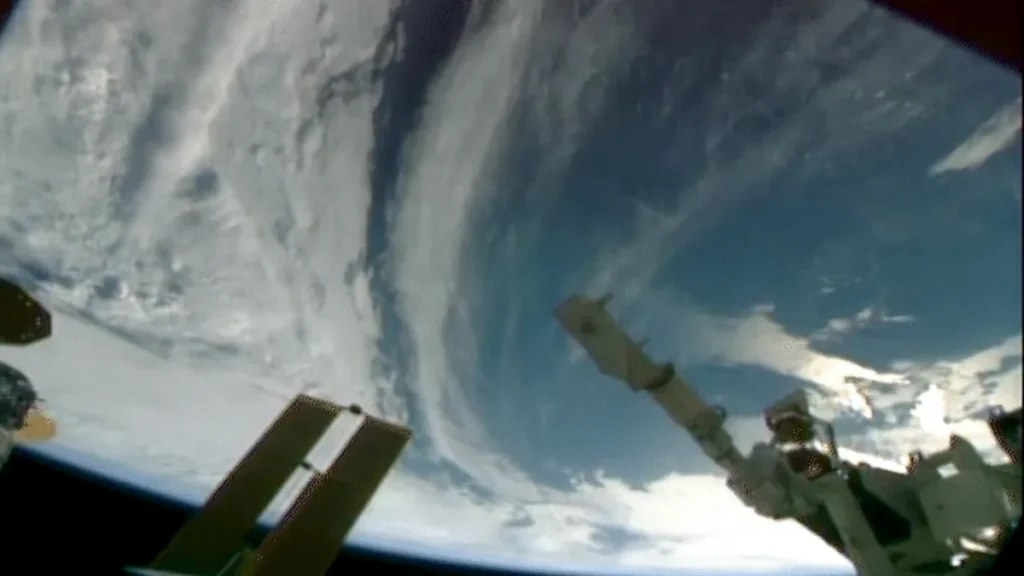
A five-year upgrade of the International Space Station’s power system ended Nov. 5, 2026, as spacewalkers Anil Menon and Joshua Kutryk installed the final roll-out solar array on the 3B power channel at the far starboard end of the main truss.
The outing ran from 8:36 a.m. EST (1336 UTC) until 3:35 p.m. EST (2035 UTC), six hours and 59 minutes in all. Unrolling finished around 3:05 p.m. EST (2005 UTC), when the array reached its full 63-foot length. Expedition 75 logged its sixth spacewalk of the year on Nov. 5, making it the ninth station outing of 2026.
Kutryk, 44, served as EV1 wearing the red-striped suit, and Menon, 50, took part in what was Menon’s fifth spacewalk and Kutryk’s second. Menon’s fifth spacewalk brought his total to 33 hours and 30 minutes. Kutryk’s second IROSA walk brought his total to 14 hours and 10 minutes.
Current from the newly connected array ran at about half the level controllers expected. Crew members mated power cables during orbital darkness, roughly 45 minutes of each 90-minute orbit, since the existing wing and cabling stay live in sunlight, finishing at about 12:36 p.m. EST. Kutryk inspected a power connector during orbital darkness and reseated it, after which controllers reported good currents. NASA had no immediate explanation for the low initial readings.
After Kutryk let go of the final restraint bolts, strain energy in carbon-fiber composite booms unfolded the panels in about 10 minutes. Once the station was back in daylight and controllers had confirmed good currents, deployment proceeded, narrated by commentator Joseph Zakrzewski. Mission Control confirmed the completed deployment after the array reached full length.
Canadarm2’s reach fell short of the outermost starboard mounting point, so Kutryk and Menon passed the folded array between themselves leapfrog fashion. Folded for transport, the unit measured about 10 feet in length and roughly 750 pounds in weight. Menon took the folded array from Canadarm2, handed it to Kutryk near the worksite, then received it back roughly 40 minutes afterward to maneuver it into place. At one point they were working about 15 minutes ahead of schedule.
For the earlier seventh-array work on the inboard left, the 58-foot arm carried a spacewalker straight to the worksite, but the spacewalkers closed the final array’s last stretch by hand.
Menon and Jessica Meir attached the triangular modification-kit bracket to the old wing’s base during an Aug. 6, 2026 spacewalk that readied the site for installation. NASA’s spacewalk records list that outing at six hours and 27 minutes.
NASA started the work in 2021 to counter wear on the station’s original solar wings from years in orbit. Crew members unrolled the first array in June 2021, and six stood in place by June 2023 before NASA ordered the final pair later that same summer. The pair launched on Oct. 13 aboard a Falcon 9, folded in half inside an unpressurized trunk section, and the station’s robot arm placed both rolled-up units on the power truss’s left side while they awaited installation.
Work on the seventh array used the station’s 2A electrical power channel. Spaceflight Now and NASA date that outing to Oct. 29, 2026, while ScienceDaily dates it to October 30, 2026, and both describe a seven-hour, 11-minute walk by Menon and Kutryk. The agency had scheduled live coverage to begin at 6:45 a.m. on Nov. 5 for the final installation.
ScienceDaily counts the outing as station spacewalk number 285 and U.S. spacewalk 100. Spaceflight Now puts the Nov. 5 final walk at 286. Those tallies follow in sequence rather than conflict.
Before the first IROSA, the original arrays put out about 160 kilowatts; after the full upgrade, capacity stands at approximately 215 kilowatts. A single IROSA produces about 8 kilowatts versus 19 kilowatts for an original wing when new. The roll-out arrays sit in front of the original wings, partly shading them while exposed portions keep producing power for a net boost. Built with state-of-the-art solar cells, the panels offset more than 20 years of degradation in the harsh space environment.
NASA puts the added capacity at up to 30 percent of available station power, enough to keep operations running through the safe and controlled deorbit. Life support, computers, research, and visiting vehicles all draw on the added power as the station heads toward its planned 2030 retirement, the agency says. Restored output keeps the station operating through the planned 2030 retirement and de-orbiting.
After the spacewalk, Menon said the arrays deliver 40 percent more power at half the old arrays’ size, a figure that conflicts with NASA’s up-to-30-percent estimate. “These solar arrays are incredible, half the size of the old ones. It’s delivering 40% more power,” he said after returning to the airlock.
Kutryk praised the team’s response to the challenges as impressive after reentering the airlock, and he lauded coordination with Mission Control. “Certainly looks like a good solid mate now,” he said. Gaurang Patel said at an Oct. 20 briefing that NASA’s next planned U.S. spacewalks would target early January for Alpha Magnetic Spectrometer upgrades.


Join the discussion