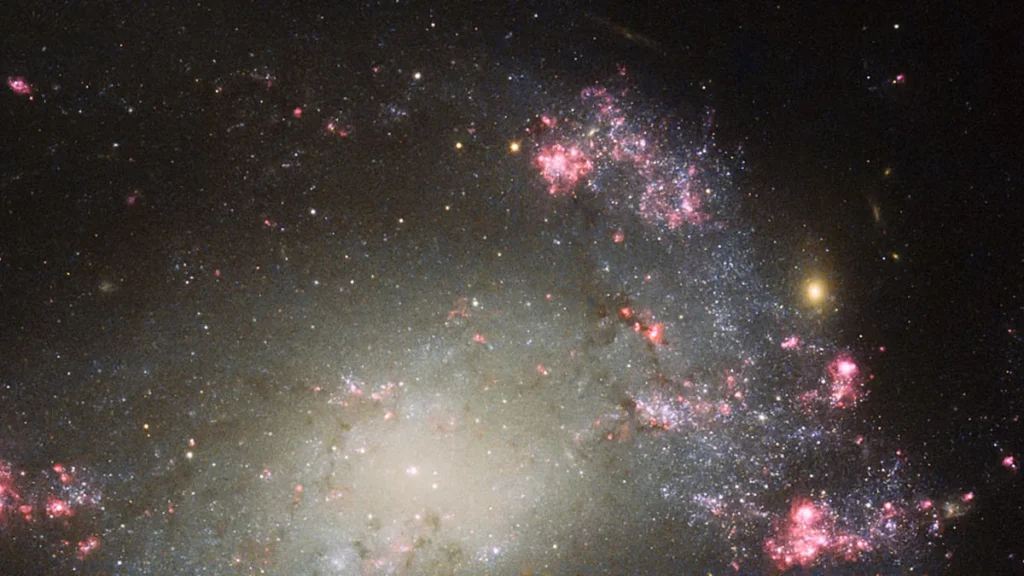
ATLAS discovered supernova SN 2026ahvu on Nov. 2, 2026, in barred spiral galaxy NGC 1433, about 50 million light-years away in the constellation Horologium. The Asteroid Terrestrial-impact Last Alert System, known as ATLAS, initially spotted the object before it became widely observed, and Phys.org reported the discovery and the new images.
Spectroscopy confirmed the object as a young Type Ia supernova, an explosion of a white dwarf that had accreted matter from a close companion star, and it received the designation SN 2026ahvu. At discovery, it shone at about magnitude 17, then brightened to magnitude 13.5 within days.
Researchers expect the explosion to reach maximum brightness between magnitude 10.5 and 12.1 from Nov. 18 to 23. New images from DECam (Dark Energy Camera) and Gemini South show the explosion against its galactic structure, and the event changes in appearance from night to night. The barred spiral galaxy sits in the southern sky, and the explosion stands out as a new feature in the galaxy. Horologium is also called the Pendulum Clock.
These explosions come from the thermonuclear destruction of white dwarfs, the dense remnants of stars similar to our sun. Researchers rely on them as tools for gauging cosmic distances, although questions about how they begin remain unresolved.
Key questions persist about which stellar systems create Type Ia supernovae and exactly how they ignite. Data from the earliest phases can help tell apart different explosion scenarios and look for signs that the blast hit a companion star or nearby material. Researchers note that signs of such interaction can fade fast as the debris expands.
DECam sits on the Víctor M. Blanco 4-meter Telescope at Cerro Tololo Inter-American Observatory in Chile, a facility of the U.S. National Science Foundation operated as part of NSF NOIRLab, and the instrument is a U.S. Department of Energy–fabricated device. Gemini South forms half of the International Gemini Observatory, an NSF-led partnership including Canada, Chile, Brazil, Argentina, and the Republic of Korea, and NSF NOIRLab operates it.
The camera took pre-explosion images of NGC 1433 during the Dark Energy Survey, which DOE’s Fermi National Accelerator Laboratory led from 2013 to 2019 to investigate dark energy, and those archival images now serve as a pre-explosion reference. Comparing pre- and post-explosion environments shows how the blast changed its surroundings, while detailed Gemini imaging provides a closer look at the system. Using the NOIRLab facilities together enables deeper investigation of rapidly changing sky events.
NOIRLab is organizing follow-up observations using Blanco/DECam, Gemini, and the Southern Astrophysical Research Telescope on Cerro Pachón in Chile to build a fuller picture of the explosion. Follow-up imaging tracks changes in the supernova’s brightness and color, and spectroscopy reveals what the expanding material consists of and its speed. Taken together, measures of brightness, color, makeup, and velocity can reveal the system before the explosion and how it detonated. Scientists plan to track the blast from its opening days through maximum brightness and into the long fade.
Ground and space telescopes are already focusing on SN 2026ahvu. NOIRLab asks other observatories to add complementary observations spanning wavelengths and time zones, and working together across sites can catch changes that one observatory alone would miss.
Non-professional observers can spot SN 2026ahvu with small to moderately sized telescopes under favorable conditions, especially from southern sites where NGC 1433 climbs high. To the eye, it looks like a faint point of light, giving viewers a chance to watch an exploding star’s changing glow in another galaxy.
In the weeks ahead, observations by professionals and amateurs will trace the supernova’s path, gathering clues to the physics of stellar explosions and cosmic distance markers. The fresh DECam and Gemini pictures preserve one moment in an ongoing story. Observations in the early stages give astronomers an uncommon chance to watch a nearby blast unfold and collect fast-vanishing evidence, which can narrow models of the stars behind the blasts and sharpen Type Ia supernovae as yardsticks for the expanding universe.


Join the discussion