
Key facts
- According to Musk, SpaceX plans to try catching both rocket stages — the booster and the upper-stage spacecraft — on Flight 15 next month, and he called the double catch a milestone for the program.
- SpaceX has caught Super Heavy boosters with the launch tower before but never recovered the Starship upper stage that way, so Flight 15 could mark the first spacecraft catch using the tower's chopstick arms.
- Musk told investors he judges the next flight's chances of success as better than even, and said SpaceX has more Starship flights lined up before the year ends.
- Flight 14 of the Starship system reached orbit, released 26 Starlink satellites, and concluded hours later with a fiery Pacific Ocean splashdown.
Elon Musk said on an investor earnings call on Oct. 20 that SpaceX plans to attempt catching both the Super Heavy booster and the Starship upper stage on Flight 15 next month. No official launch date or full mission profile has been confirmed for Flight 15, although planning currently indicates a target no earlier than Oct. 19, 2026. Musk called the double catch a milestone for the program.
Before Flight 15, SpaceX had caught Super Heavy boosters with the launch tower but had never recovered the Starship upper stage that way. The tower’s chopstick arms, mechanical arms designed to catch descending vehicles, could make Flight 15 the first spacecraft catch.
SpaceX views a successful catch as a major advance toward its goal of launching, landing, and quickly reusing the same vehicles. Rapid reusability means flying the same vehicles again instead of ending the mission with a splashdown.
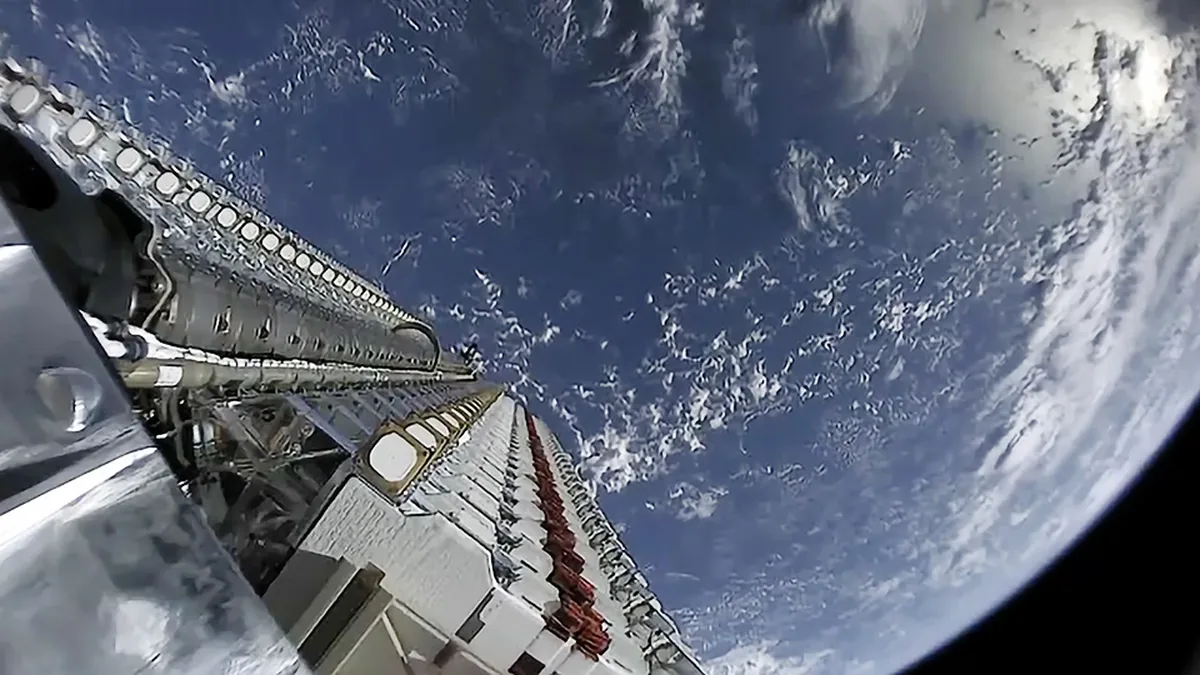
On Sept. 28, the Starship system’s 14th flight reached orbit and released 26 Starlink satellites, then ended hours later with a fiery splashdown in the Pacific Ocean. The plan called for 26 Starlink V3 satellites to enter a 171-mile (275 km) orbit at a 30-degree inclination, adding 26 Tbps of capacity, or roughly ten times the capacity of one Falcon 9 V2 mini launch.
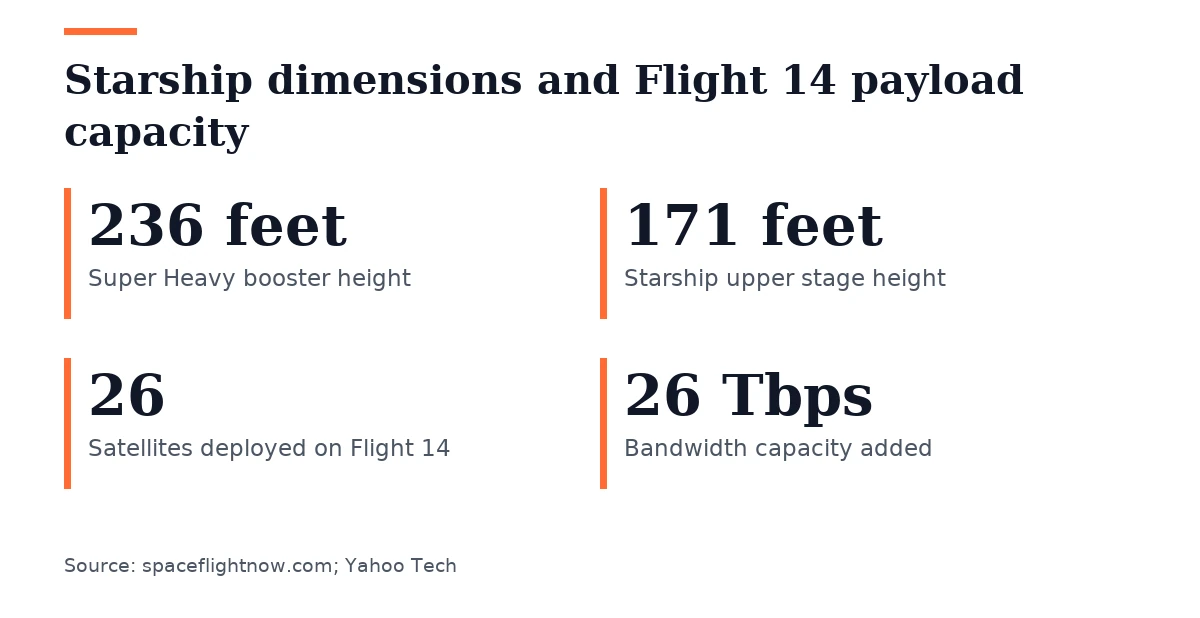
SpaceX said each Starlink V3 satellite adds 1 Tbps of capacity, bringing 26 Tbps on Flight 14, roughly ten times what one Falcon 9 V2 mini launch provides. SpaceX said the satellites would begin serving customers within weeks after checkouts. The vehicle being readied for Starship’s fourteenth flight test passed a full-duration engine firing lasting 60 seconds and using all six Raptor engines on Aug. 21, 2026.
On Sept. 21, SpaceX moved Super Heavy booster B21 from its assembly building to the launch mount at Pad 2 in Starbase, Texas. The booster departed shortly before midnight local time and arrived roughly two hours later. At 236 feet (72 meters) tall and 9 meters (29.5 ft) across, B21 dwarfs Falcon 9’s 3.7-meter (12 ft) diameter, and its downcomer pipe is about Falcon 9’s size. The City of Starbase had not published road closures as of that Monday morning, suggesting the upper stage S41 might roll out to join the booster a day or two later.
SpaceX targeted a Sept. 28 Flight 14 launch at 7:15 a.m. CDT (1215 UTC), but needed FAA approval of the license modification for the orbital flight plan before proceeding. The company needed the FAA license modification before the Sept. 28 launch attempt. To receive authorization for flight, license applications must meet environmental review, safety, policy/payload, and financial responsibility requirements, the FAA said.
The FAA requires proof of vehicle readiness, since a missed deorbit burn could bring an uncontrolled reentry that endangers people as the heat shield and bulk send large portions crashing to Earth. The planned Flight 14 license would be the first FAA orbital license for an object as large as the Starship upper stage at 171 feet (52 m) tall.
In July 2026, SpaceX’s Flight 13 sent several Starlink V3 satellites along Ship 40’s suborbital trajectory. Six of them carried cameras to scan the Starship heat shield and beam imagery before their planned demise. The satellites deployed solar arrays and linked with the Starlink constellation via laser before their planned demise.
Depending on timing, Starship Flight 14 could serve as the next Starlink mission under the additional designation Starlink 31-1. SpaceX had recently ceased launching V2 mini satellites from Florida while continuing missions from Vandenberg Space Force Base in California.
The 15th Starship flight is expected to use two newer vehicles as SpaceX works to advance the rocket’s path toward rapid reusability. That comes after the 14th flight reached orbit, deployed 26 Starlink satellites, and ended with a fiery splashdown in the Pacific Ocean. Prediction markets were analyzing when Starship’s 15th launch would occur in Florida.
Musk forecast one Starship launch per week in the first half of next year, possibly rising to two flights weekly in the second half, with additional missions before 2026 ends. Speaking to investors, Musk said he judges the next flight’s chances as better than even and that SpaceX has more Starship flights lined up before the year ends.
“I’d say it’s more likely than not that this succeeds next flight,” Musk said on the earnings call. Musk said the latest Starship mission carried 26 Starlink satellites into orbit and delivered the bandwidth of 10 Falcon 9 launches.
NASA is developing a modified version of Starship as the Human Landing System, designed to carry Artemis astronauts from lunar orbit to the surface and back. Yahoo Tech said the attempt matters beyond SpaceX’s commercial work because of the NASA link.
Musk expects Starlink to hold roughly 100 times the bandwidth of today’s constellation within about three years as SpaceX deploys more powerful satellites. Musk raised the projection during the same earnings discussion where he addressed the Flight 15 double catch attempt and future Starship launch frequency.




Join the discussion