
Key facts
- Musk's statements about extending the partnership have not been publicly confirmed by Google, and The Next Web has not confirmed independently talks between Google and SpaceX about more capacity.
- SpaceX's Super Intelligence segment brought in $7.56 billion of the company's $14.6 billion third-quarter 2026 revenue, or 51.9 percent, and one customer made up 34.5 percent of whole company revenue.
- On November 25, 2026, SpaceX received regulatory authorization for up to one million AI computing satellites, subject to technical and regulatory constraints.
- The internal group chat's name was reportedly changed by Musk to "Sell compute because we can't compete" in August, and he has expressed frustration over SpaceX lagging behind competitors in AI development.
On Nov. 28, 2026, Elon Musk posted on X that Google is interested in renting more computing capacity from SpaceX. Musk was responding to a user who compared Google and Anthropic and disclosed no figure or schedule for a new deal.
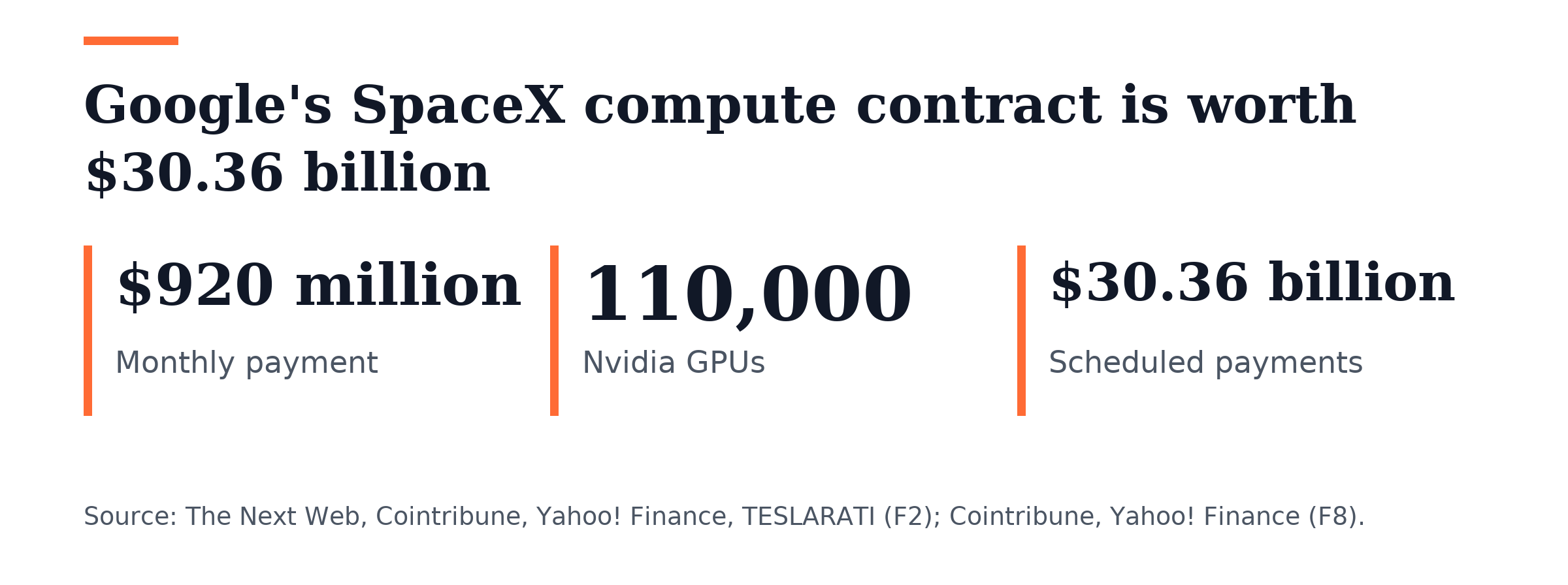
Google‘s agreement covers roughly 110,000 Nvidia graphics processors along with memory and other hardware. Cointribune put the signing date at June 5, 2026, ahead of SpaceX’s public offering. Yahoo! Finance said SpaceX made the deal public in June.
Google has not publicly confirmed Musk’s statements about extending the partnership. The Next Web could not independently verify any discussions between the companies on more capacity.
Anthropic ranks as SpaceX’s largest compute customer and is expected to pay roughly $3.1 billion monthly once the full contracted capacity arrives in December, equal to 34.5 percent of company revenue. According to Yahoo! Finance, the New York Times and Anthropic’s IPO filing support the $3.1 billion monthly rate. TESLARATI said Anthropic’s arrangement began in May at $1.25 billion monthly, using all of Colossus 1.
A larger Google compute agreement would reduce SpaceX’s reliance on Anthropic, its largest customer. Musk said on Nov. 28, 2026 that Anthropic told him it is extremely likely to keep renting and wants significantly more, while Anthropic executives reportedly told analysts in reports this month that the deal ends no later than the second quarter of 2027.
Both principal compute rental agreements include 90-day exit provisions, and Google’s applies starting in 2027, so the $30.36 billion in planned Google payments is not guaranteed revenue. Cointribune cited a June SEC filing allowing either side to end the Google agreement after December 31, 2026, with 90 days’ notice, and Yahoo! Finance said both filings contain the clauses.
Google and Anthropic agreements concluded in June together exceed $70 billion over their original planned durations. Cointribune said the Anthropic arrangement followed a May SpaceX agreement and that Google’s deal grants access to about 110,000 Nvidia graphics processors plus necessary computing equipment.
Musk said prices for large, interconnected compute blocks set up for high-bandwidth AI training are increasing, sometimes significantly, while prices for smaller allocations under about 5,000 GPUs are declining, pushing the average rental price per GPU upward. SpaceX’s installed computing capacity climbed from 0.6 gigawatts in September 2025 to 1.7 gigawatts in September 2026, and the company expects to end 2026 at 2.5 to 3 gigawatts, with roughly 10 gigawatts more planned for 2027.
On November 25, 2026, SpaceX won regulatory authorization for as many as one million AI computing satellites, subject to technical and regulatory constraints. On Nov. 28, 2026, SpaceX shares rose nearly 5 percent in regular trading but fell about 1 percent afterhours, while Alphabet Class A shares gained about 1 percent and added 0.4 percent afterhours.
Stocktwits reported that Musk changed the internal group chat’s name in August to a phrase indicating SpaceX should sell compute because it cannot compete, and he has voiced frustration that SpaceX trails competitors in AI development.
Google works with Broadcom on TPU design, and Broadcom expects Anthropic to be its largest custom-chip customer in 2027. Yahoo! Finance said both major tenants are securing their own chips, a development that matters for SpaceX as a landlord whose customers might eventually require less outside capacity.
To meet demand, Google called its current SpaceX compute arrangement short-term bridge capacity for Gemini Enterprise, the AI agent platform. Google creates Gemini, Anthropic sells Claude, and SpaceX holds Grok, and the three firms compete over part of the same AI market while keeping commercial ties.
SpaceX posted third-quarter 2026 revenue of $14.6 billion, up 161 percent year over year, with its Super Intelligence division generating $7.6 billion versus about $813 million a year earlier. Cointribune said the division represents nearly 52 percent of group revenues, with computing power rental contracts contributing significantly alongside Grok and other SpaceX AI software. The Super Intelligence segment contributed $7.56 billion of that total, or 51.9 percent, while one customer represented 34.5 percent of whole company revenue. Yahoo!
Finance pointed to SpaceX’s third-quarter 10-Q for the customer concentration figure and said the segment generated three-quarters of revenue growth compared with the prior year. SpaceX laid out about $16.4 billion on artificial intelligence investment expenditures during the third quarter. Cointribune said these investments stay particularly heavy.
Analysts project SpaceX revenue will nearly double again in 2028 and nearly quadruple in 2027. Stocktwits cited a New York Times report putting Google’s SpaceX compute deal at around $800 million monthly, in conflict with the $920 million monthly figure from The Next Web, Cointribune, Yahoo! Finance and TESLARATI.
SpaceX’s upcoming annual report will reveal whether Anthropic’s 34.5 percent share of revenue begins to fall. Yahoo! Finance said this is significant because Anthropic is expected to become Broadcom’s largest custom-chip customer in 2027 while building its own chips.
Around the time of its IPO, SpaceX derivative products recorded $5.6 billion in volume over 24 hours on Binance. Cointribune said the IPO sparked considerable enthusiasm on crypto platforms, with the Google-SpaceX contract signed a few days before the IPO.


Join the discussion