Key facts
- The team used six northern polar sites for the analysis: two locations on the residual polar cap, plus Korolev and Louth craters, Chasma Boreale, and the Phoenix landing site.
- The older method was built to study lunar soil, yet checks against Earth observations gave inconsistent results, Khuller found.
- The northern polar ice is arranged in what the researchers describe as an ice-cream sandwich pattern, with relatively dusty layers between thicker sections of cleaner ice.
- Every Martian winter, dusty frost builds up on the ice, and every summer it vanishes to reveal older, cleaner ice underneath.
Pari Mohan and Aditya Khuller published a new analysis of exposed water ice at Mars’ north pole on Sept. 8, 2026, finding it holds about 3 percent dust by mass rather than the much higher figures earlier work suggested.
Mohan, a recent geoscience graduate of the University of Washington, worked with Khuller, a senior research scientist at the university’s Applied Physics Laboratory, on the study. Khuller found that an older method built to study lunar soil produced inconsistent results when checked against Earth observations, so the pair adapted Earth-tested snow and ice techniques from University of Washington professor emeritus Steve Warren instead. Warren’s methods had been used successfully for decades before Khuller adapted them to Martian conditions.
The northern polar ice forms an ice-cream sandwich pattern, with relatively dusty layers sandwiched between thicker sections of cleaner ice. The layering reflects different dust concentrations across deposits laid down over time near the pole. Every Martian winter, dusty frost builds on the ice, and every summer it vanishes to expose older, cleaner ice underneath. Khuller said, “If it is dustier, the ice will be darker.”
Dust trapped in ice can act like an insulator, soaking up sunlight and driving the ice to melt or turn to vapor based on air pressure. The scientist likened the effect to wearing a dark T-shirt in the sun. Ice with little dust absorbs less sunlight, so less of it vaporizes and its brightness reflects more sunlight back into space. Because the ice reflects more light, its albedo rises, so less solar energy stays trapped to warm the planet.
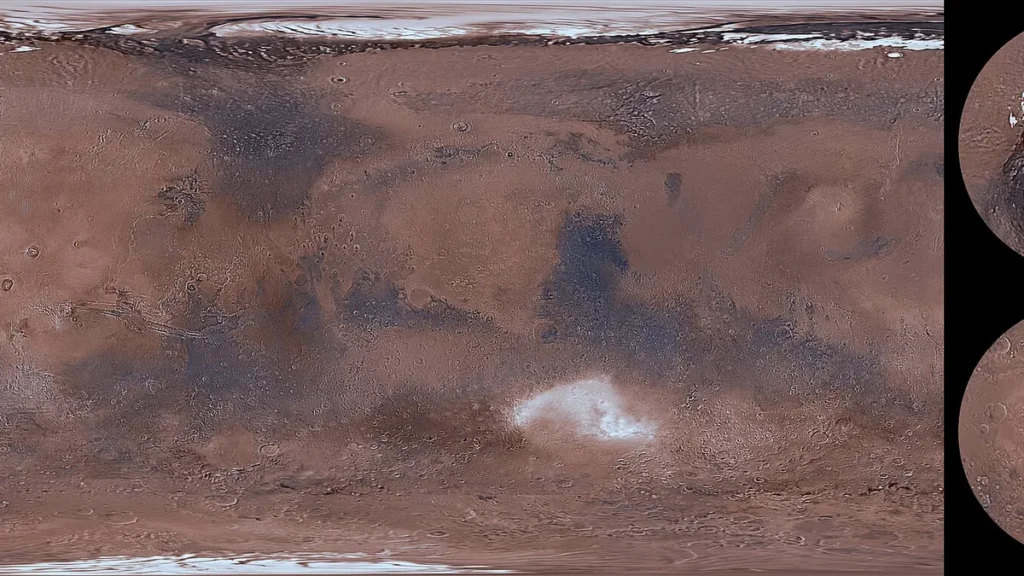
The North Polar Residual Cap sits atop numerous mile-thick water-ice sheets called the North Polar Layered Deposits. Khuller described the residual cap as the most recent active layer in the ice-cream sandwich structure. The winter carbon dioxide layer at the north pole measures about a meter deep, compared with tens of feet deep at the south pole. Because the northern layer is thinner, it sublimates faster in summer, uncovering the permanent water-ice cap beneath.
Carbon dioxide ice forms a winter coating over both of the planet’s polar ice caps. The amount of dust in each layer shifts each year as carbon dioxide frost builds up and then disappears. Orbiters from Europe and NASA, including Mars Express, the Mars Reconnaissance Orbiter and Mars Odyssey, have charted the surface and polar caps. Brightness observations also track seasonal shifts as carbon dioxide ice builds up and then sublimates.
The team used those orbital measurements to follow brightness changes over time and tell dusty frost apart from older, cleaner ice.
The first successful NASA Mars mission flew in 1976. Phoenix sampled ice close to the north pole in 2008, while the Polar Lander was lost near the south pole in 1999. The University of Washington team combined Phoenix data with satellite observations for the new study. Phoenix served as ground truth near the north pole, and the orbiters gave wider coverage.
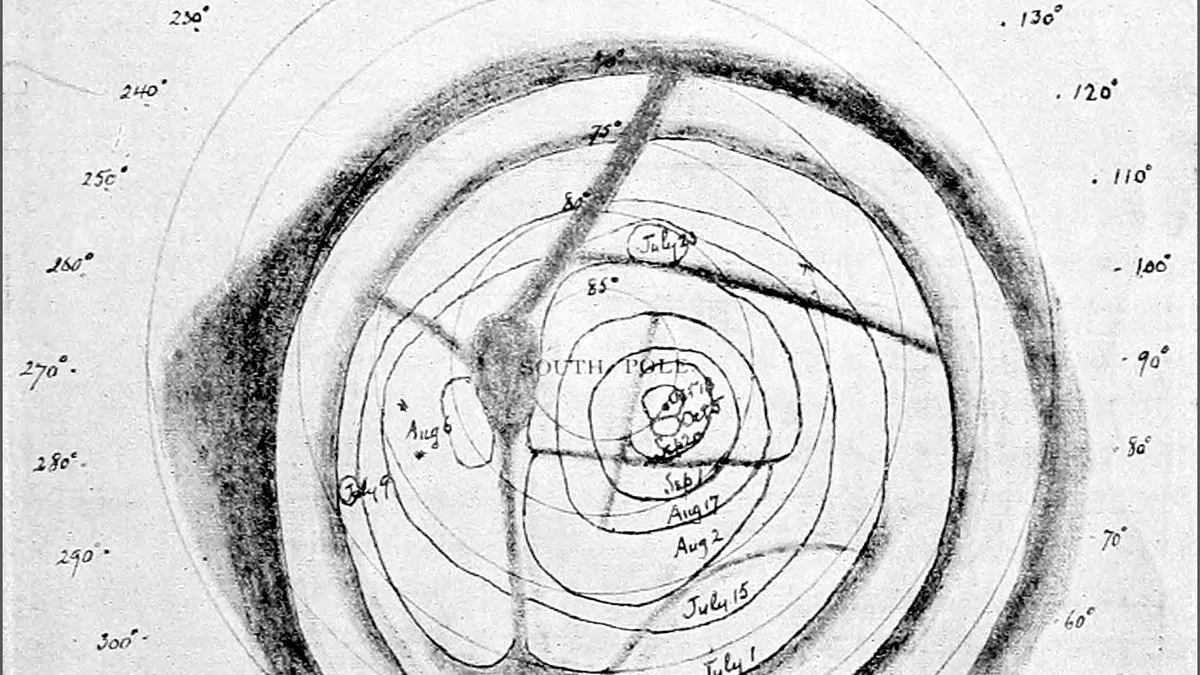
Researchers examined six spots in the northern polar region: two on the residual polar cap, along with Korolev and Louth craters, Chasma Boreale and the Phoenix landing site. At Korolev crater, past Mars Express work suggested dust levels of 15 to 22% by mass, but the newer analysis puts the top layer at roughly 0.2 to 0.4%. Past estimates of dust at the Phoenix landing site varied by as much as a factor of 25. How bright Martian ice looks depends on grain size, dust content and layering all together, and matching the same spectra can point to very different mixes of those factors.
The ice built up from snowfall thousands of years ago, leaving behind a record of ancient Martian climate, researchers believe. On Earth, researchers read ancient air through ice cores, but drilling into Martian ice would be much harder.
The planet has endured enormous ice ages that left shallow ice across about one-third of its surface. Those ice ages connect to big swings in the planet’s axial tilt. Earth’s tilt stays steady because of the moon’s gravity, but Mars has just two small moons and wobbles wildly, causing extreme climate shifts. Khuller said this wild wobble sets off the planet’s major ice ages.
A 2024 paper in Communications Earth by Khuller and colleagues argued that layers of dust and ice might trap sunlight, form meltwater pockets inside ice and possibly shelter bacteria and other simple organisms, since dust brings nutrients. They compared these possible sites to shallow meltwater pools in dusty Earth ice, where microbes thrive in summer and freeze in winter. Dusty ice on Earth contains shallow meltwater pools that often teem with microbes in summer, then freeze solid until warmth returns. Space.com said no life has been discovered on the Red Planet so far, and that Mars sits on the outer edge of the solar system‘s habitable zone, so it retains less sunlight and warmth.
Khuller said, “In the Martian summer it goes away, exposing cleaner, older ice.” He wants to expand the work by using the improved methods on ice deposits in other parts of Mars. He said studying Mars’ climate history could help explain why Earth supports life while Mars does not appear to.
The paper “Revised dust content and grain size of exposed water ice at the North Pole of Mars,” written by Pari Mohan and Aditya R. Khuller, came out in npj Space Exploration in 2026, volume 2, issue 1. Space.com and EurekAlert! reported that Khuller and Mohan’s research appeared in npj Space Exploration on September 8. University of Washington materials describe Mohan as a recent UW graduate, while Sci.News identifies her as Dr. Pari Mohan of the University of Edinburgh.



Join the discussion