Key facts
- Space.com reports that on the pre-dawn of Monday, Nov. 30, 2026, Jupiter and a waning gibbous moon appear close together in a naked-eye pairing visible before sunrise.
- Space.com and El Cronista say no telescope or binoculars are required to see the grouping, though binoculars may make it easier.
- Jupiter shines less than 2 degrees to the left of the moon during the overnight hours, per Space.com.
- Jupiter, Mars, Regulus and the Moon cover roughly 7 degrees of sky during the Nov. 30 encounter, according to Space.com.
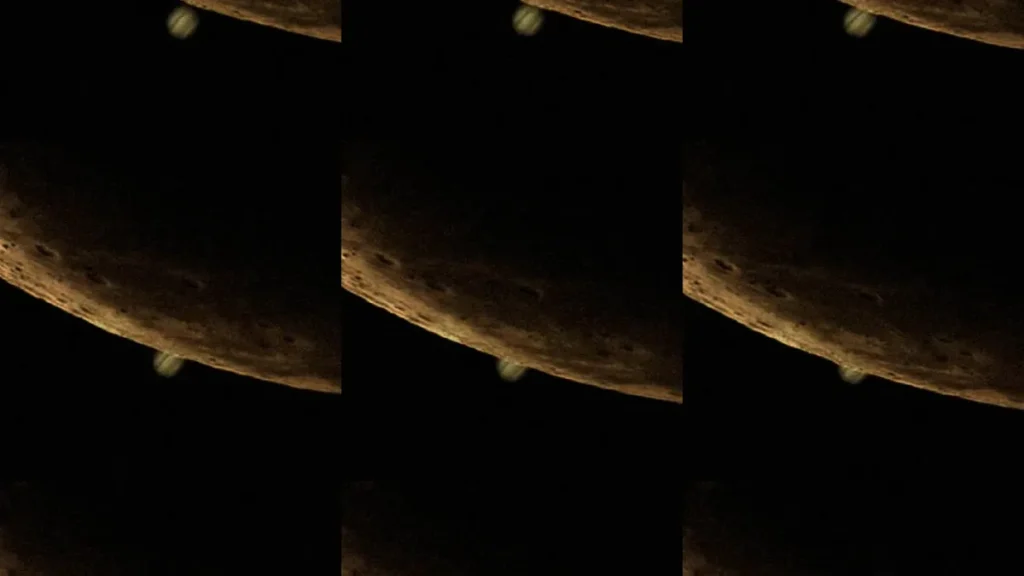
Space.com says Jupiter and a waning gibbous moon appear close together before sunrise on Monday, Nov. 30, 2026, in a naked-eye pairing visible during predawn hours when skies are clear.
El Cronista describes the same Nov. 30 date as a rare show visible from Spain before sunrise, while Space.com frames the pairing as two objects that immediately catch the eye if skies are clear during the predawn hours. Space.com and El Cronista say no telescope or binoculars are required to see the grouping, though binoculars may make it easier. Space.com adds that Jupiter’s Galilean moons can be glimpsed through 7-power binoculars held steady or better yet a small telescope.
A waning gibbous moon shows more than half of its disk illuminated, with the lit portion shrinking each night. Space.com says the moon is 62 percent illuminated and comes up over the east-northeast skyline around 10:15 p.m. local standard time on Nov. 29. This moonrise happens late on Sunday night, Nov. 29, just before the predawn hours of Monday, Nov. 30 when Jupiter appears nearby.
Jupiter shines less than 2 degrees to the left of the moon during the overnight hours, and the moon and Jupiter remain around that close for much of the night. A dime held at arm’s length spans about 1 1/2 degrees, offering a familiar measure of the tight spacing between the two bright objects. Angular distance measures how far apart two objects appear in the sky as seen from Earth, using degrees to describe apparent separation.
By 11 p.m. local standard time, Jupiter appears over the east-northeast skyline and climbs to 30 degrees altitude just after 1 a.m., per Space.com. Altitude describes how high an object stands above the horizon, measured in degrees. The outlet identifies 30 degrees as the dividing line between low and well-placed objects, and says sharp telescopic views are seldom possible below that altitude because of atmospheric turbulence.
El Cronista gives the best viewing times in Spain at 7:14 a.m. in Madrid, 6:52 a.m. in Barcelona and 7:17 a.m. in Seville on Nov. 30. These are local clock times in each city when the grouping is best placed for viewing before sunrise. In Madrid, Barcelona and Seville the Moon sits closest to the horizon at an altitude between 59 and 64 degrees.
The outlet says the Moon remains at a considerable altitude in all three cities despite being the lowest of the four objects. Jupiter, Mars, Regulus and the Moon cover roughly 7 degrees of sky during the Nov. 30 encounter, according to Space.com. Degrees of sky measure angular separation, showing how wide an area the group occupies in the dome above.
El Cronista lists Mars as reddish with an approximate magnitude of 0.5 and Regulus as white-blue, the brightest star in Leo. Space.com describes Mars as orange-yellow and Regulus as bluish-tinged, adding that all four bodies appear in the same pre-dawn scene. Magnitude is a brightness scale in which lower numbers indicate brighter objects.
Space.com reports that Jupiter has an apparent magnitude of -2.2, glowing more than double the brightness of Sirius. Apparent magnitude compares how bright an object appears from Earth rather than its true light output. The solar system’s biggest planet at 88,800 miles in diameter appears as a brilliant silvery white, non-twinkling point to the eye.
The Moon is roughly 230,500 miles or 370,700 km from Earth, whereas Jupiter sits 469 million miles or 755 million km distant, about 2,035 times farther out, Space.com notes. The close pairing is an illusion of perspective given the vast difference in distance between the two bodies.
El Cronista states that the brightness-and-proximity conditions for this four-object grouping have occurred only seven times between 1900 and 2099. The outlet attributes this rarity figure to astronomical calculations and a Star Walk analysis based on NASA’s Jet Propulsion Laboratory DE440s ephemerides. Ephemerides are tables that give the calculated positions of celestial objects over time.
El Cronista reports that the previous comparable meeting of these four bodies occurred April 24, 1980, within a span of 2.8 degrees, drawn from the Star Walk analysis based on NASA JPL DE440s ephemerides. That earlier encounter was tighter than the Nov. 30 grouping, which covers roughly 7 degrees. El Cronista says the four bodies are not physically aligned in space but appear grouped in the sky from Earth’s viewpoint. The time and position of the grouping vary depending on the observing city, so observers in different locations see slightly different arrangements.
Space.com reports that Jupiter’s four Galilean moons – Io, Europa, Ganymede and Callisto – are visible through 7-power binoculars held steady or a small telescope. The Galilean moons are the four largest satellites of Jupiter. Galileo first observed these moons through a telescope in 1610, and they change position relative to Jupiter hour to hour and night to night.
On early Monday, Nov. 30, all four Galilean moons will be in view, positioned on both sides of Jupiter. Ganymede and Europa appear very close on one side, while Io is closest to Jupiter and Callisto farthest, more than five times farther out than Io.
Space.com describes Jupiter’s Great Red Spot as roughly 10,000 miles or 16,000 km long and pale, with colors anywhere between pale beige and salmon pink shades. Space.com also describes Jupiter’s light and dark cloud belts as bands parallel to the equator that slowly change.
Jupiter arrives at opposition on Feb. 10, 2027 and can be seen throughout the night from dusk until dawn, Space.com says. Space.com presents this future opposition as a separate observing opportunity after the Nov. 30 pre-dawn pairing.
Space.com identifies Joe Rao as a sky-watching columnist and an educator at New York’s Hayden Planetarium. Space.com also describes Rao as a veteran meteorologist and eclipse chaser, an 8-time Emmy nominee, and a former Putnam Valley, New York forecaster of over 21 years.
News 12 Brooklyn reported on Oct. 30, 2026 that in early November 2026 the moon shares the early morning sky with Jupiter and Mars, with all three visible together Sunday through Tuesday before pulling farther apart. Published well before this story’s newest source from Nov. 29, its Sunday means as of that day, not today.
News 12 Brooklyn says Jupiter, Mars and the moon rise late at night and cross the sky together, with observers advised to look east-southeast and higher up. News 12 Brooklyn advises finding the moon first and using it as a guide, noting Jupiter shines brightly and Mars has an orange glow.
The moon appears highest Sunday morning, cozies up to Mars on Monday, and sits lower below Jupiter on Tuesday as it rises later each night, News 12 Brooklyn reports.

Join the discussion