Key facts
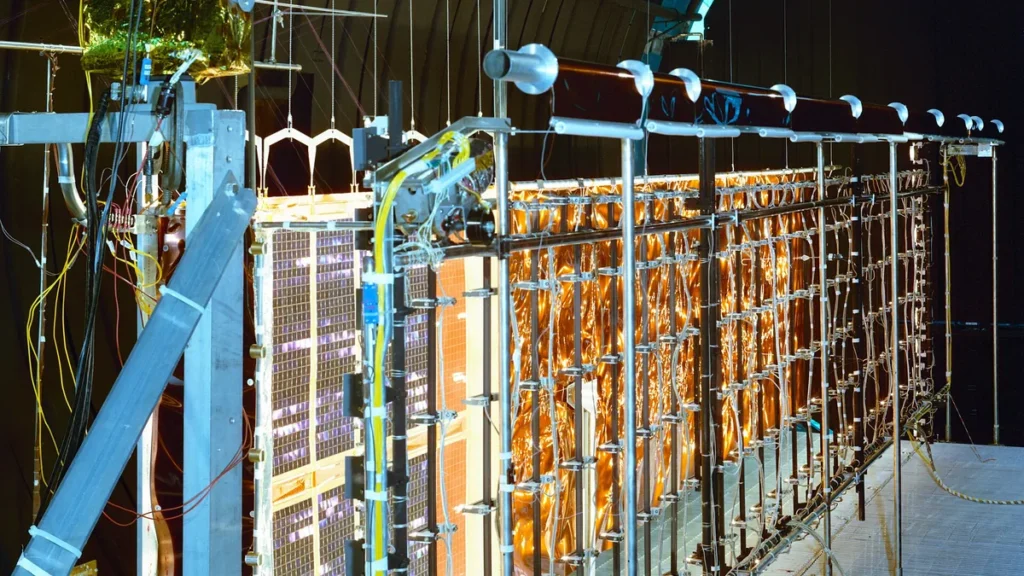
- The planned spacecraft use solar power and carry Google's custom Tensor Processing Units, or TPUs, for machine learning tasks while operating in low Earth orbit.
- Google's disclosed plan includes a 2027 milestone involving two interconnected satellites after prototype thermal-stress and radiation testing are completed.
- The New Glenn vehicle is built with a reusable first stage rated for at least 25 flights and a seven-meter fairing that holds twice the volume of smaller five-meter-class versions.
- Future concepts for the system envision dozens of TPUs aboard each spacecraft and laser links for high-bandwidth exchanges across short ranges between vehicles flying in orbital clusters.
A launch services agreement between Google and Blue Origin was made public Nov. 19, 2026, setting Project Suncatcher’s first dedicated heavy-lift flight on New Glenn for the first quarter of 2029.
Google’s spacecraft will draw solar power and fly custom Tensor Processing Units, or TPUs, to handle machine-learning work in low Earth orbit under a sun-synchronous orbit profile.
Light Reading says the MVP satellite was planned for a March 1 Transporter-18 rideshare on a SpaceX Falcon 9 rocket, and Google’s prior vibration tests showed its TPUs can withstand forces reaching 100gs while Planet created custom packaging to protect the payload during launch. A September 2026 prototype preview preceded the October 1 launch, and commissioning by Oct. 30, 2026 included activating the host and TPU trays and running machine-learning tests with Gemma 4 to create a haiku in orbit, which Google called a first for such a TPU in space.
Google plans to fly two interconnected satellites in 2027 once prototype thermal-stress and radiation testing finish, and Travis Beals wrote that the pair would validate the cooling approach.
Airflow does not work in a vacuum, so engineers have tested heat pipes and radiators in a thermal vacuum chamber to manage heat from hot AI chips, making thermal management a central obstacle. Travis Beals, senior director and Project Suncatcher lead, said the chips can run in orbit for about 15 minutes before requiring a cooldown, and Google plans to test orbital connectivity while cooling the chips with radiation heat transfer.
“generates five to eight times more power than that same panel down on Earth,” Beals said, describing the output of solar panels in orbit. According to Google, satellites in low Earth orbit get nearly constant sunlight and can generate as much as eight times more solar energy than identical panels on the ground, aided by a dawn-dusk orbit facing the Sun almost continuously. The effort responds to growing pressure on terrestrial data centers from rising AI demand, and orbital solar power could support nonstop operation for workloads that run around the clock.
Another hurdle involves keeping spacecraft connected, since orbital computing networks require fast, reliable data exchange through laser links across short distances between moving vehicles that must track each other’s positions. Google pictures each spacecraft providing roughly the computing power of one data center rack, while future concepts call for dozens of TPUs on each vehicle and laser links for high-bandwidth exchanges across short ranges between vehicles in orbital clusters.
The rocket has a reusable first stage certified for no fewer than 25 flights and a seven-meter fairing with double the volume of smaller five-meter-class versions, and it can lift 45 metric tons to low Earth orbit or more than 13 metric tons to geostationary transfer orbit. Jordan Charles, senior vice president of New Glenn at Blue Origin, said the vehicle’s lifting power and cabin space let customers take new capabilities to orbit, and Blue Origin sees that capacity supporting multiple Suncatcher satellites. “heavy-lift capacity and large payload volume give customers the flexibility to bring new capabilities to orbit,” Charles said.
Spaceflight Now reported that a May 28 test at Cape Canaveral ended in a New Glenn explosion traced to the main oxygen valve on one of seven BE-4 engines, damaging Launch Complex 36. The Motley Fool reported that the explosion destroyed the vehicle and damaged the heavy-lift program’s only operational launchpad, and that early evidence pointed to the engine section.
The Vulcan first stage flies with two methane-fueled BE-4 engines like those on New Glenn, and ULA attributed its Nov. 15, 2026 failure to inadequate fuel supply rather than engine performance. Mark Peller, ULA president and CEO, said, “we had a significant shortfall in booster first stage performance.”
Spaceflight Now reported that the company is targeting a January return to flight for New Glenn under an FCC filing covering Jan. 15 through Apr. 15. The Motley Fool said CEO Dave Limp expects the rocket to fly again before the end of 2026, and that Blue Origin still must show repeated safe launches to prove reliability.
The Motley Fool reported that after an April upper-stage issue placed AST SpaceMobile’s BlueBird-7 satellite in the wrong orbit, the U.S. Federal Aviation Administration demanded proof of nine corrective steps before the next New Glenn launch.
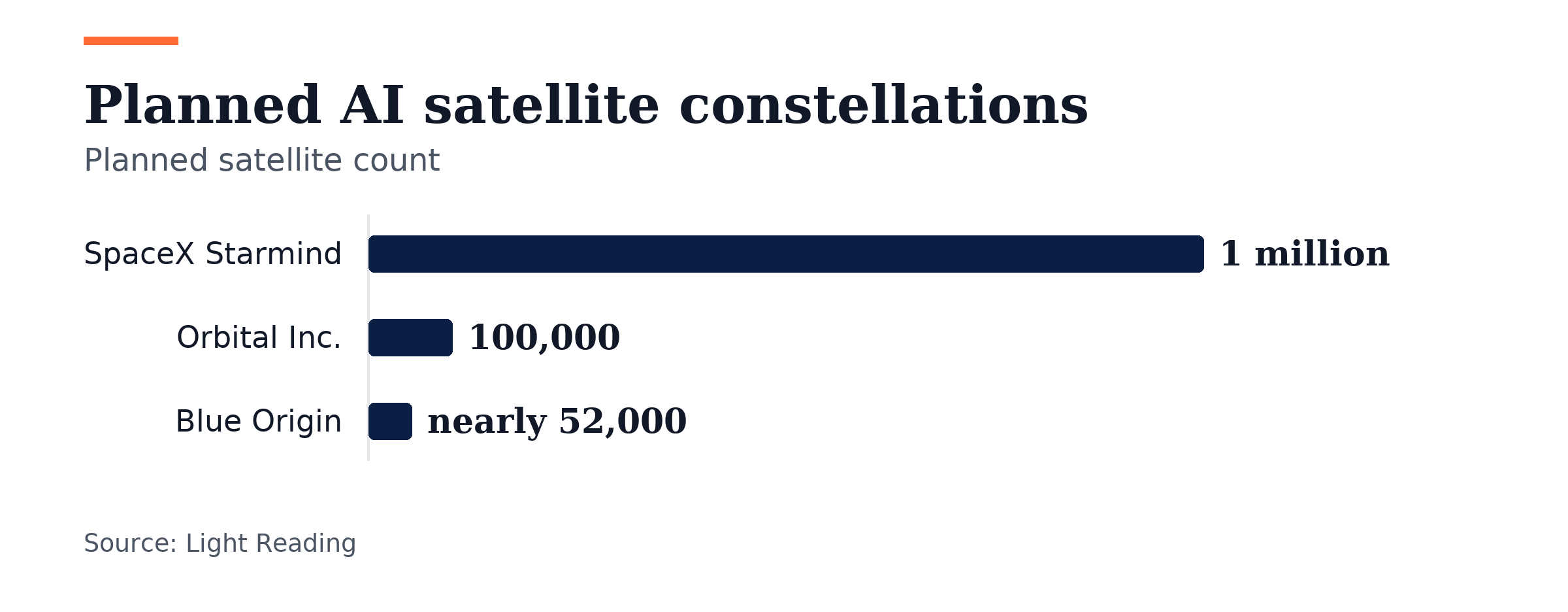
New Glenn’s early manifest already includes 12 Project Kuiper satellite launches for Amazon, with options for 15 additional missions, and NASA has hired Blue Origin to construct a second Artemis lunar lander. Rivals include SpaceX’s Starmind program, which plans to send as many as 1 million AI data satellites into orbit starting deployments in the fourth quarter of 2027 and expanding in 2028. Blue Origin’s planned orbital data center platform of nearly 52,000 satellites rounds out the field alongside Orbital Inc.’s FCC filing, which seeks as many as 100,000 AI data center satellites with a goal of 10 gigawatts of orbital computing power.
The company has not scheduled a fully operational constellation beyond 2029 and still calls Project Suncatcher a research effort. Getting from the four-TPU prototype to a working commercial constellation means overcoming thermal limits, building dependable inter-satellite links, and proving cost-effectiveness against ever-improving ground infrastructure, and future tests will show whether Suncatcher can advance from standalone orbital machines to a connected machine-learning system.


Join the discussion