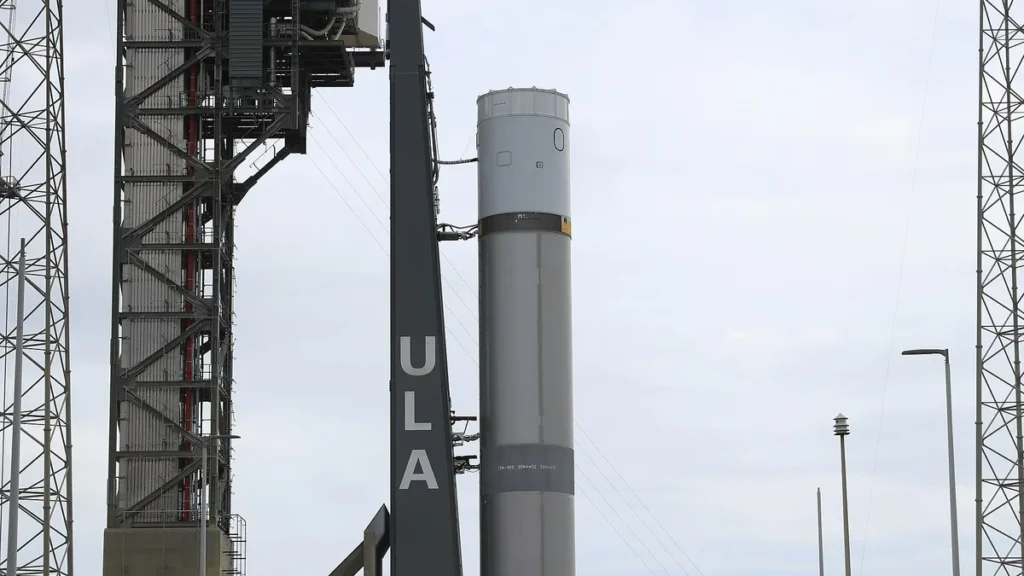
This is a new development in a story we reported earlier: Vulcan rocket suffers total failure, destroying 40 Amazon Leo satellites. Earlier in this story: Amazon Leo to launch 40 satellites on ULA Vulcan rocket.
Key facts
- ULA completed the boost phase, separated the Centaur V upper stage, ignited its RL10 engines, and separated the fairing, but the booster left Centaur in a low-energy altitude and velocity state it could not overcome.
- The BE-4 engine also powers New Glenn's first stage for NASA's Artemis program; New Glenn is recovering from a May explosion caused by an oxygen valve problem.
- New Glenn and Vulcan are both out of commission as the U.S. faces an impending launch crunch, with SpaceX planning to retire Falcon 9 and Falcon Heavy and shift to Starship.
- Peller said ULA is committed to working through the mishap investigation as quickly as it can.
ULA President and CEO Mark Peller said Nov. 17 that an early investigation traces the Nov. 15, 2026 Vulcan Centaur launch failure from Cape Canaveral, Florida, to a significant booster first-stage performance shortfall, days after the Sunday mishap.
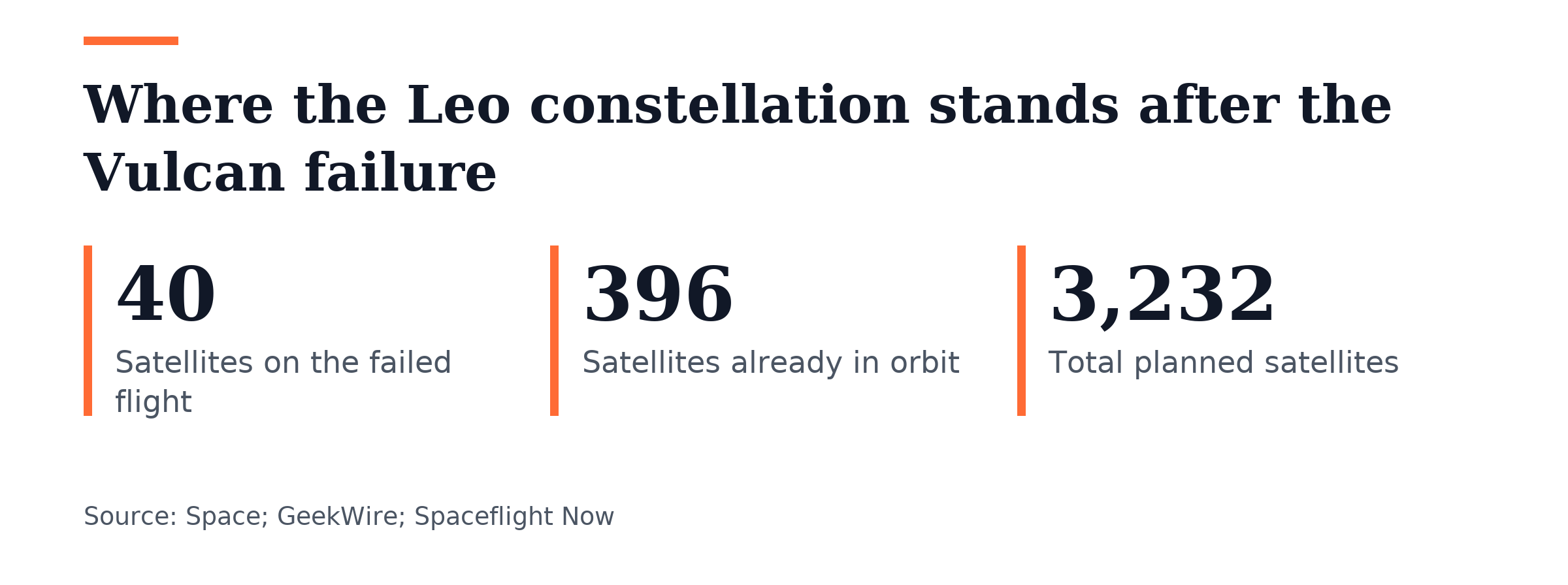
The shortfall kept the 214-foot-tall rocket from reaching orbit and deploying its payload of 40 satellites for Amazon’s broadband internet constellation, the first of 38 Vulcan flights Amazon has purchased for its Leo network. Liftoff from pad 41 at Cape Canaveral Space Force Station came at 12:40 p.m. Eastern Time with 3.8 million pounds of thrust from six Northrop Grumman solid-fuel boosters and two BE-4 engines.
ULA said it appears to have lost telemetry and the mission about 10 minutes into flight. ULA said the booster problem started just after liftoff, moving the failure timeline away from the roughly 10-minute mark during the Centaur burn where it first appeared. Peller described the flight sequence at a Washington Times event on Nov. 17: the booster completed the boost phase, separated the Centaur V upper stage, ignited its RL10 engines, and separated the fairing, but the booster left Centaur in a low-energy altitude and velocity state it could not overcome.
The two methane-burning BE-4 engines appeared to fire longer than expected based on ULA’s pre-launch timeline, and after stage separation the Centaur upper stage was to perform a planned 12-minute 15-second burn, but something went wrong during that firing. The strap-on boosters burned out and fell away about a minute and 40 seconds after liftoff, while the first stage appeared to burn longer than planned and separate later than expected. Launch controllers called a hold at T-minus 20 seconds on Nov. 15, 2026 after an unexplained technical issue with the rocket, and it is not yet known whether that problem contributed to the later failure. ULA’s launch commentators did not mention any problems, and the broadcast ended without confirming whether the Centaur’s first planned engine firing went for the full duration.
Sunday’s launch was the first flight of a Vulcan since February 2026, when the rocket experienced an issue with the nozzles of its strap-on solid rocket boosters. Vulcan debuted in January 2024 and has flown five times total, experiencing problems on three of those missions. On its second and fourth flights in October 2024 and February 2026, one strap-on solid rocket booster nozzle fell off about 30 seconds after liftoff, and the rocket overcame the problem both times and reached orbit.
The six strap-on solid rocket boosters performed normally Sunday following nozzle improvements made for the flight, and Peller said initial data indicated all six SRBs worked well after ULA implemented several improvements to the nozzle design. After the second SRB nozzle occurrence, the U.S. Space Force paused national-security launches with Vulcan until ULA addressed the issue; ULA made design and process improvements to the nozzle in an Oct. 28, 2026 update.
This was the first outright failure of a ULA rocket since Boeing and Lockheed Martin formed the company in 2006. Peller told Aviation Week & Space Technology that ULA identified three credible causes of the nozzle issue and has taken positive steps to mitigate them. He said, “We’ve identified three credible causes (of the nozzle issue), and we have taken positive steps to mitigate all of those.”
Peller said the significant booster first-stage performance shortfall prevented Vulcan from reaching orbit and successfully deploying its payload of 40 satellites for Amazon’s broadband internet constellation. He said, “we had a significant shortfall in booster first stage performance.” ULA’s current focus is determining what caused the booster performance deficit, and Peller said ULA commits to working through the mishap investigation as quickly as it can.
The FAA said it will oversee the ULA-led mishap investigation, take part in every step, and approve ULA’s final report including any corrective actions. Aerospace experts say investigations can take several weeks to several months, and testing and verifying corrective actions can take considerably longer. Marshall H. Kaplan said telemetry and launch video should help investigators determine which systems worked, and it will take probably several weeks before an answer is available. He said, “It will take probably several weeks before you’ll have an answer.”
Joseph F. Gonzalez said engineers need to understand why a failure happened, determine whether the same issue exists elsewhere, and demonstrate corrective actions address the problem. ULA said it wants to focus on the data and avoid speculation until the investigation is complete.
Two BE-4 engines built by Blue Origin power the first-stage booster, and ULA has not identified the exact booster problem or whether the engines played a role. Blue Origin CEO Dave Limp said on X that ULA should provide the mission updates and that Blue Origin is supporting with data and analysis from the BE-4s. He said, “It is ULA’s mission so they should provide the updates.”
The BE-4 engine also powers New Glenn‘s first stage for NASA’s Artemis program, and New Glenn is recovering from a May explosion caused by an oxygen valve problem. No established link exists between the May New Glenn explosion and Sunday’s Vulcan failure, and ULA has not identified the cause of the booster’s reported performance loss. Amazon also has 24 launches reserved on New Glenn, which uses seven BE-4s on its first stage.
New Glenn and Vulcan are both out of commission as the U.S. faces an impending launch crunch, with SpaceX planning to retire Falcon 9 and Falcon Heavy and shift to Starship. Atlas V will retire after just six more flights, and Vulcan Centaur is its successor.
Amazon has booked about 100 launches on a variety of rockets for a constellation of more than 3,200 satellites, and 38 of those bookings are for Vulcan. About 400 operational Amazon Leo satellites have reached orbit across 14 launches, not including Sunday’s failure, and before Sunday Amazon had launched 396 Leo satellites on 14 successful missions since April 2025, most recently on an Atlas 5 in July. ULA already has launched eight LEO flights using Atlas 5 rockets.
ULA’s failure investigation means Amazon Leo must wait before trying again with Vulcan, and Amazon is also waiting for Blue Origin to return New Glenn to flight after the May explosion. The next scheduled Amazon Leo launch is an Ariane 6 mission carrying 36 satellites, targeted for no earlier than Nov. 23, 2026 from French Guiana.
After the FCC let Amazon keep deploying despite missing a July 30 deadline for 1,616 satellites, the company has until July 30, 2029, to deploy all 3,232 first-generation Leo satellites. More than 3,300 Leo satellites will be needed to complete the constellation, and Sunday’s flight would have pushed the total launched to date to 436. Amazon plans to begin commercial internet service through Leo, the constellation once called Project Kuiper, in 2026.
NASA plans to integrate the Centaur V upper stage into its Space Launch System moon rocket for Artemis, making the Centaur’s nominal performance on Sunday good news for the agency. NASA Administrator Jared Isaacman said on X that NASA is available to assist with the investigation and corrective efforts.
ULA said it recognizes the effect on its customers and remains committed to flying again as safely and as quickly as possible. ULA said it commits to full transparency with customers, who will have visibility into the investigation process.





Join the discussion