Key facts
- Tea Temim, the study's lead author and a research scientist at Columbia University in New York, said material within stellar shells churns and circulates, causing shells to merge shortly before a supernova explosion.
- Temim said oxygen- and carbon-burning shells can merge and significantly change a star's structure, altering the chemical abundances seen in a supernova remnant's ejecta after the explosion.
- In one of those two reverse-shocked targets, Webb found ejecta made up mainly of silica dust, whereas the other consisted primarily of carbon dust.
- Webb, Chandra, and XRISM observations together indicate that the shell merger was already underway shortly before the supernova exploded.
NASA’s James Webb Space Telescope captured a high-resolution mid-infrared view of the supernova remnant Cassiopeia A, showing gas and dust left by a massive star’s explosion that will eventually seed new stars and planets.
Webb is an international program led by NASA. Its partners are ESA, the European Space Agency, and CSA, the Canadian Space Agency.
The observation gives astronomers new details to chronicle the structure and evolution of Cassiopeia A’s original star. The results appeared Monday in The Astrophysical Journal Letters. NASA describes Cassiopeia A as a legendary remnant made of clouds of gas and dust remaining after a massive star exploded. Webb’s image presents a detailed view of the remnant and reveals new details about its structure.
Such remnants eventually supply material for future generations of stars and planets. Stars begin when gravity collapses molecular clouds consisting mostly of hydrogen gas mixed with cosmic dust, heating the material into protostars where hydrogen fuses into helium and the objects become full-fledged stars. When a star exhausts its core hydrogen, the core contracts and heats up until helium begins to fuse. As core fuel depletes, contraction and heating trigger new fusion reactions in the core.
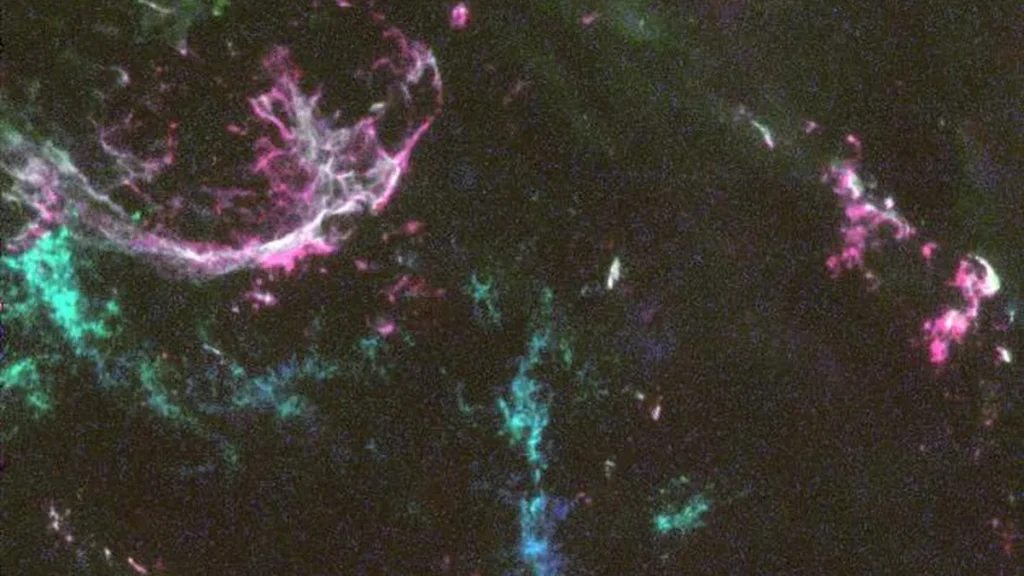
In the core, fusion works through heavier elements until iron forms, while lighter elements keep fusing in the surrounding layers, and these stacked shells record the star’s evolutionary history. Webb mapped the chemistry of individual dust clumps, each about the size of a solar system, inside Cassiopeia A. That mapping turned up evidence of a shell merger, in which layers inside the star mixed together before the explosion, and it reveals what the star’s structure looked like before the blast.
Webb’s dust map reveals shell merger signatures are present throughout much of the Cassiopeia A supernova remnant. The broad presence of these signatures indicates the merger was widespread in the star’s structure before it died. Tea Temim, the study’s lead author and a research scientist at Columbia University in New York, said material within stellar shells churns and circulates, causing shells to merge shortly before a supernova explosion.
She explained that oxygen- and carbon-burning shells can merge and significantly change a star’s structure. That merging alters the chemical abundances seen in the remnant’s ejecta after the explosion.
Webb data supports a scenario in which the interior of Cassiopeia A’s original star changed dramatically, possibly just hours before its demise.
Researchers turned to data from NASA’s retired Spitzer Space Telescope to choose three regions for Webb to study, since Spitzer could not pick out the region’s fine details. Spitzer data told researchers where to point Webb. Spitzer missed those minute details in its own observation, yet it still flagged three targets for Webb’s closer look. Two of those three targets sit inside Cassiopeia A’s reverse-shocked region, where an inward-moving shock wave strikes debris the supernova threw outward.
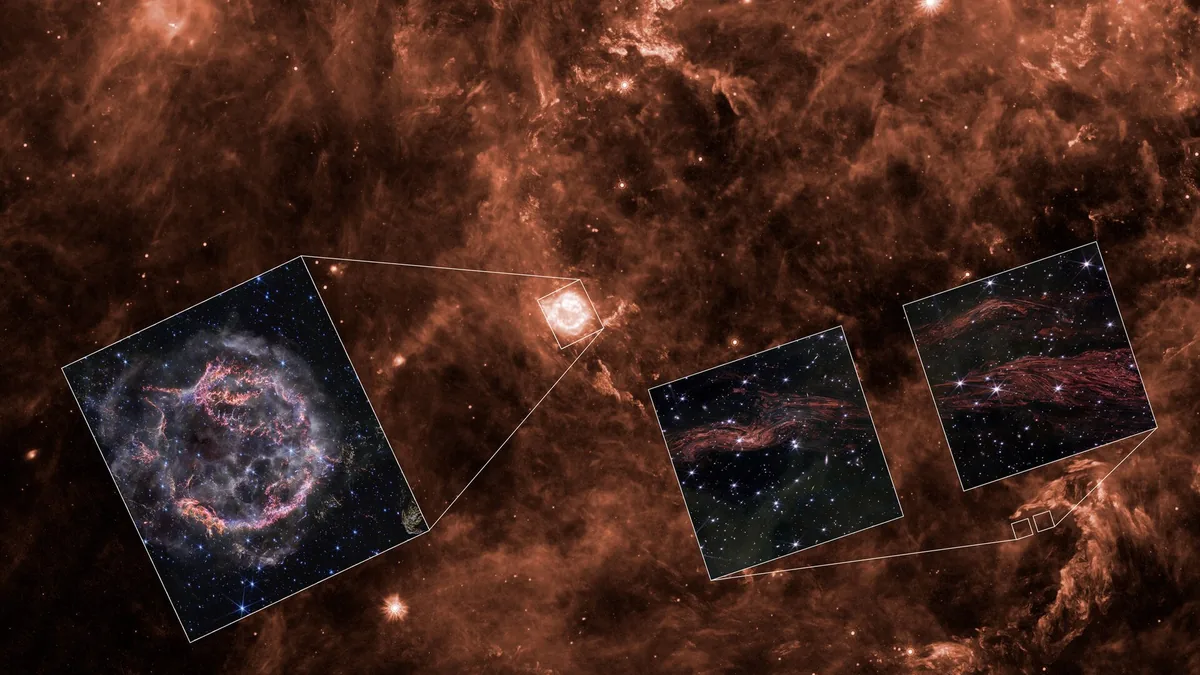
Of those two reverse-shocked targets, Webb found ejecta consisting mainly of silica dust in one, while the other was dominated by carbon dust. The third target was the Green Monster, a structure Webb discovered first that carries complex magnesium silicates. The Green Monster stands apart from those regions because it formed from matter the star cast off before it exploded, rather than from the supernova’s ejecta.
Webb’s dust map also rests on X-ray data from NASA’s Chandra X-ray Observatory together with JAXA-led XRISM, extending the composition map across the whole Cassiopeia A remnant. Those combined observations added insight into the shell merger phenomenon.
Observations from Webb, Chandra, and XRISM together indicate that the shell merger was already underway shortly before the supernova exploded. This places the merger timing near the end of the star’s life.
Dan Milisavljevic, associate professor and co-author at Purdue University in West Lafayette, Indiana, said Webb’s improved ability to resolve individual clumps enables more sophisticated dust chemistry. This advance lets researchers tie the explosion to the progenitor star’s makeup hundreds of years afterward.
The data reveals what likely occurred in the hours leading up to core collapse, Milisavljevic said. He said understanding this process is key to explaining which elements a supernova releases into the galaxy and how those elements enrich future stars and planets.
This gives astronomers a new way to infer a star’s original structure by analyzing dust from a supernova remnant. When a star goes supernova, its elements scatter into space where some condense into dust grains that can clump together. Webb used this dust to study the remnant’s composition.
The James Webb Space Telescope serves thousands of astronomers worldwide and stands as the biggest and most powerful observatory ever launched into space. It studies the solar system, distant worlds, and cosmic origins.


Join the discussion