Key facts
- Research published in The Astrophysical Journal Letters identifies TOI-2535b as the first confirmed planet circling a single star with transits seen to vanish outright.
- An unseen neighboring planet gravitationally tugs TOI-2535b, tilting its orbit so the world no longer crosses the line between its star and Earth and cannot be seen in transits.
- TOI-2535, the host star, is a K dwarf about 9.7 billion years old, somewhat smaller than the Sun, and roughly 1,100 light-years from Earth.
- Researchers first found TOI-2535b in 2019 using NASA's TESS and tracked its transits between April 2019 and March 2026 with numerous space and ground telescopes.
Astronomers led by Samuel Yee of UCLA announced on Nov. 9, 2026, that TOI-2535b, a Jupiter-sized gas giant orbiting a star about 1,100 light-years from Earth, is the first confirmed planet circling a single star with transits seen to vanish outright. The research appeared in The Astrophysical Journal Letters in March 2026, and Yee is the paper’s corresponding author.
The team first detected TOI-2535b in 2019 using NASA’s TESS, and tracked its transits between April 2019 and March 2026 with space and ground telescopes. Over seven years the transits became unpredictable, shifting by as much as six hours either way, and they grew shorter and fainter until they stopped appearing altogether in 2026. The transit path moved from across the star’s midline to ever higher on its face, eventually grazing the stellar disk before vanishing by March 2026.
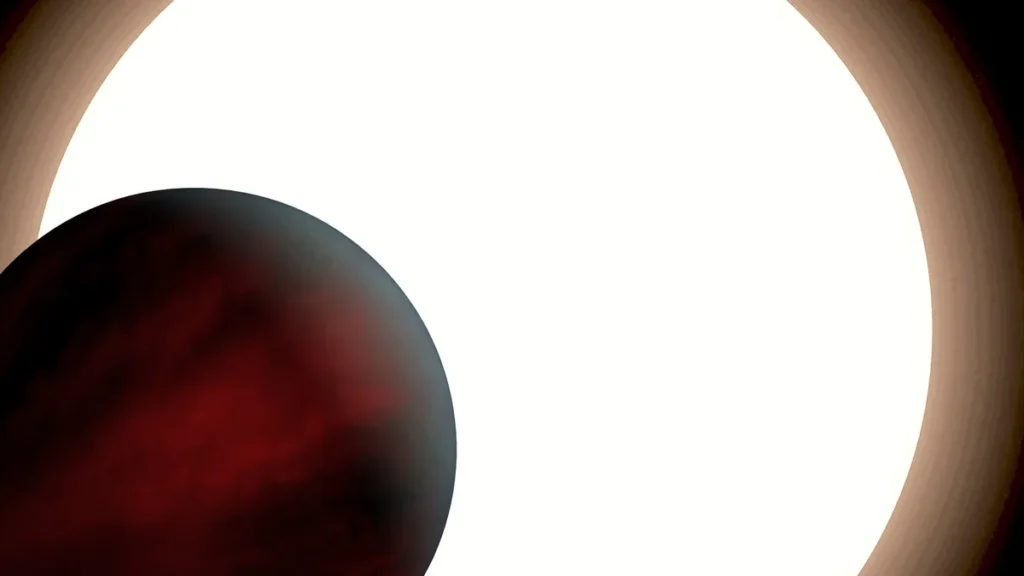
TOI-2535b, a Jupiter-sized gas giant and hot Jupiter—a gas giant orbiting close to its star—completes an orbit in just over eight days, or 8.25 days, moving 10 times faster than Mercury on its 88-day orbit, and the world is hot, according to transit size and precise observations from the WIYN 3.5-meter telescope; it may have roughly the mass of our own Jupiter. Its host, TOI-2535, is a K dwarf about 9.7 billion years old, somewhat smaller than the Sun, and roughly 1,100 light-years from Earth; other coverage rounds that distance to about 1,000 light-years.
The transit technique detects a planet when it passes in front of its star and blocks a bit of starlight, creating a brightness dip; the method accounts for roughly 4,800 of nearly 6,500 confirmed exoplanets. As of mid-October 2026, NASA’s TESS had identified more than 8,100 candidate exoplanets, with just over 1,000 confirmed, and the mission is still ongoing.
TESS was primarily aimed at finding smaller super-Earths and sub-Neptunes, classes of planets between Earth and Neptune in size, but it has also found many hot Jupiters. TESS observes the sky in rectangular sectors, and the research figure shows transits from sectors 10, 63, and 90 together with the movement of the transit chord across the stellar disk.
An unseen neighboring planet gravitationally tugs TOI-2535b, tilting its orbit so the world no longer crosses the line between its star and Earth and astronomers cannot detect its transits. Researchers describe the neighbor’s pull as making the orbit wobble like a spinning top; as the tilt grows, the transit geometry disappears. The effect is like the Moon’s tilted orbit, which makes solar eclipses rare instead of monthly, and the Moon’s orbit is a relic of its violent formation history, the result of a collision with the early Earth; if the Moon’s orbit around Earth were perfectly aligned with Earth’s orbit around the Sun, eclipses would occur every month. “If there are multiple planets in a system, they can affect each other’s orbits,” Yee said.
Models show the hidden perturber probably has at least Saturn’s mass and locks into a mean-motion resonance with TOI-2535b, an arrangement in which the two planets’ orbital periods stay in a steady ratio, yielding two short-period giant planets in one system. Mutual inclinations between the pair reach at least five degrees, exceeding most multi-planet systems, while each wobble cycle may last 30 to 50 years. Astronomers have discovered hundreds of hot Jupiters, but they do not have massive neighbors close enough to affect their orbit, and hot Jupiters are not expected to have close neighbors; when they do have neighbors, those are much less massive. TOI-2535b counts among just a few with a nearby planetary companion, likely another short-period giant planet rather than a sub-Neptune or super-Earth.

“We know of a few systems that are like this,” Yee said.
Researchers modeled one million years of the setup spanning 50 million orbits of TOI-2535b and concluded that orbital resonance may keep the pair stable and shield them from destruction or ejection despite their tilted, wobbling orbits. The system shows the largest transit duration variations and inclination change ever observed for a planet around a single star, with a precession period of decades, and the largest transit timing variations detected for a hot Jupiter. Transit duration variations are small, measurable, periodic changes in transit time, and they rank among the most extreme examples of planet-planet interactions driving orbital evolution on timescales humans can observe. The precession period is shorter than in other known systems, and researchers can watch the interactions play out over only a few years, which is rare; around single stars, inclination variations of planets are typically less dramatic and rare.
Scientists propose two migration pathways: a violent route where a near-collision excites an elliptical orbit and the star pulls the planet in, or gradual inward movement with other planets inside the protoplanetary disk, the cloud of gas and dust from which planets form. Since TOI-2535b has a close neighbor, it probably migrated by slowly spiraling inward through the disk instead of hurtling inward, but researchers expect disk migration to leave a flat system without orbital tilts between planets, which conflicts with the observed wobble because the disk would quickly damp inclinations, requiring later excitation. Yee and colleagues dismiss high-eccentricity migration as the cause, saying a system like this could not have assembled that way even though researchers have proposed that path for most other hot Jupiters; the trigger for those inclinations remains unresolved, and researchers have long weighed whether hot Jupiters reached close orbits through violent encounters or gradual movement alongside other planets.
Researchers expect the planet to return to view in about 30 to 50 years while its orbit keeps shifting, and researchers could detect the unseen neighbor sooner. The planet will keep appearing and disappearing over the coming decades, and the companion may soon pop up, giving tighter constraints on both bodies. “There are a couple of cases where we have seen the transits appear,” Yee said, noting that planets come into and out of view from our perspective all the time.
Yee says the planets in our solar system essentially orbit in a single plane with mutual inclinations of about one degree, except Mercury. He contrasts this with the much larger mutual inclinations in the TOI-2535 system.
The international team was led by Samuel Yee, a 51 Pegasi b postdoctoral fellow at UCLA, and Erik Petigura, a UCLA astrophysicist who is the study‘s second author and paper co-author. They carried out the work using observations from the WIYN 3.5-meter telescope, which sits at Kitt Peak National Observatory in Arizona.




Join the discussion