Key facts
- The exoplanet TOI-2535 b, about 1,000 light-years away, appeared to vanish after seven years of observations by NASA's Transiting Exoplanet Survey Satellite from April 2019 to March 2026.
- In March 2026, TESS stopped detecting the brightness dips produced when TOI-2535 b passed in front of its star, so the world seemed to disappear.
- Researchers using TESS data found that an unseen neighboring planet gravitationally pulls on TOI-2535 b while the planet pulls back, making both orbits wobble.
- The orbital wobble changed TOI-2535 b's alignment with its star so that it no longer passes between the star and Earth's line of sight; the world was not destroyed or thrown out of the system.
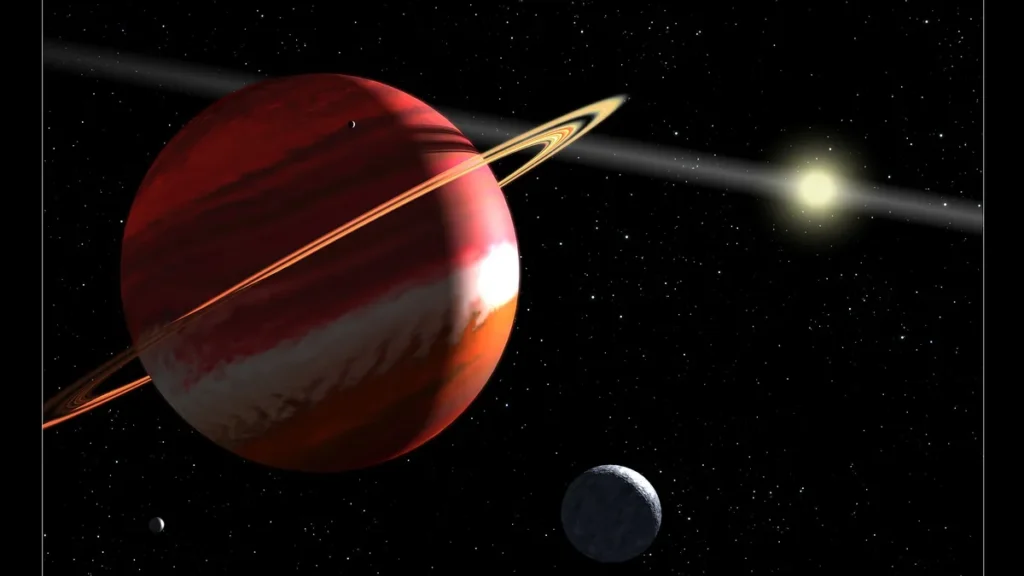
Astronomers using NASA’s Transiting Exoplanet Survey Satellite say TOI-2535 b, a hot Jupiter about 1,000 light-years away, did not physically disappear but tilted out of Earth’s line of sight after seven years of observations from April 2019 to March 2026.
TESS identifies exoplanets by observing small drops in stellar brightness when a planet crosses a star’s disk from Earth’s viewpoint, and a transit is that crossing, which produces a brief dip in the star’s light. A light-year is the distance light travels in one year, and an exoplanet is a planet orbiting a star outside our solar system. A brightness dip is a brief dimming of starlight. In March 2026, the satellite stopped detecting those brightness dips for TOI-2535 b, so the world seemed to vanish.
The end of those periodic dips prompted the disappearance reports, and the sources describe the event as an apparent disappearance after a lengthy observational campaign rather than a physical loss of the planet.
Astronomers had established an expected transit schedule from years of TESS measurements and noticed deviations from that schedule before the signal vanished entirely. A transit schedule is the expected series of times when a planet should cross its star. An observation window is the period during which astronomers collect data. Before the signal ended, TOI-2535 b arrived up to six hours early or six hours late for predicted transits, indicating its orbit was irregular.
The timing variations showed the planet was not keeping to a predictable schedule, and such deviations can signal that an unseen mass is tugging on the world.
Researchers using TESS data found that an unseen neighboring planet gravitationally pulls on TOI-2535 b while the planet pulls back, and the team analyzed the observations to infer the unseen companion. An orbital wobble is a repeating shift in a planet’s path caused by another body’s gravity. They described the mutual gravitational influence between the two worlds as an orbital wobble.
The orbital wobble changed TOI-2535 b’s alignment with its star so that it no longer passes between the star and Earth‘s line of sight, which is the straight path from Earth to the star. Because the tilted orbit no longer lines up with that line of sight, the planet remains in the system but stops producing observable transits. The world was not destroyed or thrown out of the system.
Researchers project that TOI-2535 b will not cross its star again for at least 30 years, while the hidden companion may pass across the stellar disk sooner and become detectable. The estimate covers a multi-decade wait for the next TOI-2535 b transit, and the sources suggest the unseen companion could be detected earlier if it crosses the star.
A planet can remain in its system while producing no transits, so a missing signal does not by itself prove the world is gone. The discovery shows how an unseen neighbor can alter a known planet’s orbit enough to end its transits. Astronomers use transit timing variations to detect planets they cannot see directly. The gravitational pull of one world can change another’s path without ejecting it from the system.
TOI-2535 b is a blisteringly hot gas giant classified as a hot Jupiter, and a gas giant is a large planet made mostly of hydrogen and helium. A hot Jupiter is a gas giant orbiting very close to its star. It orbits its parent star every 8.25 Earth days at a rate almost ten times faster than Mercury’s circuit around the sun. The short orbital period places the planet very close to its host star, which is why researchers classify it as a hot Jupiter.
The research findings appeared in The Astrophysical Journal Letters on Nov. 9, 2026. Samuel Yee of the University of California, Los Angeles, said in a formal statement released alongside the research that planetary systems do not operate like clockwork. He said multiple planets can alter one another’s orbits, contrasting the predictable image of orbital mechanics with complex effects seen in multi-planet systems.
He called the TOI-2535 b system the strongest case of planet-planet interaction his team has seen, and the interaction drives rapid orbital tilting that ended the transits during the observation window. Planet-planet interaction is the gravitational influence one world exerts on another’s orbit. “The planet’s orbit is tilting so quickly that its transit disappeared while we were watching,” Yee said.
Hot Jupiters probably need abundant ice to form, so they cannot begin close to a scorching star and must form farther out in colder regions before migrating inward, because formation models call for large amounts of ice to build gas giants and that material is unlikely to exist near a hot star. Migration is the movement of a planet from where it formed to a different orbit. This need motivates inward migration scenarios.
One migration path involves a violent near-collision that throws a planet into an extreme oval orbit, after which stellar gravity slowly draws it inward, and the route describes a massive object passing near the planet and perturbing it into a highly elliptical path before the star’s gravity gradually shrinks the orbit. An oval orbit is a highly elliptical path rather than a circle. This violent route contrasts with gentler alternatives.
The other path involves a planet spiraling inward slowly while embedded in a flattened protoplanetary disk of gas and dust around a newborn star, and a protoplanetary disk is a rotating disk of gas and dust surrounding a young star. A newborn star is a young stellar object still surrounded by leftover material from its formation. Theorists linked this gentle route to minimal orbital tilting.
Gentle disk migration was traditionally expected to preserve a flat orbital plane, but TOI-2535 b’s tilt shows more tilted orbits can later twist flat systems without a violent catastrophe. A destructive event is a catastrophic occurrence such as a violent collision. The quiet disk pathway refers to gentle formation inside a flat disk around a young star. The observed extreme tilt indicates that systems assembled through the quiet disk pathway can later develop large orbital angles without requiring a destructive event.
Yee said the planet probably migrated by slowly spiraling in instead of a violent fling inward, representing an uncommon but interesting formation channel, and he connected the nearby companion to the slow spiral-in and characterized the route as rare but noteworthy.
“Because TOI-2535 b has a close neighbor, it probably migrated by slowly spiraling in instead of getting flung in,” Yee explained. Scientists plan to study what the extreme wobbling system reveals about how it formed, and the team intends to use the system as a case study for understanding exoplanet formation histories. Formation histories are the sequence of events that produced a planetary system.




Join the discussion