Key facts
- Astronomers led by UCLA identified the first known disappearing planet, TOI-2535 b, located roughly 1,000 light-years from Earth.
- TOI-2535 b completes an orbit around its host star every 8.25 days, ten times faster than Mercury's 88-day orbit around the sun.
- Astronomers watched TOI-2535 b cross in front of its star many times across seven years before the transits vanished completely in 2026.
- Gravity from an unseen neighboring planet with a tilted orbit is pulling on TOI-2535 b and tilting its orbit so the planet appears to vanish from view.
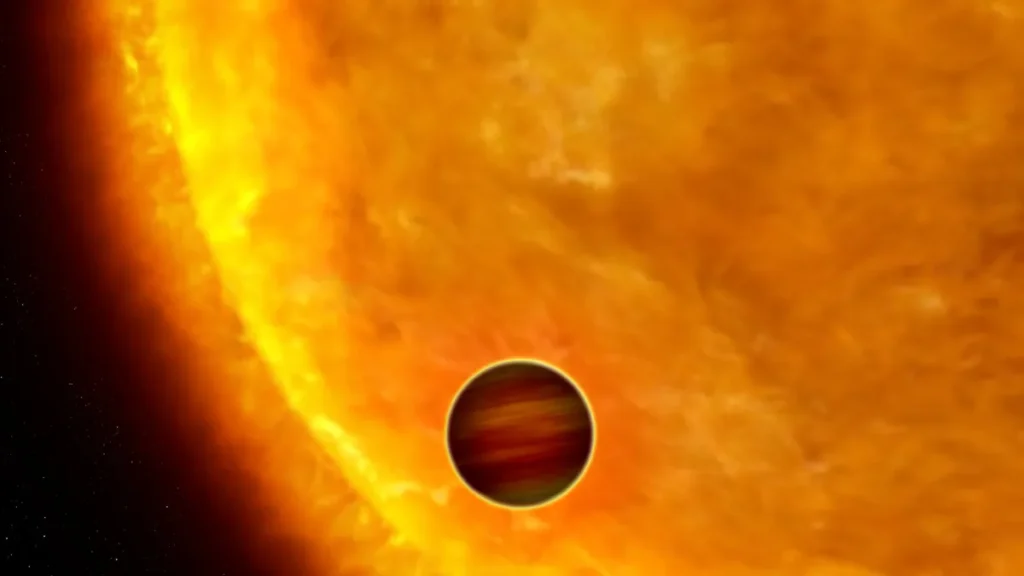
In 2026, astronomers led by UCLA reported the first known disappearing planet, TOI-2535 b, at a distance of roughly 1,000 light-years from Earth. The gas giant orbits close to its host star, completing one circuit every 8.25 days, 10 times faster than Mercury’s 88-day journey around the sun.
Astronomers followed TOI-2535 b across seven years of star crossings before the transits disappeared in 2026. NASA‘s TESS space telescope imaged the system from April 2019 through March 2026, recording transits that arrived as much as six hours early or late and grew shorter and shallower across that span. TESS finds worlds by measuring slight dips in starlight during a transit, which only works when the star, planet and observer line up precisely.
Gravity from an unseen neighboring planet on a tilted orbit is tugging on TOI-2535 b and tilting its path so the planet slips out of view from Earth. Their shared gravity causes both orbits to wobble like spinning tops, regularly shifting them out of alignment for transits, according to calculations in a 2026 UCLA-led study.
The nearby planet’s tilted orbit pulls on TOI-2535 b, tilting them away from the line of sight used for transits. This geometry is the same reason solar and lunar eclipses are infrequent on Earth rather than monthly events. Researchers are aware of a handful of systems in which multiple planets tug on one another, but the interaction here is unusually strong.
Researchers have found hundreds of hot Jupiters orbiting close to their stars, but these worlds lack massive neighbors close enough to change their paths. Most known hot Jupiters lack such nearby companions, so the TOI-2535 setup stands out as unusual.
Yee and Petigura described two routes for hot Jupiters: a violent path in which a near-collision flings the planet into an elliptical orbit before stellar tides draw it inward, and a slow spiral inward alongside other planets in a protoplanetary disk. The close-in existence of these worlds initially puzzled scientists because formation models called for large amounts of ice to assemble them, prompting study of how they migrate inward from more distant orbits. They said the gentle disk path should leave a flat system without tilts, which does not match the tilted wobble seen in TOI-2535 b because disk-driven migration preserves orbital alignment.
TOI-2535 b probably migrated by slowly spiraling inward rather than flung inward, Yee said, pointing to a rare but interesting formation channel. A nearby companion backs the gentle spiral-in route over the violent near-collision path. The two researchers are studying whether violent encounters or slow disk spiraling brought these worlds inward.

The paper’s corresponding author, UCLA researcher Samuel Yee, who holds a postdoctoral fellowship named for 51 Pegasi b, called it the most extreme example of planet-planet orbital interactions seen so far. “This is the most extreme example we’ve seen because the two planets are interacting so strongly,” Yee said. Erik Petigura, a UCLA astrophysicist and co-author, compared the setup to the moon’s tilted orbit around Earth, noting that perfect alignment would produce an eclipse every month.
Petigura said the moon’s orbital tilt probably came from a violent impact with the early Earth, drawing a parallel to the tilted orbits in the TOI-2535 system. The wobble points to long-term interactions that tilted the planets’ paths, much like a violent event that probably tilted the moon’s orbit, per the researchers’ 2026 study. The writers link the system’s tilted orbits to a dynamic history where the neighbor shaped the architecture through long-term gravitational tugs instead of a quiet migration.
A UCLA-led international team headed by Yee and Petigura found that TOI-2535 b is an extremely hot, Jupiter-sized world. The researchers used the WIYN 3.5-meter telescope at the Kitt Peak observatory in Arizona for precise observations.
TOI-2535 b is expected to cross its star’s face again in 30 to 50 years, while the unseen neighbor might show up sooner. It appeared in The Astrophysical Journal Letters in 2026 as Samuel W. Yee et al., A TESS Disappearing Act: The Vanishing Transits of TOI-2535 b, DOI 10.3847/2041-8213/aeb4a4, and it covers the TESS observations and analysis of the vanishing transit phenomenon.




Join the discussion