
This is a new development in a story we reported earlier: SpaceX targets Nov. 13 for Starship Flight 15 double landing test.
Key facts
- SpaceX caught the Starship Ship upper stage by the launch tower's Mechazilla chopstick arms at Starbase, Texas, on November 14, 2026, achieving the first-ever Ship catch and a milestone toward fully reusable spaceflight.
- The Ship upper stage deployed 26 upgraded Starlink Version 3 satellites in low Earth orbit during Flight 15.
- During its orbital flight, Ship cleared three separate checkpoints that allowed SpaceX to divert it to an ocean splashdown if needed before receiving clearance for the first-ever Ship tower catch.
- After swaying slightly back and forth, Ship came to a complete rest hanging motionless in Mechazilla's embrace and remained suspended overnight while engineers and SpaceX CEO Elon Musk inspected the spacecraft.
SpaceX caught the Ship upper stage on Mechazilla’s chopstick arms at Starbase, Texas, on November 14, 2026, achieving the first-ever Ship catch after the booster’s tower landing was aborted the day before.
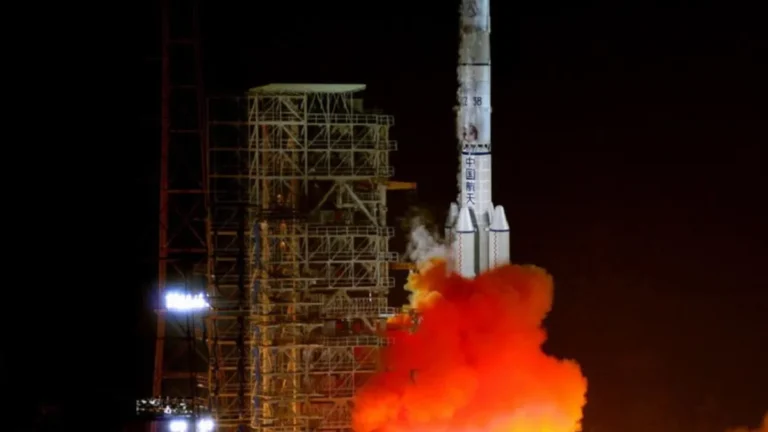
Flight 15 lifted off from Pad 2 at Starbase in South Texas at 5:47 p.m. EST on November 13, 2026, under a near cloudless blue sky. The launch window opened at 5:45 p.m. ET and stayed open for 75 minutes, with SpaceX starting its live webcast about 30 minutes before liftoff. The booster uses 33 Raptor 3 engines. At liftoff, they produce more than 18 million pounds of thrust, and all 33 engines fired as planned during ascent.
Booster 22, the Super Heavy booster, hit a low-fuel alarm and autonomously aborted its tower catch about 6.5 minutes after liftoff, diverting to an offshore splashdown in the Gulf of Mexico. The booster reoriented for its boostback burn after separation, during which one engine dropped out, leaving 32 of 33 booster engines lit to send the stage back toward the launch site. During its landing burn, Super Heavy activated 13 Raptor engines as planned before aborting to a contingency landing zone in Gulf waters, where its flight termination system destroyed it after the booster hovered, shut down its engines, and splashed down.
SpaceX spokesperson Dan Huot first said the booster abort stemmed from a guidance issue. On November 14, 2026, he clarified that the Guidance and Navigation Control system worked correctly by detecting the booster was out of catch position and triggering an automated abort. The root cause remains under investigation. “Early indications are that the booster ended its boostback [burn] early due to a low fuel mass alarm,” Kate Tice said during the November 14, 2026 Flight 15 webcast, and the team is still investigating the root cause.
During its orbital flight, Ship cleared three separate checkpoints that allowed SpaceX to divert it to an ocean splashdown if needed before receiving clearance for the first-ever Ship tower catch, with final clearance coming after the third checkpoint. At about 4:18 p.m. EST on November 14, 2026, Ship came out of cloud cover over Starbase and fired its engines for a flip and burn maneuver, lining up with Mechazilla’s chopstick arms. The catch followed stage separation at T+2:21 minutes. The vehicle was about 40 miles overhead and had completed 14 orbits around Earth.
Ship swayed slightly back and forth before coming to a complete rest, hanging motionless in Mechazilla’s embrace. It stayed suspended overnight while engineers and SpaceX CEO Elon Musk inspected the spacecraft. SpaceX lowered Ship on November 15, 2026 and moved it to the Starbase hanger bay for more checkouts, and the company has not yet said whether Ship 42 will fly again. Engineers will examine how the spacecraft held up through launch, orbit, and reentry, and the findings will inform upcoming flights as SpaceX ramps up production.
SpaceX had already caught Super Heavy boosters on three earlier Starship test flights using Mechazilla’s chopstick launch and catch towers at Starbase. Mechazilla uses chopstick arms to grab boosters from midair as they descend under control. Catching the upper stage is harder because it comes down from orbital altitude at a much higher speed. SpaceX views recovery of both stages as the bedrock of full and rapid reusability and sees the Flight 15 result as the start of a new era in Starship development.
After successfully catching an upper stage, SpaceX’s next major hurdle is demonstrating that a flown upper stage can fly again. The company has already re-flown two Super Heavy boosters. SpaceX designed Starship for full reusability and sees the rocket as key to a planned constellation of 100,000 Starlink V3 satellites and an orbital artificial intelligence data center network called Starmind. SpaceX views reusability as the way to make Starship an affordable heavy-lift booster for missions to low Earth orbit, the moon, and Mars.
Flight 15 saw Ship deploy 26 upgraded Starlink Version 3 satellites in low Earth orbit. It delivered the second batch of V3 satellites during recent Starship flight tests. SpaceX says each batch adds data capacity equal to 10 Falcon 9 Starlink V2 launches, supporting the Starlink buildout. A few of the satellites carried cameras for heat-shield inspection.
NASA picked Starship as one of two commercial landers for Artemis moon flights in 2028. Elon Musk, SpaceX’s CEO, said in an Oct. 2026 earnings call that a fully reusable orbital launch vehicle is the only way to sustain consciousness beyond Earth and called it a profound milestone for civilization and consciousness.
Starship reached orbit for the first time on Flight 14 in September 2026. That mission ended early because of an engine issue after about 10 hours rather than the planned approximately six orbits. Staying in orbit for the planned duration was crucial for Flight 15 because the vehicle had to reenter at the exact point over Starbase to line up with Mechazilla. Flight controllers planned a check when the mission reached 20 hours to pick between a Starbase landing and an early return splashdown off Hawaii, with the decision expected by about 2 p.m. EST on November 14, 2026.

Join the discussion