Key facts
- ZTF J0440+2325 contains an M8 red dwarf of roughly 85 Jupiter masses orbited by a brown dwarf of around 25 Jupiter masses, and the brown dwarf lacks enough mass to sustain hydrogen fusion.
- The brown dwarf completes one orbit every 87 minutes in a path so compact that it fits within the Sun's diameter, placing the whole binary inside a region that would fit inside the Sun.
- The brown dwarf fills its Roche lobe, so material crosses a point between the two objects and strikes the star directly instead of settling into a disk, heating a bright patch on the stellar surface.
- Kevin Burdge first noticed the unusual brightness pattern several years ago while searching through Zwicky Transient Facility survey data.
MIT scientists and colleagues reported in Nature Astronomy on Oct. 5, 2026, that ZTF J0440+2325, about 300 light-years away in the Milky Way, marks the first observed case of a small star steadily pulling material from an even smaller companion.’}, {
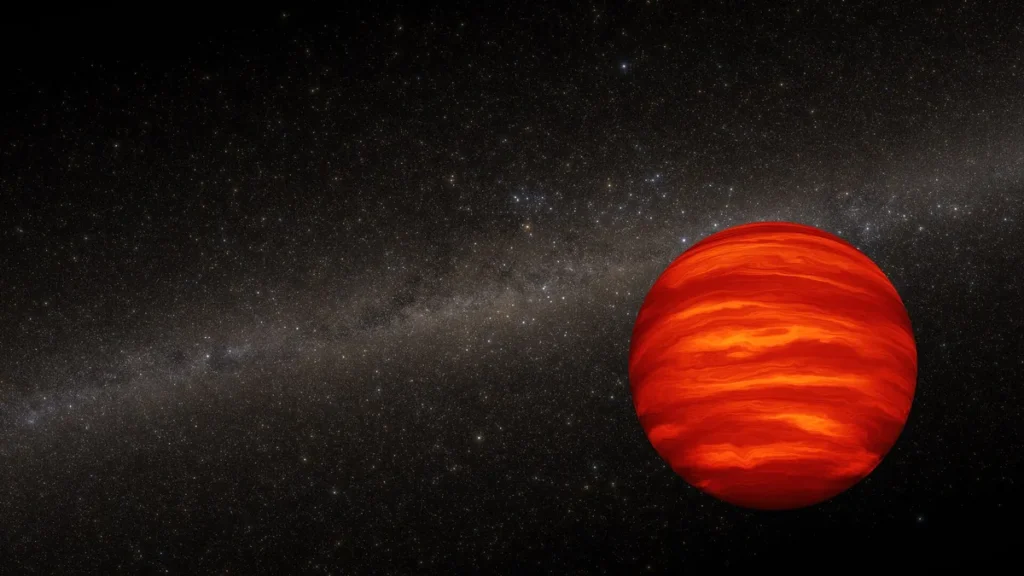
The system holds an M8 red dwarf — a cool, low-mass star classification — of roughly 85 Jupiter masses, with a brown dwarf of about 25 Jupiter masses in orbit around it. That companion lacks enough mass to sustain the hydrogen fusion that powers ordinary stars. A brown dwarf is a planetlike object: heavier than a typical planet, yet too light to keep hydrogen fusion going like an ordinary star.’}, {
The brown dwarf circles once every 87 minutes, tracing a path so compact that the whole binary fits inside the Sun’s diameter. One source’s brightness measurements put the repeat at 86.65 minutes, while the other sources describe the period as 87 minutes.’}, {
The brown dwarf fills its Roche lobe, meaning gas crosses a point between the two objects. Instead of settling into a disk, it strikes the star directly, heating one bright patch on the star’s surface. This differs from the usual accretion picture around compact objects such as black holes and neutron stars, where matter falling toward a black hole commonly builds a swirling disk. Here the absorber is a large star, so material strikes it directly at high speed, heating a patch of atmosphere that produces the brightness variations.’}, {
With each orbit, the bright patch turns toward and away from our line of sight, so the system’s brightness climbs and drops in a triangular pattern, a waveform that first stood out in Zwicky Transient Facility data. Kevin Burdge first noticed the unusual waveform years ago while searching Zwicky Transient Facility survey data. “I remember first looking at this and thinking: Stars don’t make triangular waveforms like this,” Kevin Burdge recalled.’}, {
The Zwicky Transient Facility relies on a camera mounted to a telescope at Palomar Observatory in California to look for rapid brightness changes that could point to supernovae, gamma-ray bursts, or colliding neutron stars. At the time, Burdge and colleagues were investigating a signal from a black widow binary and wondered whether the triangular pattern came from another such system.’}, {
In black widow binaries, a dense, spinning neutron star strips material from a much smaller companion. They take their name from black widow spiders, since the neutron star gradually destroys its partner. The small companion whips around its heavy neutron star, creating a pronounced wobble in the light.’}, {
Supernova light curves build a rounded, bell-like shape while a star brightens and fades, yet Burdge’s signal repeatedly traced a triangle instead. The triangular pattern stood out, unlike the smooth rise and fall of exploding stars.’}, {
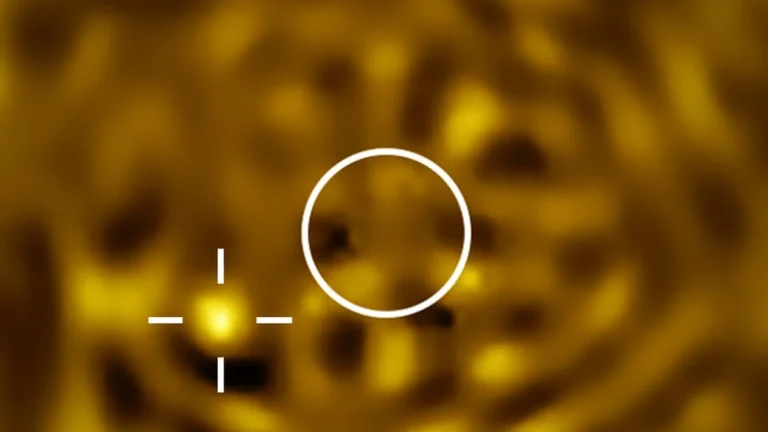
No one could explain the signal for years, until Burdge and Aaron Householder came back to it using observations from multiple telescopes. Householder is a graduate student in MIT’s Earth, Atmospheric, and Planetary Sciences department. The team pinpointed the source from the initial ZTF signal, aimed multiple telescopes at it, and detected a small but measurable wobble that they compared with black widows and similar binaries.’}, {
The researchers ran simulations of matter particles on the brown dwarf, applying the laws of physics and equations of motion to track each particle’s path over time. They wanted to test a years-old idea that less mass lets objects orbit gently without whipping back and forth, though proof had been lacking. “That was the real clincher for this system,” Householder says.’}, {
The visible star’s orbital velocity semi-amplitude — its speed shift as the companion tugs it — came to about 25 kilometers per second, too small to comfortably point to a neutron star, and the team found no X-rays at the levels seen in black widow systems. Those measurements led the team to call the visible star an M8 red dwarf paired with a brown-dwarf companion.’}, {
MIT estimates that about one hundred-thousandth of Earth’s mass moves each year — nearly two trillion kilograms every second — amounting to one part in a billion of the companion’s nearly 8,000 Earth masses annually.’}, { For scale, the researchers likened the yearly flow to roughly 40 million dump trucks’ worth of material, or about 1.3 trillion one-pound burritos each second.’}, {
The brown dwarf’s large reservoir keeps the flow slow and steady relative to the supply. Researchers estimate that the feeding could go on for hundreds of thousands of years, or even billions.’}, {
Astronomers expect the Sun to swallow Earth when it becomes a red giant billions of years from now, but this system shows that consumption can proceed more slowly, with its companion still in orbit as it gradually gives up material. Rather than a sudden crash that destroys the smaller body, the star appears to keep a steady flow of material coming from its neighbor.’}, {
The Nature Astronomy paper carries the title “Stable mass transfer from a substellar object onto an M dwarf” and the DOI 10.1038/s41550-026-02992-6. Its authors include Aaron Householder, Kaitlyn Shin, Kevin B. Burdge, Thomas R. Marsh, Saul A. Rappaport, Kareem El-Badry, Joheen Chakraborty, Emma Chickles, Fei Dai, Matthew J. Graham, S. R. Kulkarni, Pablo Rodríguez-Gil, Andrew Vanderburg and Samuel Whitebook.’}, {
MIT coauthors include Kaitlyn Shin, Saul Rappaport, Joheen Chakraborty and Emma Chickles, with colleagues from Caltech, the University of Hawaii, the Instituto de Astrofísica de Canarias, the Universidad de La Laguna in Spain, and the Harvard-Smithsonian Center for Astrophysics. Funding came in part from the National Science Foundation.’}, {
Astronomers need more examples to learn how common this process is, how long it can run, and what becomes of objects caught in such tight relationships. This marks the first time scientists have found a system balancing stable, detached orbits against stars that swallow their planets quickly, showing a new way for stars to interact with planetary companions.’}, {

Join the discussion