Key facts
- The ELT is described as one of the largest, most powerful, and most costly ground-based telescopes.
- New research in New Astronomy examines how NEXUS@SHARP can probe Lambda-CDM questions; the paper is titled "SHARP(ening the) view of unresolved globular clusters in ultra diffuse galaxies.".
- Two scenarios explain ultra-diffuse galaxy formation: failed massive galaxies quenched early, or puffed-up dwarfs that expanded.
- NEXUS@SHARP data would provide two independent mass measurements per ultra-diffuse galaxy: dynamical mass from globular cluster velocity dispersion and GC-count mass from total globular cluster number.
Researchers led by Marco Mirabile have proposed using a planned near-infrared spectrograph on the future Extremely Large Telescope to study ultra-diffuse galaxies and their dark matter halos, according to a 2026 study in New Astronomy.
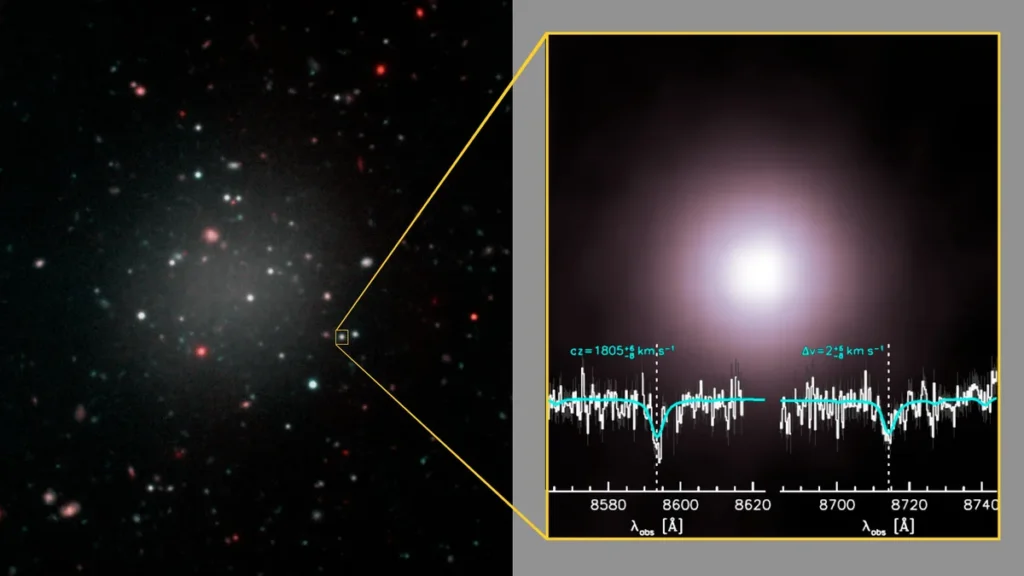
Ultra-diffuse galaxies are about as large as the Milky Way but can have thousands of times fewer stars, with the stars spread out across a dim, sprawling volume. That makes the galaxies difficult to observe and puts them at odds with expectations from Lambda cold dark matter, the standard cosmological model also known as Lambda-CDM or the Big Bang model of cosmology. Dark matter halos rank among the cosmos’ basic structural units, and they help set galaxy size, yet ultra-diffuse galaxies occupy halos that ought to yield tighter systems than what we see.
Researchers do not know what dark matter is, and some doubt it exists, leaving key questions inside the Lambda-CDM framework unanswered. Ultra-diffuse galaxies challenge current galaxy formation models within that framework, particularly dark matter content and formation histories, according to the paper’s authors. Lambda-CDM remains the best match for much data on dark matter and dark energy but does not fit everything, according to the sources.
Globular clusters are brighter than the ultra-diffuse galaxies that host them, and they extend outward farther than their host galaxies, making them better probes of dark matter halos. The number of globular clusters scales with halo mass, helping determine the mass of the dark matter halo, and their spectra reveal ages and metallicities that show how quickly stars formed. All galaxies have globular clusters, including our own, which is why they can serve as probes around ultra-diffuse galaxies.
Current spectroscopic facilities struggle to reach the depth needed to fully characterize globular cluster populations beyond the local neighborhood, according to the paper’s authors. Multi-object spectrographs already exist on Keck, the VLT, Gemini, and the JWST, showing the technique is common. The missing piece is the combination of high spatial resolution with efficient multiplexing on a much larger aperture.
Two scenarios explain ultra-diffuse galaxy formation within the Lambda-CDM framework. In the first, the galaxies are failed massive systems quenched early, preserving dwarf-like stellar masses while lying within more massive halos typical of regular galaxies; they would appear red, old, metal-poor, dark matter dominated, and unusually rich in globular cluster populations. This scenario treats ultra-diffuse galaxies as quenched descendants of larger systems rather than genuinely low-mass dwarfs.
In the second scenario, ultra-diffuse galaxies are genuinely low-mass galaxies that expanded, and they are expected to be bluer, with extended star formation histories and dark matter content and globular cluster populations resembling typical dwarfs. This model places them within normal dwarf-sized dark matter halos, contrasting with the failed-galaxy picture. The competing ideas make different predictions about color, star formation history, dark matter content, and globular cluster populations.
The ELT is one of the largest ground-based telescopes and also one of the most powerful and most costly, and its science goals cover fundamental parts of the universe, and dark matter is one of them. First light occurs in March 2029. ESO states the telescope will have a primary mirror 39 meters wide, made of 798 hexagonal segments working with nanometric accuracy and coated with silver, while Universe Today describes a 39.3-meter segmented primary mirror at the heart of the observatory, with instruments including NEXUS@SHARP if built sitting on a separate stationary platform.
A proposed instrument called NEXUS@SHARP is a near-infrared multi-slit spectrograph designed to work with SHARP, the Spectrograph for High Angular Resolution Physics. NEXUS@SHARP is currently just a concept, and the paper makes the case for building it; its construction is not guaranteed, and its scientific payoff depends on its construction. The paper introduces the instrument as one of the planned attachments for the ELT and as the subject of the New Astronomy paper.
NEXUS@SHARP can extend observational reach by combining high spatial resolution with efficient multiplexing on the ELT’s 39.3-meter-diameter segmented mirror. According to the authors, it can characterize globular cluster populations in ultra-diffuse galaxies across diverse environments out to 60 to 70 megaparsecs with a few hours of ELT time. Multiplexing lets the instrument observe many globular clusters at once, making a large survey practical compared with measuring only a handful of clusters around a few galaxies.
The reporting states that 70 megaparsecs is about 230 light-years. NEXUS@SHARP data would provide two independent mass measurements per ultra-diffuse galaxy: dynamical mass from globular cluster velocity dispersion (how fast the clusters move within the galaxy) and GC-count mass from total globular cluster number. Both measurements arise from observing many globular clusters simultaneously, which the instrument’s multiplexing capability enables.
If both mass measurements agree and are high, the ultra-diffuse galaxy has an overmassive halo compared to its stars, supporting the failed-galaxy scenario. High agreement and high values show the galaxy’s dark matter halo is much more massive than its stellar population would suggest. The result would point to a galaxy that began as something larger before being quenched.
If both mass measurements agree and are low, the ultra-diffuse galaxy is a puffed-up dwarf inside a normal-sized dwarf dark matter halo, supporting the second scenario. Low agreement and low values show the galaxy and its halo are both consistent with an ordinary dwarf galaxy. These paired measurements give researchers two ways to test which formation channel produced a given system.
If dynamical mass is low but GC-count mass is high, globular cluster formation was unusually efficient for an environmental reason, according to Phys.org. Universe Today renders the same scenario differently, saying globular cluster formation was unusually inefficient for an environmental reason. The two outlets offer different readings of the same outcome.
An earlier idea that supernova explosions spread ultra-diffuse galaxy stars outward has not endured, according to Universe Today and Around Prague. Around Prague also frames the study as forward-looking rather than an announcement of new observational results.
The paper carries the title SHARP(ening the) view of unresolved globular clusters in ultra diffuse galaxies, and New Astronomy published it in 2026, with the DOI 10.1016/j.newast.2026.102620. Its lead author is Marco Mirabile, a Ph.D. student at INAF-Astronomical Observatory of Abruzzo and Gran Sasso Science Institute in Italy. The research examines how NEXUS@SHARP can probe Lambda-CDM questions and outlines the scientific potential of using the instrument on the future ELT to study faint galaxy systems.
If built, NEXUS@SHARP could help confirm or contradict Lambda-CDM by reducing uncertainty around ultra-diffuse galaxies and their dark matter halos. The paper concludes that the instrument will act as a definitive tool for constraining formation channels of elusive galaxy populations in the local universe. Understanding ultra-diffuse galaxies and their dark matter content tests the standard cosmological model, which remains the baseline against which researchers evaluate these galaxies.
The study is a projection of what the instrument could do, not a set of new observations, and the instrument is proposed but not yet confirmed. Whether NEXUS@SHARP is built depends on the instrument being constructed and the ELT starting work as scheduled. Nothing in the paper changes what is known about ultra-diffuse galaxies today, according to Around Prague.

Join the discussion