Key facts
- A massive foreground galaxy cluster bends and magnifies light from distant objects behind it, working like a natural magnifying glass that brings otherwise too-faint galaxies into view, the report explains.
- Misty Moons forms stars at a surface density 100 to 10,000 times above the level seen in nearby dwarf galaxies.
- The team says the central clumps are so bright and compact that an actively feeding supermassive black hole cannot be ruled out, meaning some inferred star formation might come from accretion rather than stars.
- The study appeared in The Astrophysical Journal on October 19, authored by Minami Nakane and colleagues, titled VENUS: A Strongly Lensed Clumpy Galaxy at z ∼ 11–12 Behind MACS J0257.1-2325, DOI 10.3847/1538-4357/ae8d09.
A team authored by Minami Nakane of the University of Tokyo used the massive galaxy cluster MACS0257-2325 as a gravitational lens to magnify the distant galaxy nicknamed Misty Moons. The researchers report that the cluster’s gravity acted like a natural magnifying glass, bringing an otherwise too-faint galaxy into view. The cluster serves as a natural telescope for observing the early universe. The work reveals early-universe star formation that would otherwise be too faint to detect.
The study appeared in The Astrophysical Journal on Oct. 19 under the title VENUS: A Strongly Lensed Clumpy Galaxy at z ∼ 11–12 Behind the Galaxy Cluster MACS J0257.1-2325, with DOI 10.3847/1538-4357/ae8d09. Minami Nakane and colleagues authored the paper. The full title identifies the galaxy as strongly lensed and clumpy, located behind the galaxy cluster MACS J0257.1-2325.
The cluster’s mass curves the path of that light as it travels toward Earth. This effect makes the distant galaxy bright enough for detailed study of its clumps, which would otherwise remain out of reach.
The galaxy’s light left when the cosmos was 370 million to 410 million years after the Big Bang, placing it at a redshift of roughly 11 to 12. Misty Moons is less than 500 million years old.
Gravitational lensing lets astronomers study internal structures of galaxies formed only a few hundred million years after the Big Bang, which JWST cannot resolve directly. The clumpy structure of Misty Moons suggests early star formation was concentrated in compact regions rather than spread smoothly. This makes lensing essential for studying the first galaxies beyond what JWST can see directly. Without magnification, these early systems would remain too faint and small to study in detail.
Researchers found Misty Moons in JWST NIRCam images of the MACS0257-2325 field taken through 10 color filters. Older Hubble images taken with three filters supplemented the new JWST imaging. Together the multi-filter view gave the researchers the data they needed to spot the galaxy in the cluster’s field.
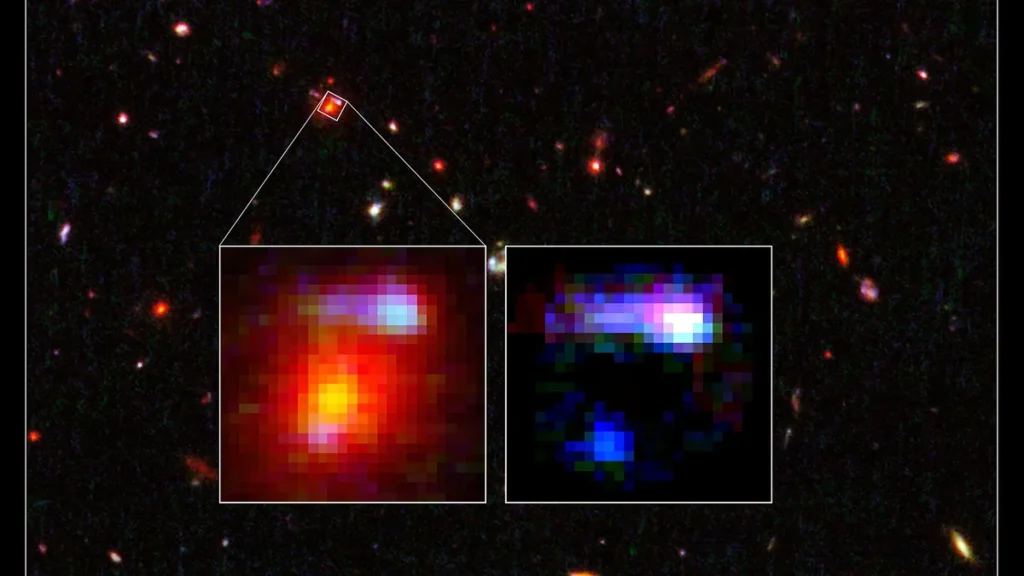
The galaxy appeared as two blobs designated ID1 and ID2. The team built two lens models that predicted five images total, identifying a third possible image while two remained too faint to detect. ID1 and ID2 are the two bright lensed images of the same distant galaxy.
The images vanish at shorter wavelengths, and the models reconstructed the galaxy’s internal structure. Correcting the distortions provided access to details beyond the telescope’s normal resolving power.
The Phys.org report put it this way: “Two of its bright lensed images appear roughly 20 to 30 times brighter than they would without magnification.” This brightening allowed the researchers to examine individual clumps in the distant galaxy.
Once the team smoothed and cleaned the images to remove blur, they spotted four clumps in ID1 and three in ID2. Smoothing and blur subtraction made the small bright spots stand out so astronomers could examine individual clumps in the distant galaxy. Removing the lensing effects showed both images share the same structure.
These stellar groupings each hold roughly 10 million solar masses of young stars that lack much dust and date to about 40 to 70 million years ago. A solar mass is the mass of the Sun, used as a unit for weighing stars. The clumps are young and free of dust.
Together the clumps account for at least 80% of Misty Moons’ estimated stellar mass. That means much of the stellar population assembled within a few exceptionally dense regions rather than spreading smoothly through the galaxy.
Misty Moons forms stars at a surface density 100 to 10,000 times above the level seen in nearby dwarf galaxies. Star formation surface density is the rate of star formation per unit area. This extreme intensity likely drives the clump-dominated mode of star formation in the galaxy. Such intensity is far beyond nearby systems.
The team concludes high-redshift clumpy galaxies are likely distinct from local dwarf galaxies not only in high star formation rate surface densities but also in short, bursty star formation during early formation. Bursty star formation means stars form in short, intense episodes rather than steadily. Local dwarf galaxies do not show the same combination of high surface density and bursty formation.
The central clumps are so bright and compact that researchers cannot rule out an actively feeding supermassive black hole, meaning some inferred star formation might come from accretion rather than stars. A supermassive black hole is a central black hole drawing in surrounding gas, while accretion is the process of matter falling onto it.
Current imaging cannot confirm a central black hole in Misty Moons, and spectroscopy might help separate young stellar radiation from active galactic nucleus emission. An active galactic nucleus is a brightly lit galactic core powered by a feeding black hole.
Star clusters born in the early universe generally contain few heavy elements and may be roughly 1,000 times denser than young star clusters found nearby. Heavy elements are atoms heavier than hydrogen and helium.
Scientists use cluster formation efficiency to gauge how many newly formed stars join bound clusters, and research indicates this efficiency tracks the star formation rate. Because early galaxies formed stars at high rates, their cluster formation efficiency might have been high, though examining individual clusters in such distant galaxies is difficult. The difficulty of examining individual clusters in distant galaxies is one reason lensing is so valuable.
Researchers are combing many lensing cluster fields for distant galaxies, since these early systems are too small and far away to divide into individual parts without magnification. Lensing makes distant objects brighter and magnified, so astronomers can pick out individual clumps. This broader motivation underlies the study of Misty Moons and similar systems. Lensing thus extends the reach of JWST into the era of the first galaxies.
JWST has discovered numerous galaxies from when the cosmos was just a few hundred million years old, among them objects that look overly bright and contain abundant nitrogen despite their small size. This brightness could offer clues about globular clusters and how stars formed in the early universe. The discoveries show that JWST is finding galaxies from very early cosmic times.
Researchers matched their observations against simulated galaxies across cosmic history and found that systems at higher redshift are generally more clumpy, in line with clumpy galaxies observed above redshift six. This pattern differs from what local dwarf galaxies show, indicating early galaxies assembled differently. The comparison between simulations and observations supports the idea that early galaxy buildup was clumpy rather than smooth.


Join the discussion