Key facts
- Two NASA-led studies show how the future LISA gravitational-wave observatory could detect a previously inaccessible exoplanet population across the galaxy.
- Launch is planned for the mid-2030s under European Space Agency leadership of the LISA mission.
- Astronomers have not yet confirmed any planet orbiting a binary white dwarf system.
- Casey McGrath alone authored the first paper, which studies the detection method and identifies suitable planet masses and orbital periods.
Two NASA-led studies published Nov. 10, 2026, show how the future LISA gravitational-wave observatory could detect an inaccessible population of exoplanets across the galaxy.
The research appeared Tuesday in The Astrophysical Journal. Casey McGrath, a postdoctoral researcher at the University of Maryland, Baltimore County and NASA’s Goddard Space Flight Center in Greenbelt, Maryland, said, “The most common source for LISA is expected to be double white dwarf systems, which are binaries composed of white dwarfs in tight orbits.”
McGrath alone authored the first paper, which studies the detection method and identifies suitable planet masses and orbital periods. The second paper, by McGrath and co-authors, explores confirmation through infrared observations from NASA’s Webb telescope.
LISA will consist of three spacecraft that follow Earth as it orbits the sun, forming a triangle with sides of 1.6 million miles (2.5 million kilometers). Each spacecraft will carry two telescopes using infrared laser beams to send and receive signals between neighboring spacecraft. The observatory will measure changes in relative distance between spacecraft smaller than a helium atom’s width.
Albert Einstein’s 1916 general theory of relativity predicted gravitational waves, and observatories on the ground first detected them in 2015. Massive objects that accelerate produce them, like two stars in orbit. They travel through space-time at light speed and pass through objects unchanged. Scientists use those traits to study the cosmos.
White dwarfs are Earth-sized remnants left behind by stars like the sun, consisting of dense stellar cores left after such stars die. Astronomers estimate that the Milky Way holds 10 million double white dwarf systems with orbital periods of under one hour. Isolated double white dwarf systems produce gravitational waves at an almost continuous frequency.
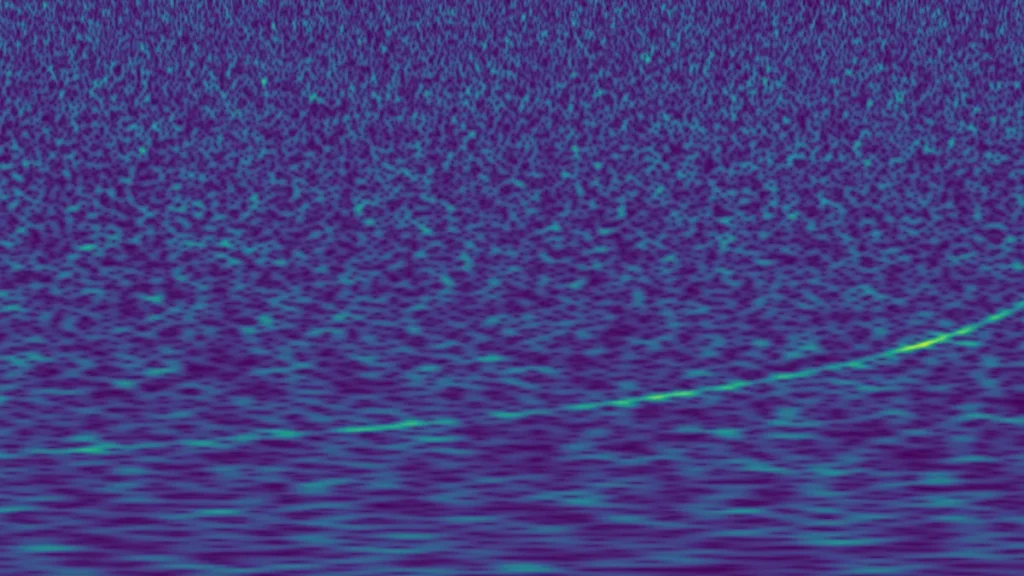
A planet orbiting a white-dwarf pair pulls on the system’s shared center of mass, and the planetary tug should create a slow wobble in the wave measured by LISA. In LISA data, the Doppler modulation will appear as sidebands, which are secondary signals at higher and lower frequencies than the main tone. Sidebands in the gravitational-wave signal carry information about whether a planet is present. McGrath compares the planet signal to sidebands in modern radio communication, where energy from a main carrier frequency forms sidebands at adjacent upper and lower frequencies carrying messages such as voices or music.
LISA’s detection approach resembles radial velocity, a method that finds exoplanets around nearby stars using light. McGrath calls the technique gravitational-wave radial velocity, and McGrath’s models show the method works best for heavy planets on slow, wide orbits.
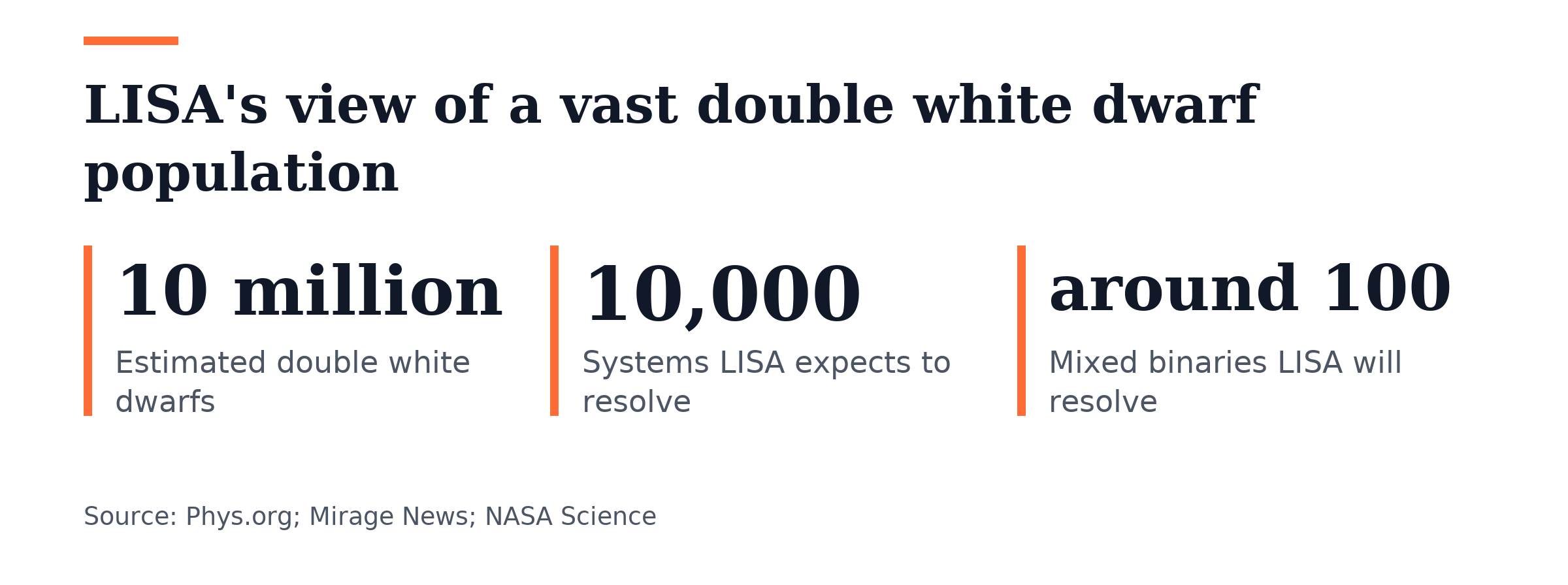
Researchers expect LISA to resolve roughly 10,000 individual systems and around 100 mixed binaries with similar orbital periods, and the mixed binaries include white dwarfs, neutron stars or black holes. White-dwarf duos in tight orbits are expected to produce most of the steady gravitational-wave signals LISA resolves. ESA expects ten thousand or more gravitational wave events, with many coming from white-dwarf pairs that might hide planets.
Webb’s instruments can detect infrared excess at distances of at least 500 light-years, and planets orbiting pairs of white dwarfs emit more infrared light than the stars alone would produce. For a test case at 500 light-years, Webb could find a planet about five times Jupiter’s mass, while LISA could sense a sub-Jupiter world under ideal circumstances. The team described a confirmation method using the Webb telescope’s infrared sensitivity.
The second paper pairs gravitational waves with light through the work of McGrath, Mary Anne Limbach, Scott Noble, and Vincent Kofman. It tests a nearby clone of ZTF J2243+5242, using JWST’s MIRI instrument to look for infrared glow from a giant planet. Scott Noble, a theoretical astrophysicist at NASA Goddard and a co-author on the confirmation paper, said, “Something similar occurs with gravitational waves.”
Mary Anne Limbach, an assistant research scientist at the University of Michigan and a co-author on the confirmation paper, said, “Once LISA captures its first exoplanet detections, it will be critical for us to validate some of them.” Limbach says early LISA data will require matched gravitational-wave and infrared detections to rule out false alarms. Gravitational-wave data alone may not fully determine a planet’s mass and orbit.
LISA would provide a detection path to exoplanets beyond the bright stars that dominate current sky surveys. Astronomers have not yet confirmed any planet orbiting a binary white dwarf system, though exoplanets exist around some isolated white dwarfs.
In 2008, Japanese astronomer Naoki Seto first proposed detecting exoplanets around pairs of white dwarfs targeted by LISA, and later research refined the gravitational-wave waveforms after that proposal. Launch is planned for the mid-2030s under European Space Agency leadership of the LISA mission, with a specific target of 2035 aboard an Ariane 6 rocket. NASA will contribute telescopes, critical hardware, engineering, and scientific support to the ESA-led mission. The agency will also supply the laser system, charge-management devices for proof masses, data analysis for gravitational wave sources, scientific and engineering expertise, and software to analyze the raw data.



Join the discussion