Key facts
- In Leviathan's spectrum, the team detected emissions from hydrogen and ionized nitrogen and used these emission lines to determine the galaxy's redshift as z = 4.0514.
- By fitting 31 different bands of Leviathan's light to models of its stars and dust, the team found a stellar mass of about 219 billion suns.
- The star formation in Leviathan is spread across its disk, and its dust glow spans about 2.2 to 2.5 kiloparsecs, only slightly more compact than the stars.
- Researchers calculated that even if all of Leviathan's gas became stars, the galaxy would shrink only to about 2.8 kiloparsecs, below compact quiescent galaxy central density.
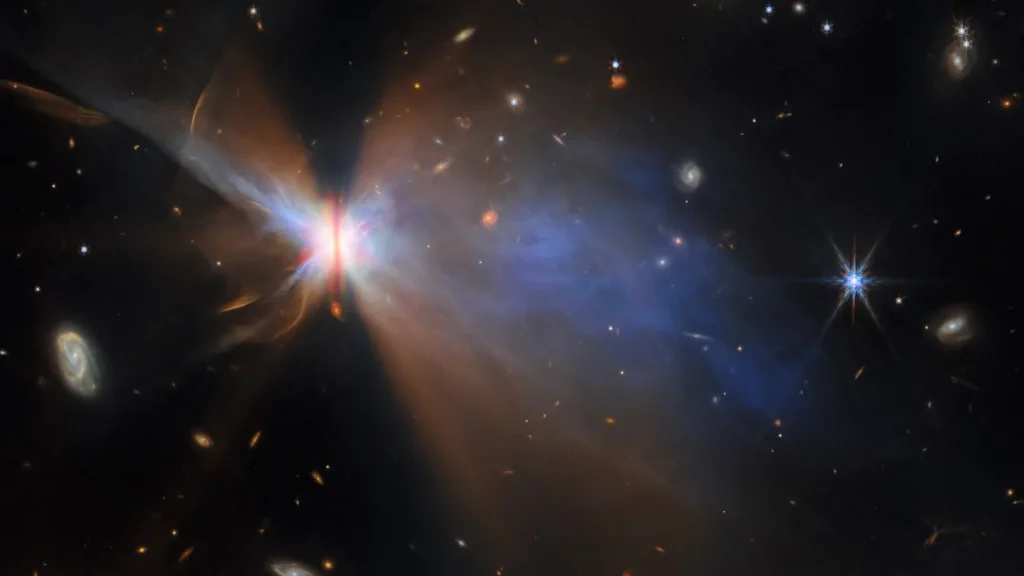
Astronomers using the James Webb Space Telescope confirmed Leviathan, an extended dust-rich galaxy seen when the universe was roughly 1.5 billion years old, in a paper posted to arXiv on Oct. 19, 2026; a JWST study published on Aug. 22, 2026, found hidden low-mass stars in massive early galaxies; and a study published on Sep. 24, 2026, found heavy elements in gas around galaxies just 500 million years after the Big Bang. The researchers behind these studies say their findings reshape how astronomers read the early-universe galaxy census, from dusty-galaxy structure to hidden stellar mass and early chemical enrichment.
Leviathan was first identified as a massive submillimeter galaxy in 2012. Baker’s team fitted 31 different bands of the galaxy’s light to models of its stars and dust and found a stellar mass of about 219 billion suns. The galaxy forms about 410 solar masses of stars per year, placing it on the massive end of the star-forming main sequence at a redshift of approximately 4. In its spectrum, the team detected emissions from hydrogen and ionized nitrogen and used those emission lines to determine a redshift of z = 4.0514.
The researchers measured Leviathan’s half-light radius at 4.3 kiloparsecs and its half-mass radius at 3.1 kiloparsecs, making it bigger than most submillimeter galaxies seen about 11.5 billion years ago. Star formation spreads across its disk, and its dust glow spans about 2.2 to 2.5 kiloparsecs, only slightly more compact than the stars. Even if all Leviathan’s gas became stars, the galaxy would shrink only to about 2.8 kiloparsecs, still below the central density of compact quiescent galaxies.
If Leviathan’s star formation continues with its present spatial distribution, the researchers say it is unlikely to develop the compact structure of massive quiescent galaxies at redshifts between 3 and 5. Massive quiescent galaxies that stopped forming stars are compact when seen 11.5 to 12.5 billion years ago, with half-light radii of 0.2 to 1 kiloparsec and tens of billions of solar masses in stars. Their ancestors are thought to be submillimeter galaxies, which must therefore have built dense stellar cores quickly, and Leviathan’s extended structure challenges this expectation of rapid core assembly.
Dust-obscured submillimeter galaxies shine at extreme luminosities, typically at redshifts around 2 to 3, and form stars at hundreds to thousands of solar masses per year. Scientists consider these objects possible ancestors of massive quiescent galaxies, the massive elliptical galaxies seen today. Dust captures optical and ultraviolet light at short wavelengths and sends it out again at submillimeter wavelengths, and dust output from these galaxies spans roughly 1 to 2 kiloparsecs and marks current star formation rather than the location of older stars.
Because dust emission traces only current star formation, the team used JWST to detect the faint stellar glow and measure where stellar mass lies rather than relying only on light. The research team wrote that determining whether these galaxies become compact massive quiescent galaxies requires measuring where stellar mass, not just light, lies. Leviathan could evolve into an extended, disk-like system that has stopped forming stars instead of a compact object.
The paper is titled Leviathan: a very massive, extended sub-millimetre galaxy spectroscopically confirmed at z = 4.05 and was posted to arXiv in 2026 with DOI 10.48550/arxiv.2610.27101 by William M. Baker et al. The Phys.org article was written by Shreejaya Karantha, edited by Sadie Harley, and reviewed by Robert Egan for Science X Network.
Beyond Leviathan’s shape, JWST is also revealing how much mass early galaxies contain. A separate study looks at the faint, low-mass stars that earlier observations missed.
A separate JWST result published in Nature Astronomy on Aug. 22, 2026, suggests that massive early galaxies contain far more small, faint stars than expected, a hidden population that could make some galaxies three to four times more massive than earlier estimates indicated. Penn State researchers joined an international team to study nine massive galaxies that had stopped forming stars, using JWST data alongside earlier Very Large Telescope observations. Joel Leja of Penn State said, “they have three or four times more mass than we expected.”
Compared with the Milky Way and other smaller galaxies, massive early galaxies contain far more low-mass stars, the researchers found. This challenges the assumption that stars formed in roughly similar proportions throughout the universe.
One galaxy in the study may have formed under one and a half billion years after the Big Bang and could have a mass four times greater than earlier estimates. Chloe Cheng, the study’s lead author and a recent Leiden University doctoral graduate, compared bright stars to skyscrapers and faint low-mass stars to houses hidden between them.
Martje Slob, a Leiden University doctoral candidate and coauthor, said measurements like these were impossible until recently. Mariska Kriek, professor of extragalactic astronomy at Leiden Observatory and research leader, said hidden mass in low-mass stars has consequences for astronomy, including the possibility of more early planets, because many planets orbit low-mass stars. The team intends to apply this same method during the next few years to examine galaxies from still earlier epochs.
After JWST started observing, researchers repeatedly uncovered unexpectedly massive and developed galaxies soon after the Big Bang, straining current theories of galaxy formation. If early galaxies contained far more stars than estimated, galaxy formation theories must explain how enormous numbers of small stars appeared so early in cosmic history. Bright stars outshine faint ones in galaxy spectra, so small stars are difficult to spot and their total mass is hard to estimate. Researchers assumed stars formed in about the same ratios everywhere in the cosmos, but the new results dispute that idea.
The journal reference is Chloe M. Cheng et al., Hidden mass in early galaxies revealed by bottom-heavy initial mass functions, Nature Astronomy, 2026, DOI 10.1038/s41550-026-02932-4. The paper’s authors include researchers from Penn State, Leiden University, and other institutions worldwide.
JWST has also traced the chemical elements that early galaxies released into space. A University of Arizona team examined the gas around three distant galaxies.
A University of Arizona study published in Nature Astronomy on Sep. 24, 2026, says galaxies were seeding the cosmos with heavy elements such as oxygen and carbon much earlier than expected. At just 500 million years after the Big Bang, roughly 3 percent of the cosmos’s current age, the first stars and galaxies were already in place.
Yongda Zhu, the paper’s first author and a University of Arizona postdoctoral researcher, said heavy elements left galaxies early in cosmic history. Stars forge heavy elements such as carbon and oxygen through nuclear fusion and shed them into space when they burn out or explode as supernovae. Researchers did not know how or when heavy elements moved from the first galaxies into the surrounding space.
Zhu’s research examined three early galaxies whose light took more than 13 billion years to reach us, showing them as they did about 500 million years after the Big Bang during the Epoch of Reionization. The team treated the distant galaxies as backlights and studied absorption imprints in light crossing nearby gas to identify particular chemical elements.
JWST’s infrared capabilities made these observations possible, and they required nearly 30 hours of exposure. During a single long night, Zhu went through public JWST spectra from hundreds of galaxies and found three showing absorption from carbon, oxygen, and silicon. Yongda Zhu, University of Arizona, said, “Think of these elements, which originated from the galaxies’ stars, as food dye dropped into a cup of water”.
The spectral lines shifted toward the blue compared with the galaxies’ redshift, showing gas flowing outward and carrying oxygen, carbon, and other heavy elements into intergalactic space. The chemical signatures of these young galaxies matched those of much older galaxies from billions of years ago, showing that galaxies at cosmic dawn were already making and dispersing heavy elements.
Astronomers call the exchange of material between galaxies baryon cycling, which means galaxies form parts of a wider galactic ecosystem instead of isolated objects. Stars create matter that later generations reuse and spread around the larger galactic ecosystem. Early baryon cycling could explain the difficulty of finding Population III stars, the universe’s first generation of stars.
Astronomers believe Population III stars were the first stars, born from pristine gas made only of hydrogen and helium before heavier elements existed. If galaxies polluted their surroundings only 500 million years after the Big Bang, pristine gas and Population III stars may not have lasted long enough to see.
The study is titled Early metal-enriched baryon cycling before the midpoint of cosmic reionization, published in Nature Astronomy on Sep. 24, 2026. The research was an observational study led by University of Arizona astronomers using publicly available JWST spectra.



Join the discussion