Key facts
- Scientists state there is no definitive theoretical explanation for how one giant quasar, much less two, could exist so early in the universe's history. Silvia Onorato made this assessment.
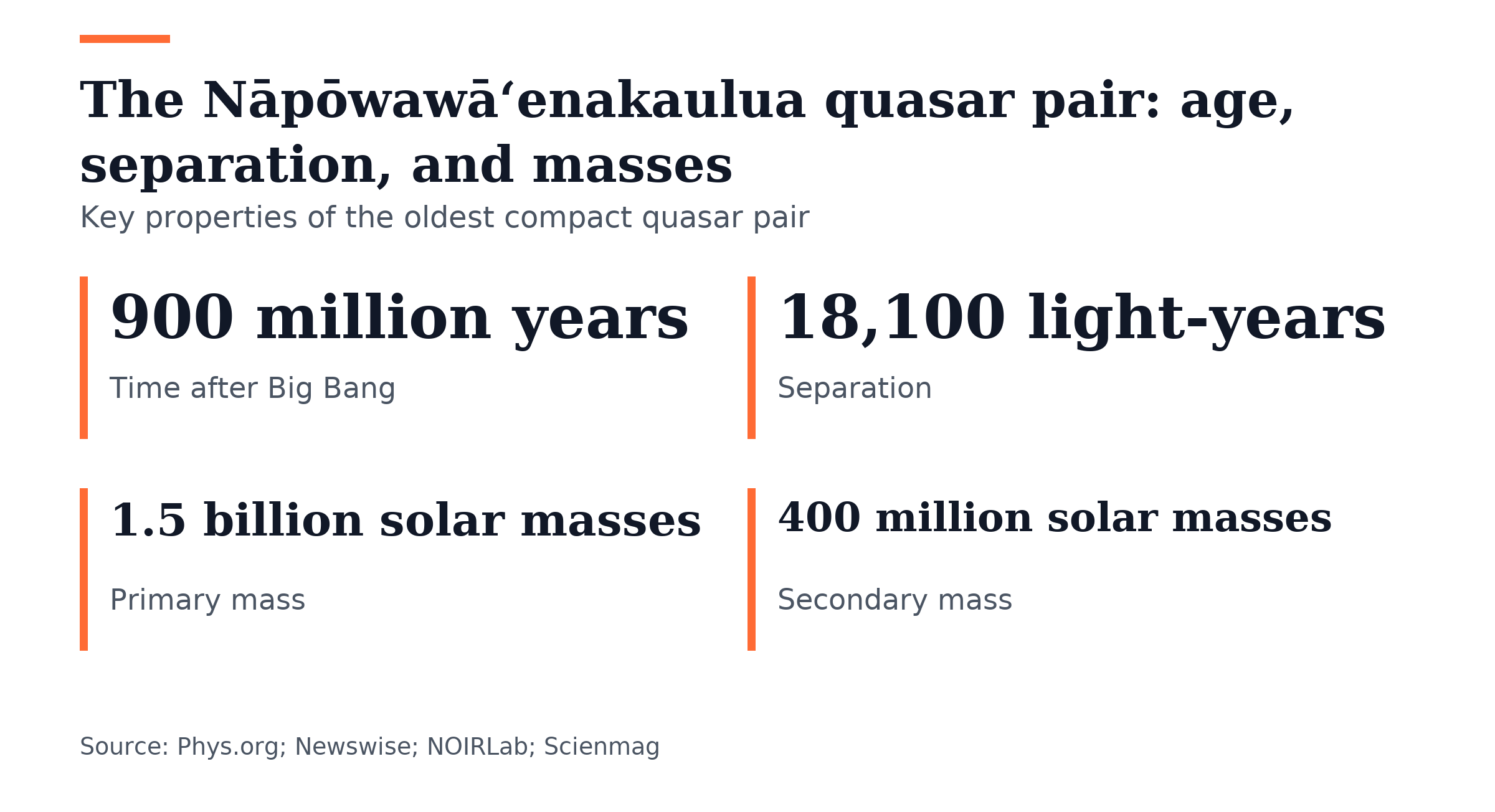
- The two quasars sit about 18,100 light-years apart, a span equal to roughly one-fifth of the Milky Way Galaxy's diameter.
- One black hole weighs 1.5 billion solar masses and the other 400 million solar masses.
- Astronomers count Nāpōwawāʻenakaulua as the third quasar pair identified during cosmic dawn and the closest pair found in that early period.
JWST’s Aether survey spotted a companion to quasar J1602+4228A during visual inspection of its data set, and Gemini North ground observations separated the two quasars into distinct objects. The system, announced in November 2026, existed just 900 million years after the Big Bang and offers a rare setting for studying how the first giant galaxies formed alongside their central black holes through direct meetings in the early cosmos.
The two black holes weigh 1.5 billion solar masses and 400 million solar masses. They sit about 18,100 light-years apart, a span equal to roughly one-fifth of the Milky Way Galaxy’s diameter. The universe was only a thirteenth of its present age when astronomers observed the quasars, placing the sighting during cosmic dawn, when the first stars, galaxies and black holes were still comparatively young. Its extreme mass at this early stage puts pressure on existing theories of how large-scale cosmic structures form.
Scientists state there is no definitive theoretical explanation for how one giant quasar, much less two, could exist so early in the universe’s history. Silvia Onorato, a postdoctoral research associate at NSF NOIRLab who led the international team, made this assessment. The presence of two fully developed supermassive black holes of enormous size at 900 million years after the Big Bang puts serious pressure on current ideas about how cosmic structures develop over time. Researchers suggest Nāpōwawāʻenakaulua could mark an unusually dense spot in the young universe’s matter distribution, with galaxy interactions driving both star birth and fast black hole growth together.
She noted that Nāpōwawāʻenakaulua’s supermassive black holes are just as massive as those seen today. Onorato made the comparison while observing that the universe was only a thirteenth of its present age at the time. She said, “We observed Nāpōwawāʻenakaulua at a time when the universe was only a thirteenth of its age”.
The discovery emerged from the Aether survey, a JWST program directed by Emanuele Paolo Farina that sought to compile a census of objects in the early universe. Farina is an Associate Scientist at NSF NOIRLab/Gemini. The survey employed JWST’s Near-Infrared Spectrograph Integral Field Unit to gather 200 quasars, a figure equal to 43 percent of all quasars known at this point in cosmic history. The sample covers a large share of known high-redshift quasars.
While examining the Aether data set visually, the team discovered that quasar J1602+4228A had a companion. The observation revealed that the cataloged quasar was not isolated.
Ground-based observations with the Gemini Near-Infrared Spectrograph separated the two quasars into distinct objects. J1602+4228A and J1602+4228B lie so close together, and J1602+4228B is so faint, that ground observation should have been nearly impossible. Further observations with the Gemini Multi-Object Spectrograph placed tighter constraints on the pair’s properties.
GNIRS spectra resolved Nāpōwawāʻenakaulua into two distinct physical entities, and both objects exhibited spectral characteristics of actively accreting black holes. GMOS observations placed robust constraints on the physical parameters governing the energetic radiation from the compact quasar duo. GMOS stands for the Gemini Multi-Object Spectrograph. The ground-based Gemini North observations with GNIRS succeeded in isolating the light from both sources despite the companion’s faintness and proximity.
Atmospheric conditions above Maunakea let the observers gather the required information during just two nights. Onorato said the sky was clean and sharp. The faintness and closeness of J1602+4228B normally make ground-based detection almost impossible.
“The sky over Maunakea was so clean and sharp that we managed to collect the data in only two nights,” Onorato said. “Nāpōwawāʻenakaulua is a really unique environment,” Onorato said.
Scientists used GMOS to check if a foreground gravitational lens produced the look of the second fainter quasar. The team wanted to confirm the second source was a separate active nucleus rather than an observational artifact. Spectral differences between the two quasars lead the team to favor a real physical pair, though a lens model is still required to definitively exclude gravitational lensing.
The team proposes that an unusually dense node of the cosmic web drove intense gravitational collapse, triggering simultaneous bursts of rapid star formation and funneling reservoirs of cold gas into the gravitational wells of both galactic nuclei. Because the luminous feeding stage is short in cosmic terms, two neighboring systems feeding together is a statistical long shot, yet the detection supplies a real-world check on early black-hole growth models.
In the universe’s first billion years, dark matter halos collapsed, the first stars switched on, and massive galaxies created the earliest supermassive black holes in their cores. As galaxies collided and merged, large quantities of gas and stars flowed into their centers. A fraction of the accreted mass turned into energy, making the black holes bright enough to outshine every star in their host galaxy.
The early era also involved intense ultraviolet radiation from the first massive stars and nascent galaxies. That radiation tore apart neutral hydrogen and created expanding bubbles of ionized gas, a period known as the epoch of reionization.
Astronomers count Nāpōwawāʻenakaulua as the third quasar pair identified during cosmic dawn and the closest pair found in that early period. Scientists expect many quasar pairs because galaxy interactions and mergers are common, yet spotting them is hard. The quasar phase is brief, the objects are distant and faint, and close pairs are difficult to separate. The pairs should have separations smaller than a typical galaxy.
The Astrophysical Journal Letters published the research as Nāpōwawāʻenakaulua: a close quasar pair at cosmic dawn in the Aether survey, carrying DOI 10.3847/2041-8213/aeb11f.
The paper’s author team includes researchers affiliated with institutions in the United States, Italy, Germany, the United Kingdom, Japan, and Chile. Gemini North forms half of the International Gemini Observatory, an effort led by the U.S. National Science Foundation with Canada, Chile, Brazil, Argentina and the Republic of Korea, operated by NSF NOIRLab. The source lists individual team members with their institutional and national affiliations, showing a broad international collaboration behind the discovery.
NSF NOIRLab’s headquarters are in Tucson, Arizona, and the Association of Universities for Research in Astronomy manages it under a cooperative agreement with the U.S. National Science Foundation. The organization serves as the U.S. National Science Foundation’s hub for ground-based optical-infrared astronomy.
The organization operates NSF Kitt Peak National Observatory, NSF Cerro Tololo Inter-American Observatory, the Community Science and Data Center, and NSF–DOE Vera C. Rubin Observatory and the International Gemini Observatory. The same source lists the facilities operated by NOIRLab, situating Gemini North within a larger portfolio of U.S. astronomical observatories.
The research takes place on Maunakea in Hawai‘i, which is culturally significant to the Kanaka Maoli community, and on I’oligam Du’ag (Kitt Peak) in Arizona, significant to the Tohono O’odham Nation. The source includes an acknowledgment recognizing the cultural role and reverence of these mountains to Indigenous communities where the observatories stand.
The name Nāpōwawāʻenakaulua comes from the A Hua He Inoa program at the ʻImiloa Astronomy Center of Hawai‘i and the University of Hawai‘i’s Ka Haka ʻUla O Ke‘elikōlani. Its meaning invokes fathomless powerful darkness, brilliance of heat, reincarnation and a double pair.
Larry Kimura, a professor at Ka Haka ʻUla O Ke‘elikōlani, created the name. The A Hua He Inoa program uses traditional naming practices and works with students, teachers, and community members fluent in ‘Ōlelo Hawai‘i.
The name combines Nā, Pō, Wawā, ʻEna and Kaulua. Wawā refers to reincarnation or procreation from hānau wawā in the Pukui-Elbert 1986 dictionary. Nā is a plural indicator, Pō means fathomless powerful darkness, ʻEna means brilliance of heat, and Kaulua means double or pair. The notes break down each component of the Hawaiian name and link Wawā to a specific dictionary reference, Pukui-Elbert (1986).
Pōwehi marks the first black hole image from 2019, while Pōniuāʻena was the farthest quasar known when discovered in 2020. The notes say the new name harkens back to these two named objects from the same program, linking the discovery to earlier Hawaiian-named astronomical milestones.
The pair’s separation of approximately 18,100 light-years presents a tight angular separation from Earth, requiring extraordinary angular resolution and specialized spectroscopic instrumentation to distinguish the two components. This is one of the technical barriers to detecting compact systems at extreme distances, alongside faintness and atmospheric blurring.
These black holes match the mass of the largest quasars in today’s universe even though they had only a small slice of cosmic history to build up. The discovery confronts astrophysicists with questions about mechanisms that can produce titanic gravitational structures in a young universe.




Join the discussion