Key facts
- The 2026 Antarctic ozone hole ranked seventh largest among 48 years of observations when measured by average seasonal area, according to NASA and NOAA.
- NASA and NOAA scientists said an exceptionally strong polar vortex over Antarctica caused the 2026 expansion by holding frigid air in place and sustaining ozone-destroying conditions across a wider area.
- Researchers project the Antarctic ozone hole will heal by the 2070s even though unusually large seasonal holes can still occur, as in 2026.
- NOAA instruments recorded the 2026 low over the South Pole at 105 Dobson units on October 17; the lowest reading ever measured there was 92 Dobson units in October 2006.
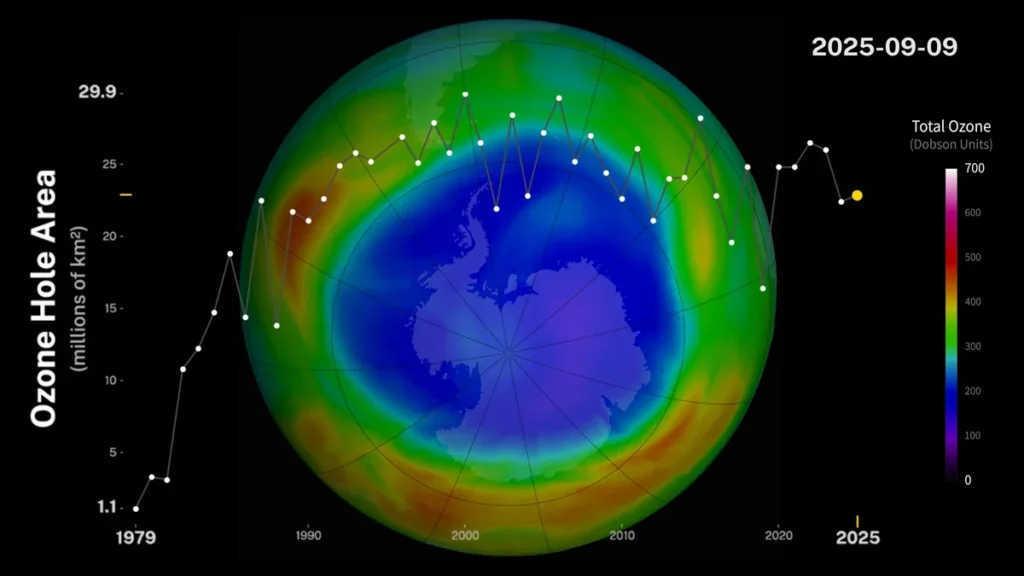
NASA and NOAA ranked the 2026 Antarctic ozone hole seventh largest in 48 years of observations after the hole reached its largest extent over Antarctica on September 18, 2026, covering 10.5 million square miles, about 90 percent of the record set on September 9, 2000.
Between September 7 and October 13, 2026, during the peak ozone-depletion window, the hole averaged roughly 9.6 million square miles, or 25 million square kilometers, more than twice the area of the United States. Researchers rely on this seasonal average for year-to-year comparisons, and the figure indicates the hole exceeded the size of the continental United States. NASA and NOAA scientists said an exceptionally strong polar vortex over Antarctica expanded the hole by trapping cold air and preserving ozone-destroying conditions across a wider region. The vortex is a seasonal band of strong winds circling Antarctica; when it stays powerful, cold air and stratospheric clouds that trigger ozone destruction persist over a larger region.
The ozone hole is defined as the region where ozone concentrations fall below the historical threshold of 220 Dobson units. The 2026 hole covered broad ground but was not as deep as other major ozone holes on record, NASA and NOAA said. Record-breaking events from roughly 10 to 20 years earlier produced more extreme ozone loss even when covering less ground.
Measurements in 2026 combined weather-balloon and Dobson-spectrophotometer readings with satellite data from NASA’s Aura, NOAA-20, NOAA-21, and Suomi National Polar-orbiting Partnership. Spaceborne instruments have tracked ozone changes since 1979, giving scientists a long record for comparing the annual hole. NOAA instruments measured a 2026 low of 105 Dobson units over the South Pole on October 17, 2026; the lowest reading ever recorded there was 92 Dobson units in October 2006.
In 1985, British Antarctic Survey scientists reported that Earth‘s natural sunscreen was thinning dramatically over Antarctica each spring, and NASA satellites later showed the continental scale of the thinning. The ozone hole above Antarctica was first discovered in the 1980s, and scientists found that it returns every year between September and November.
Since measurements began in 1979, the largest single-day ozone hole spanned 11.5 million square miles in September 2000. That 2000 event remains the record benchmark against which the 2026 peak is compared. Ozone depth reached a 1979 maximum of 194 Dobson units, while the deepest hole on record dropped to 73 Dobson units in 1994.
Chlorine and bromine compounds released by human activity reach the stratosphere, where ultraviolet radiation breaks them apart and the resulting atoms destroy ozone through reactions with polar stratospheric cloud particles. Chlorofluorocarbons were used in refrigerators and aerosol sprays starting in the 1930s, and these long-lived chemicals circulate for decades before ultraviolet light breaks them apart in the stratosphere. Human-produced bromine compounds occur in much smaller amounts than chlorine but destroy ozone far more effectively, and they also contribute to the Antarctic ozone hole. Year-to-year differences in the hole’s size and depth are driven by changes in stratospheric temperature and circulation, with colder conditions enlarging the area and lowering ozone values in the core.
Paul Newman, a senior scientist at the University of Maryland who leads NASA’s ozone research team at Goddard Space Flight Center, said recent years have seen the ozone hole begin forming later in the season, evidence he cited that the ozone layer is healing. Newman said limits on ozone-destroying chemicals kept the 2026 hole smaller by an estimated 1 to 2 million square miles, or 3.5 million square kilometers, than it would have been without them.
Newman said the hole now begins forming later in the season than it did in past years, and he said that timing indicates the ozone layer is healing.
Global emissions of ozone-depleting substances have fallen by more than 99 per cent under the 1985 Vienna Convention and the 1987 Montreal Protocol. The treaties were created to eliminate production of ozone-damaging chemicals, and studies estimate that the Montreal Protocol and related treaties have prevented millions of excess cases of skin cancer. The Montreal Protocol adopted a 2016 amendment to phase down hydrofluorocarbons, the greenhouse gases that replaced ozone-depleting chemicals.
Stephen Montzka of NOAA’s Global Monitoring Laboratory said chlorine linked to ozone-depleting chemicals in the Antarctic stratosphere has fallen about one-third from 1980s peak levels. The Antarctic ozone hole is projected to heal by the 2070s, researchers said, even though unusually large seasonal holes can still occur, as in 2026. Models indicate that stratospheric chlorine and other ozone-depleting substances will stay above pre-1980 levels until later this century. According to researchers, about 80 percent of today’s stratospheric chlorine comes from human activity rather than natural sources.
Montzka said the holes would vanish once these gas concentrations drop below a certain point, though annual weather swings still matter.
These chemicals can remain in the atmosphere for decades, while older equipment, materials, and landfill waste can release additional emissions of substances produced years ago. Stephen Montzka said progress depends on continued compliance with past phase-out agreements for damaging chemicals, and that international agreements have cut the use of ozone-damaging chemicals in aerosols, refrigeration and foam propellants. Amy Butler, a research scientist at the NOAA Chemical Sciences Laboratory, said planetary-scale weather systems that normally rise from the lower atmosphere and disrupt the stratospheric polar vortex were unusually weak in August and September, leaving the strongest vortex winds several degrees of latitude farther from the South Pole.
NOAA’s Boulder-based Global Monitoring Laboratory co-leads ozone research, and staff in Boulder launch balloon-borne ozonesondes from the Amundsen-Scott South Pole Station in winter; the device originated in Boulder in the 1960s.
Nine Colorado Front Range counties routinely violate U.S. standards for ground-level ozone, a lung-damaging pollutant that is distinct from the protective stratospheric ozone layer. Surface-level ozone is a pollutant frequently linked to human activity, unlike the protective ozone layer high in the atmosphere.
The ozone layer blocks nearly all harmful solar ultraviolet radiation, and added exposure raises skin cancer and cataract risks while lowering agricultural productivity. Most atmospheric ozone sits in the stratosphere, roughly 10 to 50 kilometres above Earth’s surface, and the entire layer would measure only about three millimetres thick if brought to ground level.
A South Pacific underwater volcano eruption that released water vapor high into the air helped drive a 2023 ozone hole spike. During that September, the peak day covered 10 million square miles, while the peak-month average reached 8.9 million square miles.

Join the discussion