Key facts
- Aashay Pai and co-authors stated in a study accepted by The Astrophysical Journal Letters that the Milky Way satellite Rubin-GC1 has an intermediate age of about 9.2 billion years and is moderately rich in metals.
- Marla Geha stated on October 28, 2026, that finding new Milky Way satellites in data from the Vera C. Rubin Observatory has been a long-standing future prospect and described it as remarkable that it is now a reality.
- The authors of the second study stated that the identification of Rubin-GC1 heralds an era of discovery in which the Vera C. Rubin Observatory, Euclid, and the Nancy Grace Roman Space Telescope will pierce Galactic dust.
- The Vera C. Rubin Observatory is located on the summit of Cerro Pachón in northern Chile and features a 3.2-gigapixel camera built for astronomy.
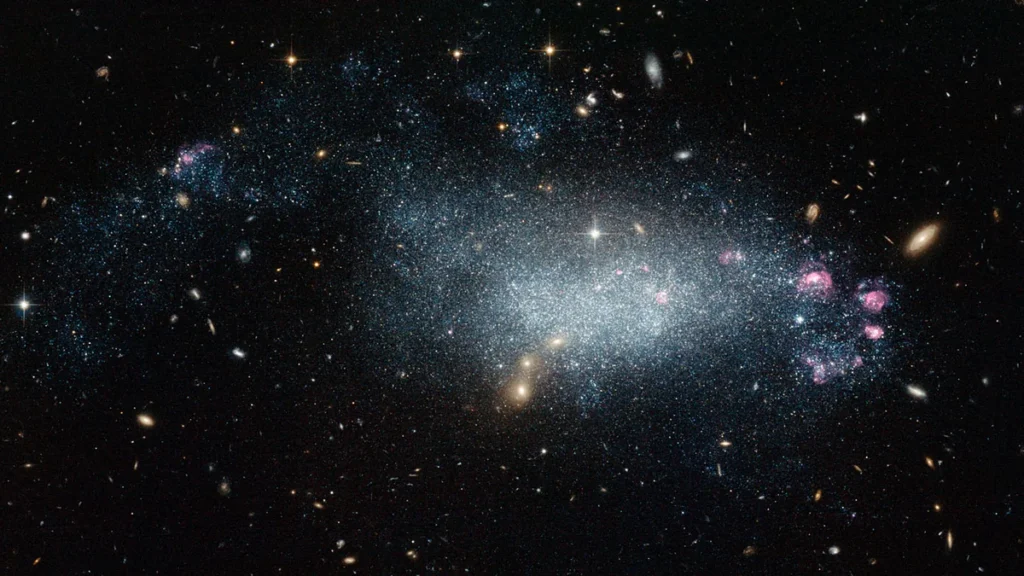
Astronomers analyzing preview data from the Vera C. Rubin Observatory discovered Aquarius IV, an ultra-faint satellite galaxy orbiting the Milky Way about 355,000 light-years from Earth, and announced the finding in August 2026.
William Cerny and his co-authors posted their study on arXiv on Aug. 4, 2026, and published it in Research Notes of the American Astronomical Society as Discovery of the Distant, Ultra-faint Milky Way Satellite Aquarius IV with the Vera C. Rubin Observatory Early Data Preview 2. The discoveries are presented in two separate papers detailing the new Milky Way satellites found in the observatory data, and the Aquarius IV paper is authored primarily by Yale graduate student William Cerny.
Cerny said on Oct. 28, 2026, that Aquarius IV is the first ultra-faint Milky Way satellite identified using Rubin Observatory data, and he described it as a low-luminosity, compact stellar system in the outer Galactic halo. The system lies approximately 355,000 light-years from Earth and has an apparent magnitude of 18.3, with an ancient, low-metallicity stellar population that closely resembles the smallest confirmed ultra-faint dwarf galaxies. A globular cluster classification is not yet completely ruled out.
Cerny said confirming whether Aquarius IV is definitively an ultra-faint dwarf galaxy will require deeper imaging and spectroscopy because only a small number of its stars have been detected so far. He said the discovery was confirmed using images from the Dark Energy Camera. That confirmation followed analysis of the initial detection in preview data and verification of the low-luminosity compact stellar system using archival imaging.
William Cerny said on Oct. 28, 2026, that the full 10-year survey by the Vera C. Rubin Observatory will provide many more Milky Way satellite discoveries and offer new opportunities to test galaxy formation models and investigate dark matter. “What I find especially exciting is that these discoveries are just the beginning for Rubin,” Cerny said. He said these new satellite discoveries follow preview data findings that demonstrate the sensitivity of the observatory.
Aashay Pai and his co-authors reported in a study accepted by The Astrophysical Journal Letters that Rubin-GC1 has an intermediate age of about 9.2 billion years and is moderately rich in metals. These combined properties show that Rubin-GC1 is most likely a faint globular cluster located in the faint tail of the luminosity function. Pai and his research team said Rubin-GC1 is likely a star cluster accreted to the Milky Way and associated with the Sagittarius leading arm, based on comparisons to the Sagittarius dwarf spheroidal galaxy. The Sagittarius leading arm represents a massive tidal stream of stars stripped away as the Sagittarius Dwarf Spheroidal Galaxy merges with the Milky Way.
Pai and co-authors wrote a paper titled Rubin Observatory Reveals a Dust-Shrouded Halo Globular Cluster in Ophiuchus, accepted by The Astrophysical Journal Letters and available at arxiv.org. They said Rubin-GC1 is likely a star cluster residing in the faint tail of the luminosity function of globular clusters surrounding the Milky Way. They said the discovery underscores the observatory’s capacity to find faint and resolved satellites within dust-shrouded regions of the Milky Way. Locating globular clusters in the direction of the Galactic bulge presents significant challenges because of dense stellar crowds and heavy dust extinction, and the successful detection of Rubin-GC1 demonstrates the telescope overcomes these obstacles.
The Vera C. Rubin Observatory sits on the summit of Cerro Pachón in northern Chile and is equipped with an 8.4-meter Simonyi Survey Telescope funded jointly by the National Science Foundation and the U.S. Department of Energy’s Office of Science. The facility also features a 3.2-gigapixel camera built for astronomy and conducts the 10-year Legacy Survey of Space and Time. The observatory relies on advanced optical hardware located in Chile to capture wide-field images of the night sky repeatedly over a ten-year campaign.
Researchers analyzing data from the observatory’s Early Data Preview 2 used test observations taken between April 2025 and January 2026 that covered about 7% of the total night sky. Those test observations preceded the official start of the Legacy Survey of Space and Time in June 2026. Astronomers analyzed test data gathered before the observatory’s official launch to find the new dwarf galaxy. The preview data findings demonstrate the sensitivity of the observatory.
The authors of the first study stated that systems like Aquarius IV are ultimately expected to be detectable with greater than 85% efficiency using the same search algorithm applied to the preview data. As the Legacy Survey of Space and Time progresses, the sensitivity of the telescope will steadily increase. The authors of the second study said the identification of Rubin-GC1 heralds an era of discovery in which the Vera C. Rubin Observatory, Euclid, and the Nancy Grace Roman Space Telescope will pierce Galactic dust. These combined observatories will reveal faint satellites that were hidden by the dust of our Galaxy.
Marla Geha said on Oct. 28, 2026, that finding new Milky Way satellites in data from the Vera C. Rubin Observatory has been a long-standing future prospect and described it as remarkable that it is now a reality. She stated that continued discoveries of satellite galaxies will enable astronomers to complete the census of satellite galaxies around the Milky Way. Completing this census serves as a vital key to understanding the formation mechanisms of the universe’s faintest galaxies.
Large galaxies like the Milky Way are orbited by retinues of satellites, including small dwarf galaxies and globular clusters, which form part of the galaxy’s hierarchical assembly through mergers. Large galaxies such as the Milky Way grow through the hierarchical accretion of smaller satellite systems, leaving behind stellar streams and halo substructures. Ultra-faint dwarf galaxies are among the least luminous, oldest, and most dark matter-dominated objects known, making them vital tools for probing galaxy formation and dark matter physics.
These systems contain a high fraction of dark matter compared to regular stars, making them important laboratories for cosmology and galaxy formation models. Discovering faint Milky Way satellites with the Vera C. Rubin Observatory provides astronomers with new opportunities to test galaxy formation models, complete the census of neighboring dwarf galaxies, and investigate the role of dark matter in the assembly history of the Milky Way.




Join the discussion