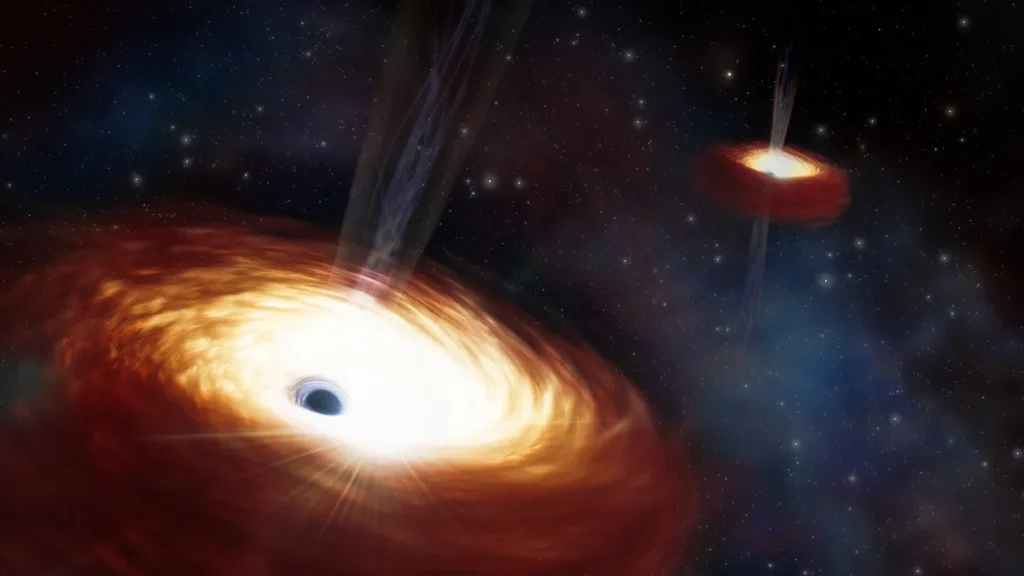
Yiqin Chen’s team at Beijing Normal University used 18 years of observations of 30 pulsars from Australia’s Parkes Pulsar Timing Array to place the first direct mass constraints on supermassive black hole pairs in the cosmic dawn, publishing the work in Physical Review Letters in 2026. The research offers a gravitational-wave check on the oversized black holes that the James Webb Space Telescope has found weighing billions of solar masses less than a billion years after the Big Bang, with astronomers still unclear how the objects grew so large so quickly.
Orbiting supermassive black hole pairs stir spacetime and send gravitational waves across the universe, but for pairs this massive a single orbit takes around a year, producing waves too slow for Earth-based detectors. Earth-based detectors cannot capture these slow waves, so astronomers use pulsar timing arrays as galaxy-scale instruments instead. These arrays are networks of rapidly spinning neutron stars spread across the galaxy that flash with the steady rhythm of cosmic clocks, while a passing gravitational wave subtly shifts their timing in a pattern shared across the whole array. Astronomers seek the shared timing pattern across the array as the signature of gravitational waves from distant black hole pairs, and the long Parkes data set enabled the team to search for nanohertz gravitational waves from distant binary black holes.
Standard searches overlook cosmic expansion, which stretches gravitational waves during travel and can distort distant pair masses, confining these searches to the nearby universe. That limit kept distant binaries effectively out of reach because redshift was ignored, so pulsar timing searches stayed confined before Chen’s team accounted for it. Chen’s team developed a new approach accounting for strong redshift, where a redshifted wave reaching Earth was first released at a higher frequency while the black holes orbited tightly, and this brightening can outweigh the dimming caused by distance. A wave emitted during a tighter orbit was stronger at the source, an effect that can compensate for the dimming of distant signals.
The researchers combined their search with the known positions and redshifts of two targets to calculate limits on the true masses of any black hole pairs in these systems. The first target was an ultrabright quasar from less than 900 million years after the Big Bang, and its position and redshift were used together with the second target to calculate mass limits for any black hole pairs in that system. The second target was a distant galaxy detected by JWST under 300 million years after the Big Bang, and its extreme distance and known redshift let the team test for massive binary black holes in the early universe.
Chen’s team says the results could offer a new way to hunt for black hole pairs and could help explain how such massive black holes appeared so early in the universe’s history. The finding challenges the assumption that distance is a barrier to finding early supermassive black hole pairs. As the Parkes array merges its data with other arrays and upcoming instruments such as the Square Kilometer Array improve pulsar timing, Chen’s team hopes these constraints will tighten further, potentially bringing less extreme pairs within reach.
The work appears as Yiqin Chen et al., Nanohertz Gravitational-Wave Constraints on Supermassive Binary Black Holes at Cosmic Dawn, in Physical Review Letters (2026), with DOI 10.1103/5z5g-shly and arXiv identifier arxiv.org/abs/2609.00613v1. This is the peer-reviewed paper presenting the new mass limits.
Pulsar timing work in the United States also rests on National Science Foundation facilities and support. The NANOGrav collaboration receives backing from National Science Foundation Physics Frontier Center award numbers 1430284 and 2020265, the Gordon and Betty Moore Foundation, NSF AccelNet award 2114721, an NSERC Discovery Grant, and the Canadian Institute for Advanced Research.
NANOGrav is a collaboration receiving NSF and other funding for pulsar timing work related to supermassive black hole mergers. The Arecibo Observatory is an NSF facility operated under cooperative agreement #AST-1744119 by the University of Central Florida in alliance with Universidad Ana G. Méndez and Yang Enterprises Inc., and it is part of the radio astronomy infrastructure used in pulsar timing observations.
The Green Bank Observatory and the National Radio Astronomy Observatory are National Science Foundation facilities operated under cooperative agreements by Associated Universities Inc., and they are NSF-supported facilities relevant to pulsar timing infrastructure.


Join the discussion