Key facts
- Roman primarily observes in infrared light with some visible coverage over a much larger field than Hubble, creating panoramas of the universe.
- Albert Einstein first predicted gravitational lensing, which happens when a massive foreground galaxy or cluster bends, warps, and magnifies light from a background object farther away.
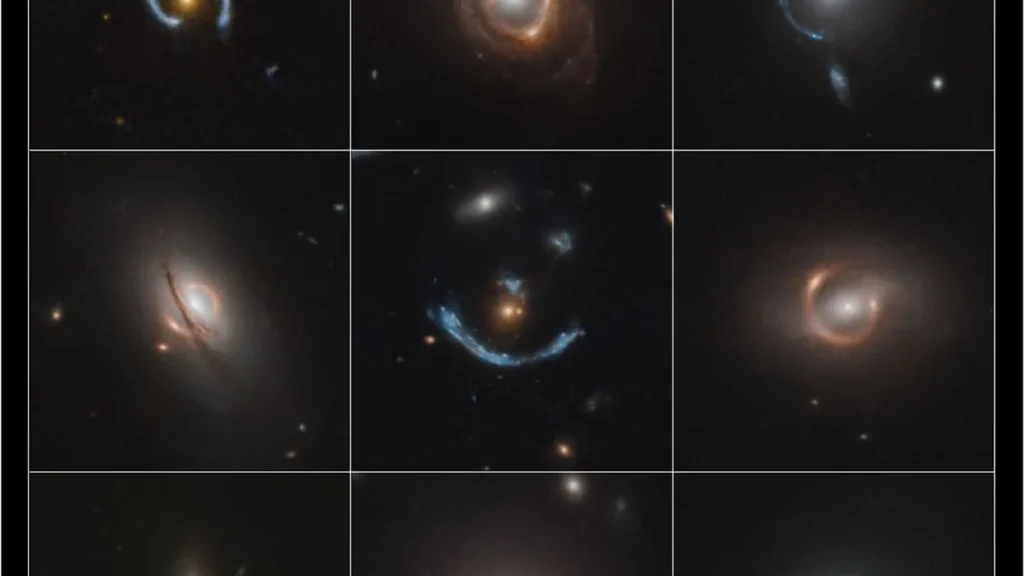
- Panel A shows an arc-counterarc configuration where the lensed background galaxy appears as two duplicated arcs. A pair of foreground galaxies magnifies the galaxy by bending its light around their combined mass.
- Panel F shows an Einstein Ring, where the alignment of the background galaxy and the approximately spherical foreground lens mass is so perfect that the background galaxy nearly surrounds the foreground galaxy.
On Nov. 12, 2026, NASA released a Hubble Space Telescope gallery of gravitational lenses that serves as a sampler of lensed galaxies and a preview of targets for the Nancy Grace Roman Space Telescope’s coming survey.
Albert Einstein first predicted gravitational lensing, in which a large foreground galaxy or cluster bends and magnifies light from an object farther away. In each system, a background galaxy lines up with the mass of a foreground galaxy, so the foreground galaxy’s mass stretches the background light into arcs around the foreground object.
Astronomers found these strong lenses with the Dark Energy Spectroscopic Instrument at Kitt Peak, observed them with Hubble, and plan further Roman observations. By measuring how the foreground mass distorts the background images, researchers calculate the amount and spread of mass in the foreground galaxy, including the dark matter that gives off no light.
Panel A pairs two foreground galaxies that magnify one background galaxy by bending its light around their combined mass, producing two duplicated arcs. Panel F is an Einstein ring, created when the background galaxy and an approximately spherical foreground mass line up so closely that the background galaxy almost encircles the foreground galaxy. Panel I shows a quadruply lensed galaxy copied four times as smeared dots around the foreground galaxy. Panel C shows a different quadruply lensed galaxy whose double knots are probably strong star-forming regions in the background galaxy.
A visible dust lane appears in Panel D’s foreground galaxy, a detail rare in a lensing galaxy that Hubble’s sharp visible-light vision is especially good at revealing. The foreground galaxy in Panel G looks elongated, which could be real or just a matter of perspective, and the foreground galaxies in Panels B and F seem to have spiral arms. Some lensed background galaxies shine blue because they contain young stars, while others look red because they hold older stars.
Elliptical galaxies, which are older, denser, and more compact, make up most of the foreground lenses, and a lensed image appears only when the foreground galaxy’s mass density passes a critical level. One Hubble view pairs a foreground elliptical galaxy roughly 4.5 billion light-years away with a background galaxy about 8 billion light-years away, seen as a big arc plus a smaller flipped image.
A heavier foreground galaxy makes a stronger lens and bends light more, yet visible matter by itself cannot explain the observed distortion. Dark matter is the invisible substance believed to supply most of the mass in the universe. Using Hubble’s sharp imaging and careful models, researchers hope to spot flaws in lensed arcs that would reveal small clumps of dark matter.
The cold dark matter theory predicts many small dark matter clumps of between one million and one billion solar masses, while the Milky Way’s dark matter halo totals about 1.3 trillion solar masses. Researchers plan to model a large and varied set of gravitational lenses to weigh the foreground galaxy in each system and potentially confirm or reject a dark matter theory.
Studying the Hubble lens images closely should let researchers build a super-intelligence tool that efficiently finds similar arcs in future Roman images. They are also building a computer model based on Hubble’s sharp images to measure dark matter-driven distortions, and that tool will help process Roman’s large images.
Hubble observes in visible and ultraviolet light, with some infrared coverage, and gives high-resolution views of individual objects. Roman observes mainly in infrared with some visible light across a much wider field than Hubble, producing panoramas of the universe. Roman’s Wide Field Instrument matches Hubble’s sensitivity across a field 100 times larger. Hubble gives the better look at any one lens, while Roman finds more lenses by scanning more sky.
Roman’s primary mirror measures 7.9 feet, the same width as Hubble’s. Its Wide Field Instrument will look at one image spanning more than 100 times the sky area Hubble covers and will scan the sky at more than 1,000 times Hubble’s survey speed. It has the potential to survey the entire sky at Hubble-like resolution, although Hubble has observed roughly 0.1 percent of the night sky in over 30 years. It will observe billions of galaxies to track how cosmic structures grew and to test the standard model of cosmology.
In January 2027, Roman’s science operations should begin. Roman will operate with Hubble and the Webb Space Telescope rather than replace them, using its surveys to spot unusual targets for Hubble and Webb to study closely. When Roman turns up a promising lens, researchers can follow up with Hubble’s visible and ultraviolet instruments on individual objects. Hubble and Webb can linger on single objects in extraordinary detail, while Roman supplies the wide view and turns up large numbers of objects.
On Aug. 28, 2026, Roman was two days from launching as NASA’s flagship astrophysics mission following the James Webb Space Telescope. The gallery shows cooperation across NASA’s Great Observatories, since Roman joins Hubble and the Chandra X-ray Observatory plus the James Webb Space Telescope. Dark matter and dark energy together make up nearly all the universe: dark matter has gravity but emits no light, and dark energy corresponds to the universe’s accelerating expansion.
NASA chose the Arizona Cosmology Lab at the University of Arizona for a wide-field science effort and an infrastructure project. Elisabeth Krause leads the Roman Space Telescope‘s wide-field Kinematic Lensing team, backed by $2 million. Tim Eifler leads a working group inside the project infrastructure team called Maximizing Cosmological Science with the Roman High Latitude Imaging Survey.
Tim Eifler’s lab received $800,000 for computing resources and $2.4 million over five years for science from the NASA Roman Project. Tim Eifler co-chairs a cosmology group of more than 1,000 scientists worldwide. The University of Arizona will lead nine NASA-approved Roman investigations worth more than $2 million. “Roman doesn’t do Hubble science faster,” said Julie McEnery, Roman’s senior project scientist.




Join the discussion