Key facts
- The mission aims to investigate dark energy and dark matter, which sources estimate make up about 70 percent and 25 percent of the universe respectively.
- Strong gravitational lensing candidates in the release total about 15,000 probable cases, compared with roughly 1,000 previously known cases, and about 170,000 are expected by the mission's end.
- The full Data Release 1 is scheduled for mid-2027 and will add weak-lensing observations plus analysis of galaxies and clusters in the cosmic web.
- Stephen Serjeant, professor of astronomy at the Open University, said strong lensing reveals how dark matter clumps and that a breakthrough in dark matter properties might come from this technique.
On Nov. 12, 2026, ESA’s Euclid mission published DR1-Foundation, its first major data release, listing more than 900 million galaxies and roughly 15,000 strong gravitational lensing candidates.
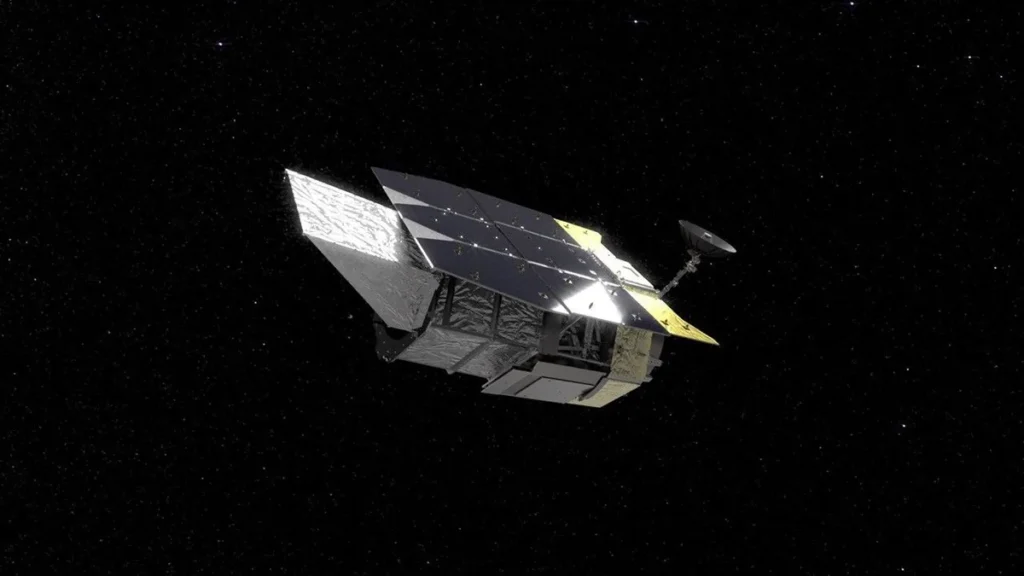
The release covers about 13 months of observations and is the first major batch of mission data since the spacecraft’s launch in mid-2023. Euclid lifted off in July 2023, with one source specifying July 1, 2023, and began routine science observations on Feb. 14, 2024. The spacecraft will spend six years surveying one third of the sky and more than 10 billion years of cosmic history, creating the largest and most accurate three-dimensional map of the universe while tracing dark energy and dark matter across cosmic time. [S2, Uniinnsbruck, S10]
This release’s survey portion covers 1,900 square degrees, or about 14 percent of the total sky area Euclid will survey. That is far larger than earlier Euclid releases, which covered only a few days of observations over roughly 60 square degrees, according to ESA project scientist Valeria Pettorino, and represents a change in scale from those first efforts. The new catalogue holds more than one billion cosmic objects across a patch of sky as big as 9,500 full Moons.
DR1-Foundation also contains over 60 million quasar candidates along with spectra from more than 160 million sources, totaling 1.7 million gigabytes of data in what sources call the first public release of Euclid data. These blazing objects sit at the center of distant galaxies, and supermassive black holes power them.
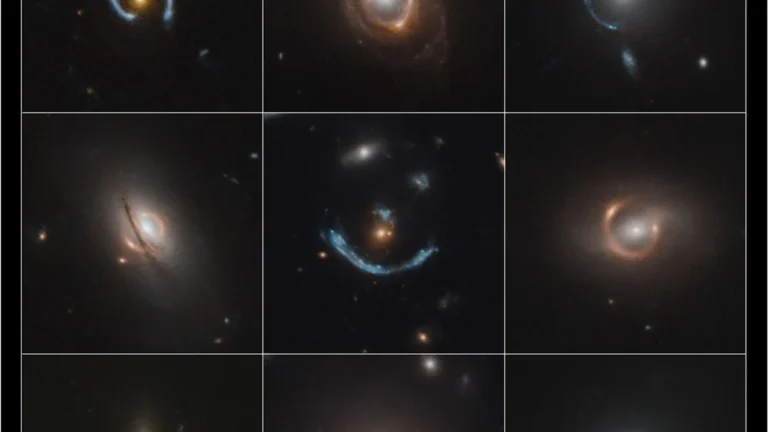
A strong gravitational lens occurs when a foreground galaxy, frequently part of a cluster, sits in front of a more distant galaxy and distorts space-time, pulling background light into bright arcs or rings. Because Euclid observes from space above Earth’s image-blurring and light-dimming atmosphere, it can find far more of these rare events than ground telescopes, which are limited by the atmosphere. This release builds the largest strong-lens catalogue ever assembled, surpassing all earlier catalogs put together.
Studying strong gravitational lenses lets scientists weigh individual galaxies, including their invisible dark matter, and may rule out competing theories about dark matter’s nature. Euclid aims to study dark energy and dark matter, which sources estimate account for about 70 percent and 25 percent of the universe respectively. Strong lensing reveals how dark matter clumps, and because the distribution of dark matter within a galaxy depends on its properties, different dark matter models predict different lensing patterns, making the technique a very diagnostic probe.
The release contains about 15,000 probable strong lensing candidates, up from roughly 1,000 previously known cases, with about 170,000 expected by the end of the mission. Euclid reported about 500 strong lens candidates in March 2025, illustrating the rapid increase in data volume as the mission moved from early observations to its first major year-long survey release.
The complete Data Release 1 is set for mid-2027 and will include weak-lensing observations plus analysis of galaxies and clusters in the cosmic web. Weak lensing tracks subtle distortions caused by foreground dark matter and will pair with the strong lenses in this release to chart dark matter across the universe. Andy Taylor of the University of Edinburgh said a further release is expected next summer and will include results on galaxy distribution and weak gravitational lensing.
Carole Mundell, ESA’s director of science, described the release as far more than beautiful pictures, a scientific milestone and the largest survey of its kind ever flown in space, adding that it demonstrates European technology, science and international collaboration and lays the groundwork for future discovery in a new regime for astronomy. Andy Taylor of the University of Edinburgh, who leads the UK science ground segment, said Euclid keeps high resolution while mapping vast sky volumes, unlike Hubble which covers less area, and called the release the biggest high-resolution image of the universe ever obtained. He noted that while larger surveys exist, none match the detail and information content of Euclid, and that no human can examine all Euclid data anymore.
Stephen Serjeant, a professor of astronomy at the Open University, called strong lensing a very diagnostic probe because different matter types clump differently, while cautioning that a breakthrough in dark matter properties is not certain. Natalie Lines of the University of Portsmouth said Euclid would transform strong lens discovery and that the technique lets astronomers study how the universe is expanding; her team predicted this capability over 10 years ago and the day has now arrived.

Euclid employs spectroscopy to break galaxy light into rainbows that reveal distances, placing galaxies within the universe’s three-dimensional structure and linking them to the cosmic web. For the brightest galaxies, these spectral rainbows also point to origin and composition, helping build the detailed three-dimensional map at the heart of the mission. This release marks the first demonstration of Euclid’s capabilities as a sky surveyor.
First image glimpses from Euclid appeared in November 2023 and May 2024, then the first piece of its great map of the Universe arrived in October 2024 before preliminary survey batches followed in March 2025 and June 2026.
Francine Marleau of the University of Innsbruck estimates that the new dataset holds hundreds of thousands of dwarf galaxies and that Euclid will identify more than two million by the end of the mission across roughly 14,000 square degrees. Her estimate draws on an initial analysis of a small sky region carried out last year, while earlier observations already found and characterized thousands of dwarf galaxies. She said the mission will deliver the first statistically robust, homogeneous sample across a cosmologically relevant part of the universe. In that role she coordinates consortium research areas beyond primary cosmology, including exoplanets, galaxy formation, supernovae and distant black holes.
Barbara Sartoris of the JL Lagrange laboratory in Nice said Euclid provides views of large samples of ancient galaxy clusters not previously within reach. Her team plans to study these clusters in the coming months to learn how the giants grew and what they reveal about the dark universe.
Francisco Castander of ICE-CSIC and IEEC said the release enables researchers worldwide to make discoveries and maximizes the mission’s scientific impact. He pointed to the remarkable quality and scale of the dataset as support for a broad spectrum of cosmic studies. Rafael Rebolo, a CSIC professor at the IAC and Euclid Consortium Board of Directors member, said the release holds only first-year science data and marks just the start. He said it lays the groundwork for a more extensive future dataset that will address fundamental problems in cosmology and astrophysics.
Valeria Pettorino, ESA’s Euclid project scientist, said the dataset contains enough statistics to uncover even rare objects, with much more discovery still to come.
The Euclid Consortium comprises more than 2000 scientists from 300 institutes in 15 European countries, the USA, Canada and Japan. Spain contributes NISP instrument filter wheel work through ICE-CSIC, IFAE, IEEC and PIC, and NISP control electronics through the Instituto de Astrofísica de Canarias and the Polytechnic University of Cartagena. The Spanish nodes joined the scientific consortium in 2010, one handling the NISP filter wheel and cosmological simulations and the other responsible for NISP control electronics and boot-up software, with José Javier Díaz as technical lead and Carlos M. Gutiérrez as principal investigator and coordinator. About 80 European companies take part in Euclid, nine of them Spanish, while roughly 100 Spanish scientists at more than 20 institutions prepare analysis of the dark universe data.
German research centers including LMU Munich and Max Planck Institutes provided key optical components and data processing for the mission. The IAC’s technological contribution earned the EUCLID Consortium EULER Award for outstanding contribution to the mission’s instrumentation, recognizing design and construction work by IAC and the Polytechnic University of Cartagena on the NISP instrument’s electronic unit and boot-up software. Researchers can access Euclid data through the Euclid Data Space at euclid.dataspace.esa.int and explore it in full color on ESASky at sky.esa.int.



Join the discussion