Key facts
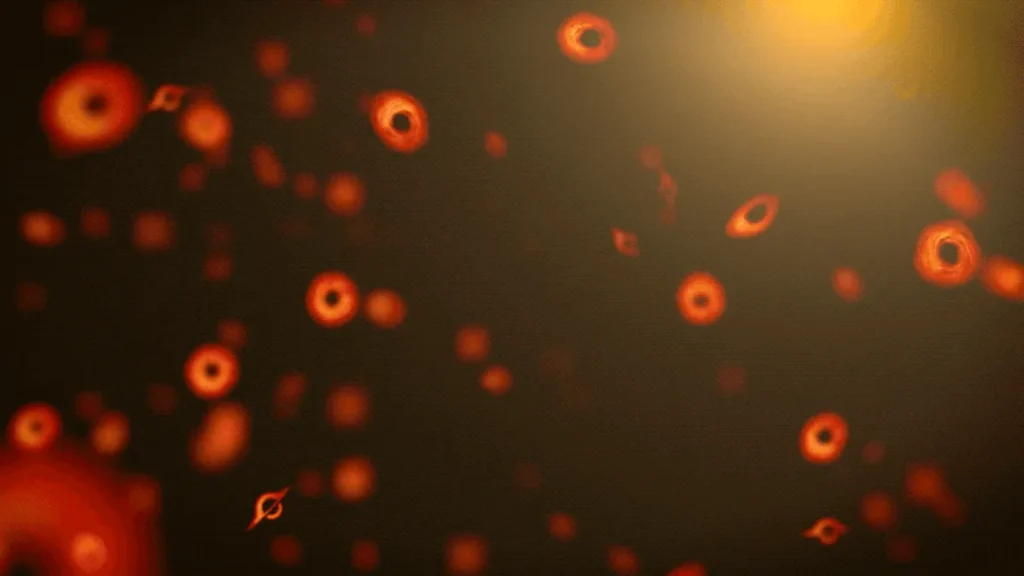
- Researchers from PRISMA++ and Mainz propose microscopic primordial black holes reheated the young universe immediately after post-Big Bang expansion, per a Physical Review Letters study.
- The model indicates tiny black holes formed shortly after inflation ended, while expanding radiation cooled faster than the holes, letting the singularities dominate the cosmos.
- Such a burst would have created a powerful Poltergeist gravitational wave signal, but no such intense radiation appears in the observed gravitational wave background.
- General relativity predicts a spectrum of primordial black hole masses rather than one uniform size, making the uniformity assumption incompatible with the theory.
Researchers from PRISMA++ and Johannes Gutenberg University Mainz propose that microscopic primordial black holes reheated the young universe immediately after cosmic inflation between 10^-35 and 10^-33 seconds, according to a Physical Review Letters study. Their proposal addresses a period cosmologists know little about, the epoch between initial reheating and the first atomic nuclei. It builds on longstanding questions about these objects and how the cosmos evolved after the initial expansion, and it is framed as a potential advance in understanding how the early universe behaved right after the Big Bang.
Standard theory says cosmic inflation between 10^-35 and 10^-33 seconds left the universe supercooled, requiring an initial reheating that filled space with hot matter and radiation. Inflation was an exponential expansion that cooled the cosmos, and the reheating that followed restored hot matter and radiation before evolution continued. Physicists currently lack direct evidence for the period between the end of initial reheating and the appearance of the first atomic nuclei, which the Mainz team calls a major observational blind spot.
Pedro Schwaller, a theoretical physicist at Johannes Gutenberg University Mainz and the PRISMA++ Cluster of Excellence, is among the researchers proposing that tiny black holes formed shortly after inflation ended. As expanding radiation cooled faster than the holes, the singularities came to dominate the cosmos. The model holds that radiation lost energy faster than the holes as expansion continued, shifting the balance until the black holes dominated the early universe. This created a second supercooled era made mostly of expanding spacetime and black hole singularities, tying the universe’s subsequent evolution directly to the fate of these objects.
Stephen Hawking showed black holes evaporate slowly, ending in a final explosion, and larger holes live longer than smaller ones. Hawking radiation means smaller black holes evaporate faster than larger ones, so a primordial black hole’s lifespan depends directly on its mass. When these primordial holes evaporated and exploded, their energy reheated the universe a second time, producing the hot plasma from which material structures formed. The researchers argue that evaporating black holes ended in explosive bursts that supplied the energy needed to recreate the hot conditions associated with the Big Bang.
These smallest holes may have been subatomic while holding nearly all the universe’s energy. Earlier models assumed primordial black holes were uniform, meaning all of them would vanish simultaneously. Prior studies treated the primordial black hole population as monolithic, implying every object would disappear at once and dump its energy into the cosmos simultaneously. That kind of burst would have generated a strong Poltergeist signal in gravitational waves, but the observed background contains no such intense radiation.
Leister says an instantaneous burst would have generated gravitational waves far stronger than anything seen in the background, which led earlier work to reject primordial black holes as a reheating mechanism. General relativity predicts primordial black holes come in a spectrum of masses rather than one uniform size, which makes the uniformity assumption incompatible with the theory. Primordial processes naturally generate black holes across a spectrum of masses under general relativity, undermining the idea that all objects were identical. A mass spread means lighter holes explode first, producing gradual heating instead of one sudden burst and keeping spacetime ripples faint because lighter black holes evaporate more quickly and spread the energy release over time.
The team simulated the early universe with primordial black holes of various sizes while respecting Hawking’s 1970s upper limit of 109 grams, equal to 1,000 metric tons, with a lifetime of only one second. Hawking’s 1970s calculation places the ceiling at 109 grams, or 1,000 metric tons, beyond which primordial black holes would disrupt atomic formation through gravitational waves and simultaneous explosions. The researchers wanted to determine whether gravitational waves from primordial black holes of various sizes would be small enough to avoid disrupting cosmic chemistry. They ran simulations centered on the primordial black hole mass spectrum to test whether a varied population could satisfy the upper limit and still produce the needed thermal effects for cosmic reheating.
Models with varied hole sizes suppressed gravitational waves enough to preserve atom creation and cosmic expansion because the holes exploded at different times. Staggered explosions let the models keep gravitational wave production below levels that would interfere with atom creation or stop cosmic expansion. The researchers say an early universe dominated by ultra-light primordial black holes is physically viable and could deliver the second reheating behind the hot Big Bang, restoring a scenario once thought ruled out.
Nicolas Leister, a PhD student at PRISMA++ and a co-author on the Physical Review Letters study, described the objects as ultra-light black holes and spoke for the research group. Because the predicted gravitational waves are faint, future gravitational wave experiments will probably not be able to test the theory directly, though the mechanism remains physically viable. Leister said that while the mechanism is physically viable, the weakness of the predicted signal makes it unlikely to be tested by upcoming gravitational wave observatories. Leister said, “Future gravitational wave experiments probably won’t be able to probe this theory.”
The paper appeared in Physical Review Letters under the title Opening the Window of Ultra-Light PBHs by Exorcising the Poltergeist. The title refers to the Poltergeist signal predicted by earlier uniform models, and the authors present their work as opening a window into the universe’s first second. Physicists at Johannes Gutenberg University Mainz collaborated with colleagues from the Institut d’Astrophysique de Paris on the theoretical modeling. The research team includes physicists from the Mainz Institute for Theoretical Physics in Germany.
Subatomic primordial black holes, according to the calculations, may have held nearly all the energy in the early universe and filled it with hot plasma across many different formation scenarios. The computational approach let researchers model the universe’s earliest microseconds and identify the precise conditions needed for a gas of black holes to achieve dominance. All observable matter today could ultimately be remnants of atomic-scale black holes, a legacy the researchers trace to atomic-scale black holes from the universe’s first moments. Universe Today says the research may help explain how life arose and whether life could form on other worlds throughout the universe, connecting it to broader questions about life’s origins.

Join the discussion