Key facts
- The Event Horizon Telescope links dishes into a virtual Earth-sized telescope and brings together scientists and radio observatories in a massive international collaboration.
- Blazars are bright active galactic nuclei with supermassive black holes at their centers whose relativistic jets of ionized matter point straight toward Earth.
- 3C 279 lies about 538 million light-years away, and its jet is powered by a supermassive black hole estimated at about 800 million solar masses, compared with about 4.3 million solar masses for Sagittarius A*.
- Kitt Peak and NOEMA added intermediate baselines that improved intermediate-scale coverage and let the team constrain particular angular scales needed to study both compact and extended jet structures.
The Event Horizon Telescope has produced detailed images of relativistic jets from 3C 84 and M87*, the supermassive black hole at the center of the M87 galaxy, in work carried out between 2024 and 2026.
The EHT Collaboration released the first image of a black hole in 2019, showing M87*, the supermassive black hole at the center of the M87 galaxy, from data collected in 2017. Phys.org places the 2019 M87 image before the 2022 Sagittarius A* image and the 2024-2026 jet images.
In 2022, the EHT provided the first image of Sagittarius A*, the supermassive black hole at the center of the Milky Way. Phys.org presents this as the EHT’s second landmark black hole image, after M87* in 2019 and before its 2024-2026 jet work.
M87 is a giant elliptical galaxy about 55 million light-years away, and it powers a bright, narrow jet roughly 3,000 light-years long. Estimates of its central black hole run from roughly six billion to 6.5 billion solar masses.
Observations from the 2021 campaign resolved 3C 279’s innermost jet region at subparsec scales, meaning scales smaller than a parsec, a unit of astronomical distance. The images mapped the jet’s dynamics and geometry and indicate that it bends toward Earth-based instruments.
The work appeared in 2026 in Astronomy & Astrophysics, a peer-reviewed journal. Phys.org says these results appeared in an Astronomy & Astrophysics paper and, together with earlier campaigns and multifrequency data, are helping the team identify the jet’s nature and driving mechanisms.
The Event Horizon Telescope links radio dishes into a virtual Earth-sized telescope, uniting scientists and radio observatories in a large international collaboration. Phys.org introduces the EHT as a collaboration that continues producing results after its 2019 and 2022 black hole images.
The collaboration’s jet work also extends to blazars, bright active galactic nuclei whose supermassive black holes power relativistic jets of ionized matter pointed straight at Earth. One such blazar is 3C 279, about 538 million light-years away; its jet is powered by a black hole of about 800 million solar masses, compared with roughly 4.3 million solar masses of Sagittarius A*. Its brightness makes it a frequent calibration source, and it is among the top targets for very long baseline interferometry, a technique linking distant telescopes to work together.
Phys.org reported that Hendrik Müller, a staff scientist in the Data Management and Software group at the National Radio Astronomy Observatory and a former Max-Planck-Institut für Radioastronomie researcher, led the 3C 279 paper in Astronomy & Astrophysics. Phys.org says Müller spoke to Universe Today by email about the array’s growth and the importance of Kitt Peak and NOEMA.
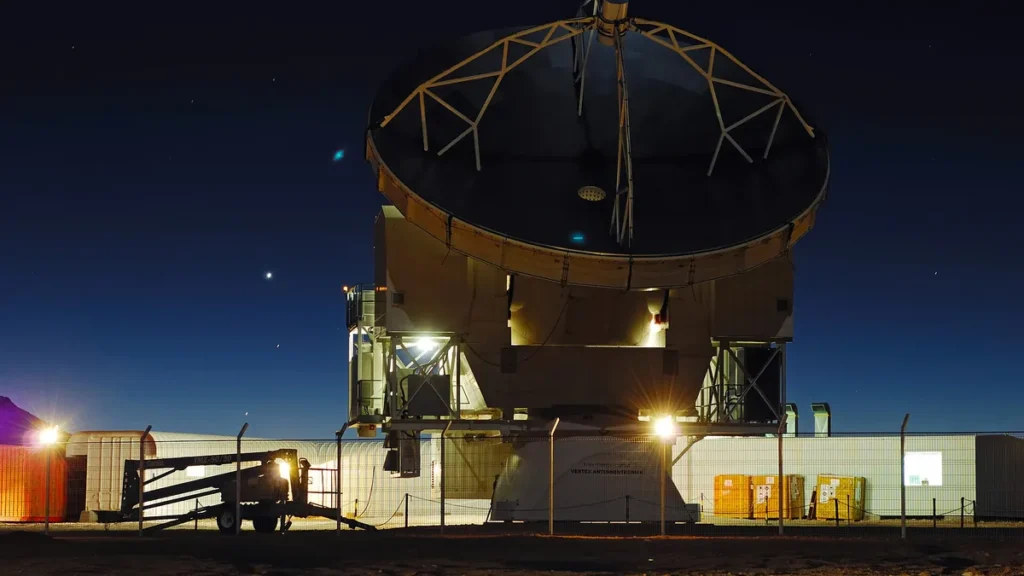
No earlier EHT array configuration published to date was as large as the 2021 observing campaign. It added two stations: Kitt Peak Observatory’s 12-meter telescope in Arizona, and NOEMA in the French Alps. Both supplied crucial intermediate baselines. Those baselines improved coverage at intermediate scales and allowed the team to pin down particular angular scales for studying compact jet structures as well as extended ones.
Phys.org reported that Müller explained to Universe Today that an antenna baseline’s physical separation sets the spatial scale it resolves, comparing the idea to the Very Large Array’s railway-track design.
Phys.org reported that the EHT adds telescopes every year, including the Greenland Telescope in 2018, Müller said. Phys.org attributes this to Müller’s email to Universe Today while discussing the array’s continuous growth.
The proximity of NOEMA to Pico Veleta near Granada, Spain, meant the two sites added information missing from earlier years, Phys.org reported. Phys.org notes the EHT cannot move its telescope locations, so proximity between new and existing sites mattered for the 2021 configuration.
To process the EHT data, the team used Comrade, DoG-HiT, kine and Difmap, following an approach similar to the reconstruction of the 2019 M87 image. The packages make different assumptions about the image, and checking consistency across methods builds confidence in the result. Imaging was not the only task: many collaborators and software packages also handled correlation and calibration at an early stage.
The results indicate that the 3C 279 jet bends in a way that aims one section closer to Earth, which produces brighter emission and slows its apparent motion along one bright stretch farther out in the inner jet. Müller explained that plasma moving close to light speed concentrates radiation in the direction it travels. When that direction points more closely at Earth, the emission looks brighter and features seem to move more slowly across the sky. He compared the situation to a fast car arriving almost head-on: such a car barely shifts left or right in the viewer’s field of view.
Images from the EHT show that 3C 279’s inner jet changes direction over time, which offers hints about what powers the jet. Müller said features close to the jet’s apparent base cross the sky at the same speed as features farther downstream, which shows that the jet picks up most of its speed near its base. Müller said, “We also found a clue about where the jet picks up speed.”
How 3C 279’s central jet is driven remains a mystery, and astronomers possess only a few subparsec-scale images even after decades of observations on larger scales. The EHT is extremely useful for deep surveys and high-resolution work that reveals details about the jet’s innermost region not previously available.
Researchers are studying EHT observations from several years alongside same-time multifrequency observations, and they expect results over the next few years because different frequencies show different parts of the jet. When observations taken close together in time at different frequencies are compared, instrumental frequency effects can be separated from real changes in the jet. Müller called the current manuscript just the beginning. He called 3C 279 a prime opportunity to study how black holes launch jets and speed them up to nearly light speed.
ALMA is one of the most sensitive and critical stations in the EHT network, and the U.S. National Science Foundation National Radio Astronomy Observatory is a partner in ALMA. Campaigns from 2017 and 2018 had no intermediate baselines, but the expanded array now joins the region around the black hole’s ring to the jet itself. That bridge lets researchers test detailed computer models of how jets are launched, and it supports new tests of black hole physics through direct imaging of the jet’s base, the region where matter near the black hole supplies the outflow. Future observations will add ALMA together with the Large Millimeter Telescope in Mexico.
In 2021, EHT observations of M87 compared radio brightness across spatial scales and found that the glowing ring does not account for all the radio emission. The expected location of the jet base matches a compact source about 0.09 light-years from the black hole. Intermediate baselines built with ALMA and other stations turned out to be essential, revealing structures that link the environment around the black hole to the larger jet.
Astronomy & Astrophysics published the M87 jet study on Jan. 28, 2026; it drew on EHT data gathered in 2021. The authors say the result stands up to their assumptions and tests, though they call for new EHT observations with greater sensitivity, stronger intermediate-baseline coverage, and more frequencies for definitive confirmation and tighter constraints.
Fox News reported that Padi Boyd of NASA said in a video that very high magnetic fields launch jets and that active supermassive black holes are rare, present in only a few percent of cases at any given time. She also called the M87 image observational proof that a jet connects to the central supermassive black hole of its galaxy. Fox News frames M87 as active, sucking in gas and dust while spewing charged particle jets from its poles.
Saurabh, who leads the Max Planck Institute for Radio Astronomy’s team, described the study as an early step connecting jet-launching theory with direct observations, and said pinning down the jet’s origin adds an important element to understanding the central engine, Fox News reported. Saurabh said, “This study represents an early step toward connecting theoretical ideas about jet launching with direct observations.”
According to the National Science Foundation, a black hole’s event horizon is the boundary past which light cannot get out. The EHT network imaged M87’s surroundings and traced its jet toward a likely source point near that boundary.



Join the discussion