Key facts
- The campaign also obtained two near-infrared imaging epochs from Keck/MOSFIRE and four near-infrared spectroscopic epochs from Gemini/Flamingos-2 and GNIRS over the same 2025 July to 2026 May span.
- The C2/CN ratio nearly doubled from 0.257±0.014 on 2025 September 14-15 to 0.481±0.080 on 2025 November 26.
- The C3/CN ratio fell from 0.327±0.024 on 2025 August 28 to 0.214±0.009 on 2025 September 14-15.
- MOSFIRE near-infrared imaging on 2025 July 11 gave Y-J=0.466±0.143, J-H=0.239±0.052, H-Ks=0.454±0.150, and J-Ks=0.693±0.202 magnitudes.
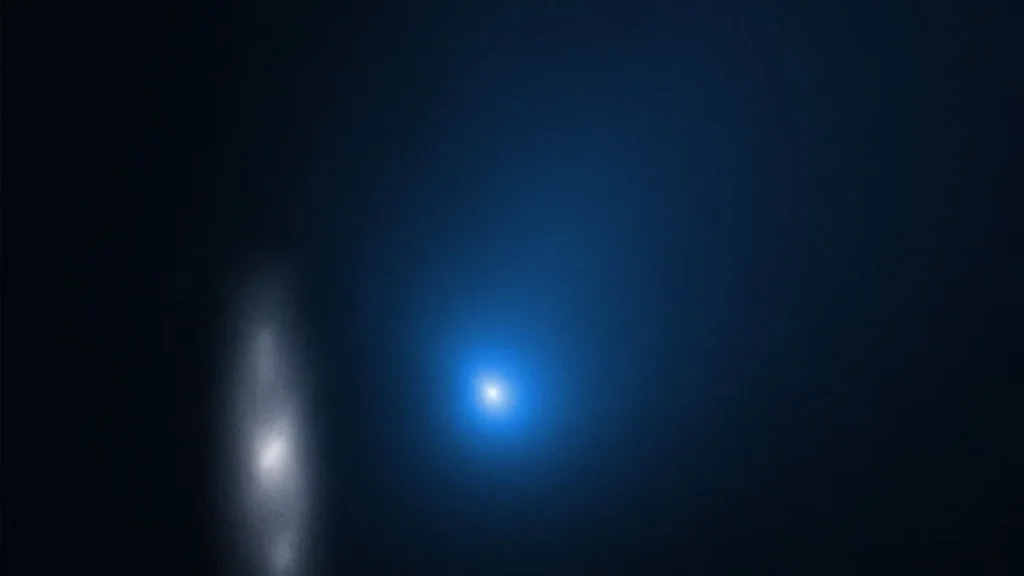
Astronomers using the Keck and Gemini observatories imaged and spectroscopically observed interstellar comet 3I/ATLAS between July 2025 and May 2026 as the object passed through the Solar System. [Cite: Astrobiology Web, arXiv.org, S4]\n\n
Keck/LRIS and Gemini/GMOS provided 14 optical imaging observations and eight spectroscopic observations. The near-infrared component added two imaging observations from Keck/MOSFIRE and four spectroscopic observations from Gemini’s Flamingos-2 and GNIRS. All observations spanned July 2025 to May 2026. [Cite: Astrobiology Web, arXiv.org, S4]\n\n
Between July 3, 2025 and May 15, 2026, the team calculated dust losses of 2.7×10^9 kilograms and 1.0×10^10 kilograms for grains from 1 micrometer to 1 millimeter, corresponding to surface layers of 0.26 meter and 0.99 meter under adopted assumptions. The coma appeared concentrated on August 27, 2025, with a compact sunward feature and antisolar tail. By November 26, 2025, it had broadened, and extended dust remained visible through February 17, 2026. [Cite: Astrobiology Web, arXiv.org, S5]\n\n
From September 14-15, 2025 to November 26, 2025, the C2-to-CN ratio nearly doubled, rising from 0.257±0.014 to 0.481±0.080. Earlier, on August 28, 2025, the C3-to-CN ratio stood at 0.327±0.024, then dropped to 0.214±0.009 by September 14-15, 2025. [Cite: Astrobiology Web, arXiv.org, S5]\n\n
The activity law tied phase-corrected red-band output to heliocentric distance, scaling to the minus 2.10±0.14 power inbound and to the minus 3.34±0.43 power outbound, a steepening after perihelion compared with the inbound leg. Across perihelion, GMOS colors remained steady at g-r=0.732±0.029, r-i=0.237±0.025, and i-z=0.109±0.022 magnitudes. Imaging from MOSFIRE on July 11, 2025, produced near-infrared colors of Y-J=0.466±0.143, J-H=0.239±0.052, H-Ks=0.454±0.150, and J-Ks=0.693±0.202 magnitudes. [Cite: Astrobiology Web, S3]\n\n
The team recorded spectroscopic near-infrared colors on September 5-6 and again on December 1-2, 2025. On September 5-6, 2025, spectra showed J-H=0.24, while December 1-2, 2025, brought J-H=0.27-0.28 and J-Ks=0.21-0.22 over retained passband intervals. Model-calibrated imaging from February 6, 2026, returned a near-solar J-Ks of 0.303±0.051. None of the tested continuum and calibration choices produced a robust water-ice absorption signature in the near-infrared spectra. [Cite: Astrobiology Web, arXiv.org, S5]\n\n
A NASA-funded telescope in Chile, part of ATLAS, discovered 3I/ATLAS in July 2025 as it moved at about 137,000 miles per hour. It became the third known interstellar visitor, after 1I/’Oumuamua in 2017 and 2I/Borisov in 2019. The comet ranks as the largest known interstellar visitor, with an icy core spanning 1,400 feet to 3.5 miles across, and is also the brightest. [Cite: S2]\n\n
Published in Nature on June 22, a study drawing on JWST and ALMA observations from December estimates that 3I/ATLAS is about 10 billion to 12 billion years old, or roughly three times the age of the Solar System. Researchers derived the age from the ratio of two carbon forms measured in the comet’s gases, and the result shows formation only a few billion years after the Big Bang, during the cosmic noon era when star formation reached its peak. [Cite: S2]\n\n
Measurements show the comet holds around 30 times the deuterium found in solar-system comets, and researchers suspect it formed at or below minus 405 degrees Fahrenheit in a frigid environment. The finding extends earlier April research that proposed the comet predated its home system’s host star. [Cite: S2]\n\n
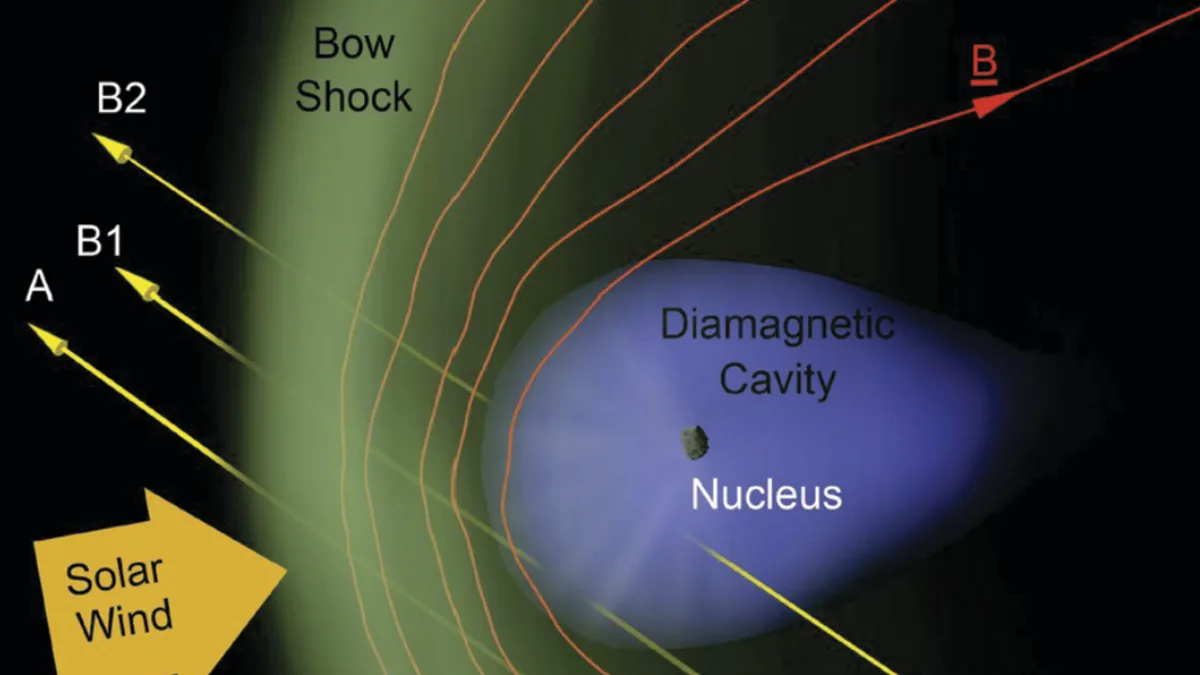
Study co-author Martin Cordiner, an astrochemist at NASA’s Goddard Space Flight Center, called 3I/ATLAS “the oldest object to have been observed in our solar system.” The Nature study relied on JWST and ALMA observations from December, and Cordiner discussed the comet with Agence France-Presse’s Daniel Lawler and with Science’s Hannah Richter. [Cite: S2]\n\n
Stefanie Milam, a NASA Goddard astrochemist and study co-author, said studying interstellar objects helps reveal how widespread life-friendly conditions might be across the universe. She noted that Earth is the only known place where chemical ingredients led to life. [Cite: S2]\n\n
Michigan State University astrophysicist Darryl Seligman, unaffiliated with the study, told AFP that before these measurements, gathering such data on an interstellar object had seemed like a dream. Seligman is not part of the research team. [Cite: S2]\n\n
SpaceOdysseyHub reports that Indian telescopes had earlier reported a similar carbon shift after perihelion, seeing the comet’s carbon chemistry move from depleted to typical. The outlet says this independent data set points the same way as the Keck/Gemini preprint, though neither paper has been peer-reviewed. [Cite: S5]\n\n
SpaceOdysseyHub also notes that the arXiv preprint had not been peer-reviewed and that its authors announced no new observations of the comet. The arXiv listing classifies the paper under Earth and Planetary Astrophysics and Astrophysics of Galaxies, with the identifier arXiv:2610.32972. [Cite: SpaceOdysseyHub, S3]\n\n
AstroGroot says researchers designed the campaign to measure dust output, coma shape, and chemical abundances across multiple epochs, creating a baseline for interstellar object dynamics and material properties. As an interstellar object during its high-velocity transit through the Solar System, 3I/ATLAS offers a chance to analyze physical traits of extraterrestrial bodies from outside the solar neighborhood. The findings serve as a benchmark for studying “Oumuamua-class” objects and planning future interstellar missions, expanding knowledge of cometary variation across the galaxy and shaping how future interstellar encounters are observed. [Cite: S4]\n\n

Join the discussion