Key facts
- JWST's MIRI/LRS instrument observed a single partial secondary eclipse of the ultrahot rocky lava planet TOI-431b and measured an eclipse depth of 81 ± 16 parts per million.
- The brightness temperature ratio R of 0.81 ± 0.10 is 1.2 standard deviations higher than the value previously reported by Spitzer.
- Secondary-eclipse thermal emission observations can reveal whether a rocky exoplanet has an atmosphere, since an atmosphere may raise the albedo and/or shift heat off the dayside, lowering the measured eclipse depth.
- Whether rocky exoplanets orbiting extremely close to their host stars, known as lava worlds, can keep significant atmospheres is an open question in exoplanet science.
Researchers using JWST’s MIRI/LRS mid-infrared spectrograph observed a single partial secondary eclipse of the ultrahot rocky lava planet TOI-431b and measured an eclipse depth of 81 ± 16 parts per million, Astrobiology Web reported on Nov. 15, 2026. The observation captured only part of the eclipse, so the result is a single partial eclipse rather than a full one.
Astrobiology Web reported that the eclipse depth yields a brightness temperature of 1967-253+237 kelvin and a brightness temperature ratio, R, of 0.81 ± 0.10. Brightness temperature is the temperature inferred from the planet’s thermal emission. The figure carries an asymmetric uncertainty of minus 253 and plus 237 kelvin. Both numbers come from the same JWST MIRI/LRS measurement and appear beside the earlier Spitzer value for the same planet.
The brightness temperature ratio is 1.2 standard deviations higher than the value reported by Spitzer for TOI-431b, according to the report. That comparison situates the new JWST measurement against the prior space-based measurement of the planet’s eclipse signal. The observed ratio is also 1.8 standard deviations below the value for a zero-albedo, zero-heat-redistribution bare rock, for which R equals 1.
The bare-rock benchmark assumes neither reflectivity nor day-to-night heat transport, so it sets the reference case of a bare rock for judging an atmospheric signal, the report explained. Because researchers expect magma pools to have low albedos, the researchers concluded the TOI-431b results are best explained by the presence of an atmosphere. A low-albedo magma surface alone would not produce the observed ratio, so the authors attribute the result to an atmosphere instead of to a bare molten surface.
Secondary-eclipse thermal emission observations can reveal whether a rocky exoplanet has an atmosphere, since an atmosphere may raise the albedo and/or shift heat off the dayside, lowering the measured eclipse depth, according to the report. In this geometry, the planet passes behind its star from Earth’s viewpoint, briefly blocking its dayside glow from view. Changes in eclipse depth can betray an atmosphere through reflectivity and heat transport from the permanently lit side to the dark side. An atmosphere can make a planet look cooler or less bright in eclipse than a bare rock would.
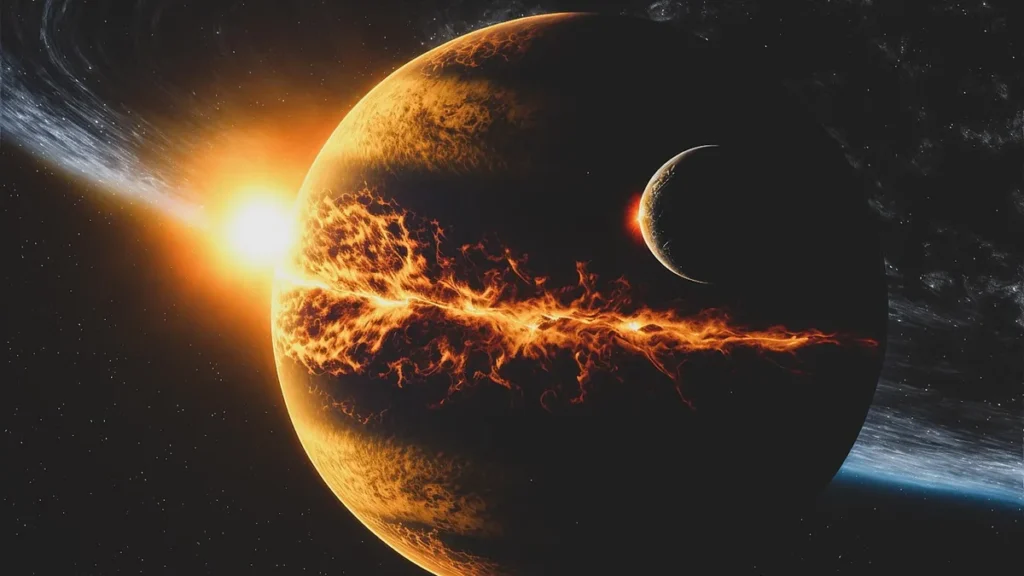
Whether rocky exoplanets orbiting close to their host stars, known as lava worlds, can keep significant atmospheres is an open question in exoplanet science, the report said. Lava worlds are strongly heated by their nearby stars, so whether they can survive with an envelope intact remains unclear. Recent eclipse observations of lava planets, rocky planets hot enough to hold liquid magma surfaces, have suggested the presence of atmospheres on such worlds.
Those earlier detections build the sample of small exoplanet atmospheres into which the new TOI-431b result fits as one case, according to the report. Future work should measure the exact composition of TOI-431b’s atmosphere and improve models of lava planet atmospheres to better constrain the nature and evolution of lava planets. The authors say composition and modeling work remain outstanding because the present detection points to an atmosphere without identifying what gases it contains.
The TOI-431b research appeared in The Astronomical Journal as an open-access paper titled “JWST MIRI Reveals a Potential Atmosphere on the Ultrahot Rocky Planet TOI-431b,” Astrobiology Web reported. The paper frames the observation around whether intensely irradiated rocky planets can hold on to gaseous envelopes.



Join the discussion