Key facts
- A new study by the GRAPES-3 team published in the Journal of Cosmology and Astroparticle Physics explained why the telescope detects more thunderstorm events from the east than the west.
- From April 2011 to December 2020, GRAPES-3 recorded 487 thunderstorm events, with 81.5 percent on the eastern side and 13.7 percent on the western side of its field of view.
- The imbalance comes from the geomagnetic cutoff, which makes lower-energy positive cosmic rays from the east reach the atmosphere less easily than those from the west.
- The modeled charge ratio was about 1.37 toward the east and about 1.14 toward the west; using this directional ratio reproduced the east-west asymmetry, while forcing the same ratio in both directions erased it.
The GRAPES-3 team, led by first author Hari Haran Balakrishnan of the Tata Institute of Fundamental Research, published a study in the Journal of Cosmology and Astroparticle Physics on Oct. 2, 2026, explaining why its muon telescope in Ooty, India, records more thunderstorms from the east than from the west. The work combines data and statistical analysis with simulations of muon production and travel through the atmosphere.
A 560-square-metre muon telescope at Ooty, India, records around four billion muons every day for GRAPES-3. The instrument was originally built to study space particles and cosmic-ray physics, not weather, yet its steady stream of ground-level muons now helps investigators probe thunderstorm electricity.
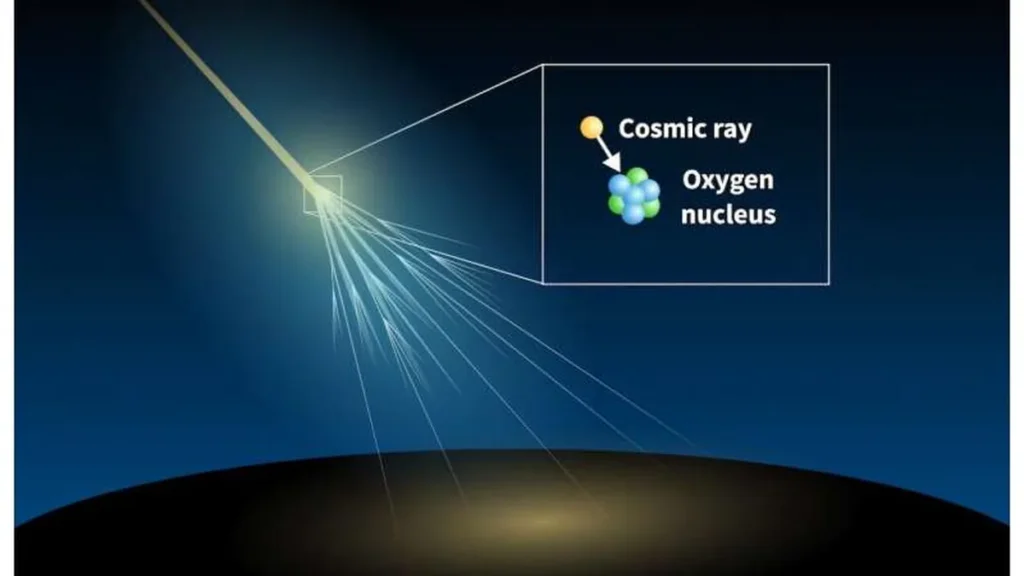
Most primary cosmic rays are protons. Because they carry electric charge, Earth’s magnetic field deflects their paths before they strike atmospheric nuclei and create secondary showers that include short-lived muons moving near light speed. Ground-level detectors mainly record those muons, and positive muons normally outnumber negative ones, so the muon charge ratio is greater than one.
"The cosmic rays we detect at ground level consist predominantly of muons"
Sunil Gupta of the Tata Institute of Fundamental Research (TIFR), Astrobiology Web
Inside a thundercloud, separated charges build strong electric fields and large potential differences. Those fields generally slow positive muons while speeding up negative muons. Because positive and negative muons do not arrive in equal numbers, their opposing responses do not cancel, leaving a small but measurable change in total muon flux.
Direct measurement of thundercloud potential is difficult because it requires instruments flown by aircraft or weather balloons into storms or close to them. Sampling a large, fast-changing phenomenon from inside or near it poses a challenge, so ground-based muon monitoring offers a way to watch cloud electricity without sending hardware into active weather.
An earlier GRAPES-3 study measured a thunderstorm potential of 1.3 gigavolts, while previous direct measurements had reached only about 130 million volts. The gap of more than an order of magnitude illustrates the difficulty of sampling a storm from within and shows why researchers look to muons as an alternative probe.
Charles Thomson Rees Wilson, the 1927 Nobel laureate, proposed as early as the 1920s that thunderclouds could reach enormous voltages. His idea anticipated the large potentials later inferred by GRAPES-3, although direct instruments had not recorded such scales.
From April 2011 to December 2020, GRAPES-3 recorded 487 thunderstorm events. Of those, 81.5 percent appeared on the eastern side of the telescope’s field of view and 13.7 percent on the western side, producing a strong eastward detection bias.
A separate network of instruments tracking atmospheric electric fields showed that actual storms did not favor the east to a similar degree. That result ruled out a local weather explanation for the eastern skew in GRAPES-3 detections and pointed toward an instrumental and geomagnetic cause.
The imbalance comes from the geomagnetic cutoff. Earth’s magnetic field deflects charged cosmic rays, so lower-energy positive cosmic rays from the east reach the atmosphere less readily than those from the west. The cutoff varies across the telescope’s field of view, changing its directional sensitivity.
Scientists have known about this east-west effect for nearly a hundred years. The modeled charge ratio was about 1.37 toward the east and about 1.14 toward the west. Using that directional ratio reproduced the observed east-west asymmetry, while forcing the same ratio in both directions erased it.
Simulations of muon production and propagation through the atmosphere confirmed that including the direction-dependent charge ratio creates the asymmetry, whereas a uniform ratio removes it. The result means GRAPES-3 is more responsive to storm electricity in the east even if actual storm voltages do not differ by direction.
"Muons are actually an ideal gift for doing these kinds of studies"
Sunil Gupta, EurekAlert!
The finding strengthens the case that cosmic-ray muons can serve as a natural way to study thunderstorm electricity. Understanding the geomagnetic direction effect is necessary before researchers can use GRAPES-3 as a dependable probe of thundercloud electricity, and it clarifies how researchers must account for that effect in future measurements.

Join the discussion