
Key facts
- The methane deuterium-to-hydrogen ratio in 3I/ATLAS is roughly 13 times the ratio found in comet 67P/Churyumov-Gerasimenko, a body that probably came from our own solar system.
- The research team states that no methane measurement elsewhere in the solar system has shown a higher deuterium-to-hydrogen ratio than the one found in 3I/ATLAS.
- The comet's methane enrichment is about three times higher than the deuterium ratio previously measured in its water, so researchers suggest the methane formed later as chemistry concentrated more heavy hydrogen.
- Deuterium is a heavier form of hydrogen with an extra neutron in its nucleus, and it can replace ordinary hydrogen in methane, changing the molecule's infrared signature so astronomers can distinguish the two forms.
Nathan Roth of American University and NASA’s Goddard Space Flight Center, working with colleagues, used the James Webb Space Telescope on Dec. 22 and 23, 2025, to measure a deuterium-to-hydrogen ratio of approximately 3.2% in methane from the interstellar comet 3I/ATLAS, then about 2.4 times as far from the sun as Earth is. The telescope examined infrared light from the comet’s coma. The finding appeared in Nature Astronomy in a paper by Nathan X. Roth and colleagues titled An enriched methane D/H ratio in the interstellar object 3I/ATLAS, with DOI 10.1038/s41550-026-03002-5. Nathan Roth and colleagues reported the research on Nov. 1, 2026.
Deuterium is a heavier form of hydrogen with an extra neutron in its nucleus, and it can replace ordinary hydrogen in methane, changing the molecule’s infrared signature so astronomers can distinguish the two forms. The comet’s methane enrichment is about three times higher than the deuterium ratio measured in its water, and researchers suggest the methane formed later as chemistry concentrated more heavy hydrogen. The research team states that no methane measurement elsewhere in the solar system has shown a higher deuterium-to-hydrogen ratio than the one found in 3I/ATLAS.
The methane deuterium-to-hydrogen ratio in 3I/ATLAS is roughly 13 times the ratio found in comet 67P/Churyumov-Gerasimenko, a body that probably came from our own solar system. Comet 67P is a Jupiter-family comet that probably originated in the Kuiper Belt and is the only other comet where scientists have detected deuterium-bearing methane, a measurement that required close-up investigation by the Rosetta spacecraft, while Webb detected the molecule from afar in 3I/ATLAS. Researchers led by scientists from NASA’s Solar System Exploration Division found that 3I/ATLAS methane holds far more heavy hydrogen than anything measured in the Solar System.
The elevated deuterium ratio fits a picture of ices forming in a cold, metal-poor setting between stars or around a young star, with frequent cosmic ray bombardment. A low carbon-13 content suggests the comet comes from an early universe not yet enriched by generations of stars that forged heavier elements in supernovae. Researchers argue the methane result fits a proposed origin for 3I/ATLAS in a cold cloud or near a forming star that is low in elements heavier than helium and heavily bombarded by cosmic rays.
Astronomers have identified three interstellar visitors: 1I/ʻOumuamua, which passed through in 2017; 2I/Borisov, a comet that appeared in 2019; and 3I/ATLAS, only the third known interstellar object. Astronomers spied 3I/ATLAS in July 2025 at about three times Mars’ distance from the sun and determined it originated in another star system, though they do not know where or how it escaped that distant system. The two interstellar comets 3I/ATLAS and 2I/Borisov probably originated in the distant outer regions of their home planetary systems, preserving a record of early conditions around their stars like comets in our own solar system.
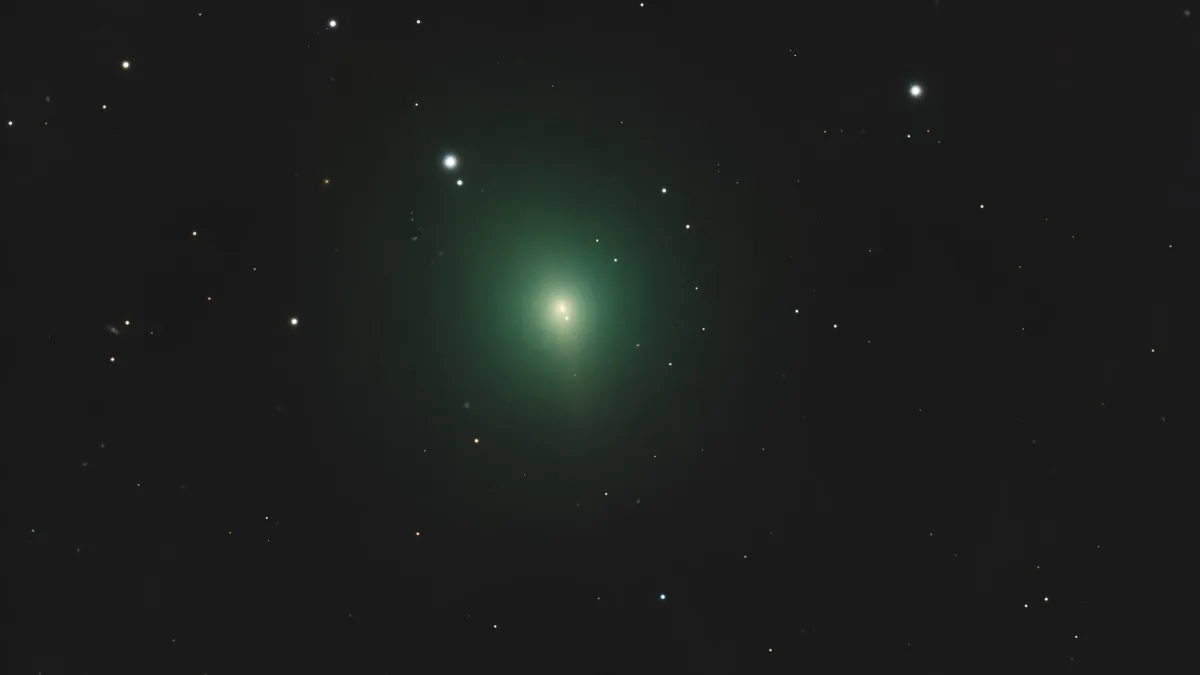
Radio telescopes at the Atacama Large Millimeter/submillimeter Array in Chile detected deuterated water in 3I/ATLAS on November 4, 2025, shortly after perihelion as the object emerged from behind the sun. Ordinary solar-system comets hold one deuterated water molecule per 10,000 regular water molecules, but 3I/ATLAS is 30 times more enriched than solar-system comets and 40 times more enriched than Earth’s ocean water.
The chemical processes that enhance deuterated water require environments colder than roughly 30 Kelvin, or roughly minus 406 degrees Fahrenheit, because deuterium-containing molecules are more stable at low temperatures. Lead author Luis Salazar Manzano stated that these chemical processes are highly sensitive to temperature and require conditions colder than about 30 Kelvin, or about minus 406 degrees Fahrenheit.
At temperatures near 10 degrees above absolute zero, processes that reverse deuterium enrichment become less effective, and reactions on interstellar dust grains produce deuterium-rich ice that can enter a comet. Around Prague said the comet may have journeyed through space for seven billion years before the Sun’s birth and formed before massive stars forged many atoms now in the Sun and planets.
The conclusions come from one study and rest on interpreting isotope ratios as a hypothesis about the comet’s origin rather than a settled answer. Scientists lack direct measurements of methane’s deuterium-to-hydrogen ratio from distant star-forming environments for comparison, and available chemical model estimates fall short of the value measured in 3I/ATLAS, giving those models a demanding test.


Join the discussion