Key facts
- The preprint is the third installment in a series on exomoons and exorings with the Habitable Worlds Observatory and has been accepted to AJ.
- The UK Space Agency awarded £3 million to continue developing one of HWO's core instruments.
- The Nancy Grace Roman Space Telescope is slated to launch in 2026.
- Sam Hopper, Mary Anne Limbach, and Rachel Bowens-Rubin authored the preprint study examining exomoons and exorings with HWO, which was posted to the arXiv preprint server on November 17, 2026.
Sam Hopper, Mary Anne Limbach, and Rachel Bowens-Rubin posted the third installment of their exomoon and exoring study to the arXiv preprint server on Nov. 17, 2026.
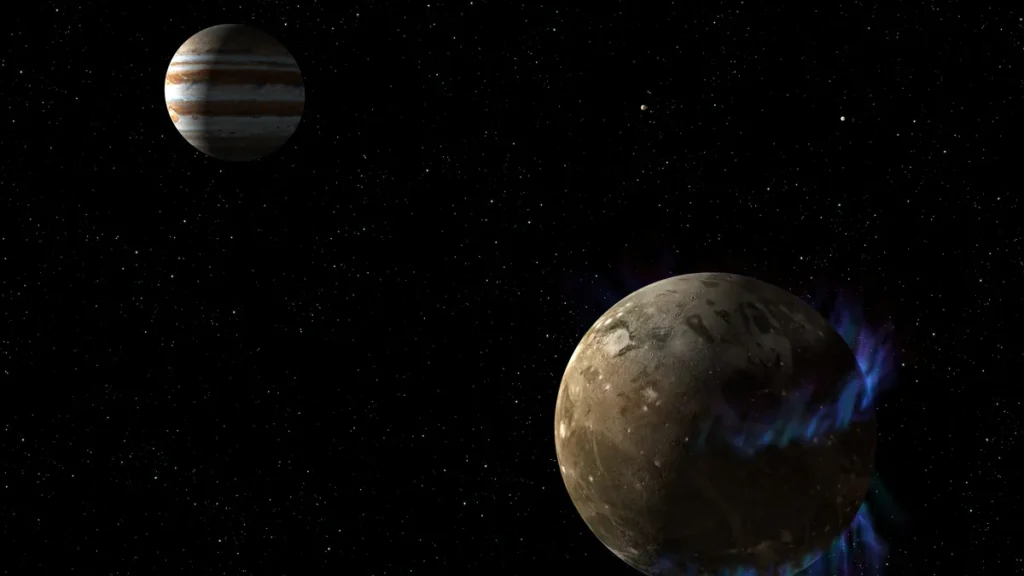
The authors treat the Solar System’s giant planets as exoplanet analogs and find that, at their locations, the dominant point sources of reflected near-infrared light observed with the Habitable Worlds Observatory would be Jupiter, Saturn’s rings, Uranus, and Triton, Neptune’s icy moon. The authors report that HWO could detect reflected light from exomoons like Triton and exorings like Saturn across a wide range of sizes, distances, and separations.
For the nearest systems, the team estimates that icy Titan-sized exomoons would be detectable at star-moon separations of about 2 AU (astronomical units), while icy Earth-sized exomoons would be detectable out to about 6 AU. These estimates assume albedos matching the moons’ Solar System analogs.
Motivated by cases where rings or moons outshine their host planets in the Solar System, the researchers calculated expected signal-to-noise ratios for moons and rings possessing identical albedos to their Solar System equivalents across many sizes, system distances, and separations. Saturn-like exorings would likely be the brightest point sources in many extrasolar systems, capable of greatly outshining their host planets, and potentially detectable at system distances out to 100 parsecs. The study carries arXiv identifier 2611.22150 in the astro-ph.EP category, and the Astronomical Journal accepted it as the third installment in the series.
Target lists must account for sources where rings or moons dominate the reflected light. The authors call for new identification and disentangling methods where exomoons and exorings blend with exoplanet signals and remain spatially unresolved from them in HWO data.
An observatory still years from flight
The Habitable Worlds Observatory is a planned space-based telescope whose primary job is to directly image Earth-like exoplanets. Phys.org explains that direct imaging and atmospheric spectroscopy alone are insufficient without a planetary mass measurement.
Phys.org reports that HWO likely will not launch until at least the early 2040s. EurekAlert! reports that the observatory is expected to launch in the 2040s and is not expected to launch for another two decades. satnews.com reports that HWO is slated for launch in the late 2040s. Phys.org describes HWO as still a long way away.
EurekAlert! describes HWO’s headline scientific goal as seeking Earth-like planets orbiting nearby stars and studying their atmospheres for evidence of life. Rather than surveying the whole galaxy, the observatory will focus on nearby stars in our cosmic neighborhood, and at about 30 light-years it should be able to directly study Earth-like planets. It will also serve as a general-purpose observatory.
It will tackle one of the biggest questions in science: are we alone in the universe?
Professor Martin Barstow, University of Leicester, EurekAlert!
EurekAlert! also describes HWO as the first in NASA’s next generation of flagship Great Observatories, developed through the Great Observatories Maturation Program following the 2020 US Astronomy and Astrophysics Decadal Survey. HWO is NASA’s next flagship space telescope after the Nancy Grace Roman Space Telescope. HWO builds on the legacy of Hubble and the James Webb Space Telescope while seeking to answer whether life exists elsewhere in the universe.
satnews.com says HWO’s main goal is to seek Earth-like exoplanets around sun-like stars within 30 light-years and to directly image and spectroscopically study at least 25 of them, searching their atmospheres for oxygen, ozone and methane. According to satnews.com, HWO’s instruments and mirror segments must stay steady to within a fraction of a picometer, about 1/50th of a hydrogen atom’s width, across multi-hour observation windows.
The Gazette reports that the brightness of an exoplanet relative to its star is about one in 10 billion, comparable to a firefly next to a thousand stadium floodlights separated by about a millimeter. Alison Nordt, Lockheed Martin Space’s director of space sciences and instrumentation, offered the comparison on the first full day of symposium events at the 41st Space Symposium, a six-day gathering at The Broadmoor.
NASA has found more than 6,000 planets orbiting other stars but has never found an Earth-like planet, according to The Gazette. NASA Goddard planetary scientist and astrobiologist Giada Arney shared a rendering of the solar system from 33 light-years away, showing Earth barely visible and Venus relatively visible.

Measuring mass where radial velocity fails
Phys.org reports that about 30% of HWO’s target list consists of hot, rotating A and F-type stars for which radial velocity measurements are essentially useless. These stars have hot photospheres with few distinguishing spectral lines and rotate rapidly, blurring spectral data and making high-precision radial velocity measurements impossible. The outlet describes a separate astrometry paper by Kaz Gary of Ohio State and co-authors, motivated by the fact that direct imaging and atmospheric spectroscopy alone cannot provide a planetary mass measurement.
The astrometric signal for an Earth-like planet 10 parsecs away is roughly 0.3 microarcseconds, Phys.org reports. HWO’s High-Resolution instrument would rely heavily on background stars, and photon noise from those stars is the primary limit, so the direction of observation strongly affects uncertainty.
Researchers suggest a dedicated 200-day astrometry survey across HWO’s five-year primary mission, with about 100 observations per target star, to measure masses of about 40 habitable-zone Earth-like planets to 10% precision. Researchers consider 10% mass precision essential because without it atmospheric models face degeneracy and cannot identify whether nitrogen or carbon dioxide dominates a planet’s atmosphere. The authors propose using the Gaia G band to balance star density and the diffraction limit.
Robotics, partnerships, and a long wait
NASA confirmed during a technical briefing at the American Astronomical Society’s 248th meeting in Pasadena that HWO is being structurally engineered to mandate robotic in-space servicing, assembly and maintenance. Shawn Domagal-Goldman, NASA’s astrophysics division director, made the confirmation, describing the $11 billion optical instrument as an upgradable orbital asset at Sun-Earth Lagrange point 2. HWO will sit 1.5 million kilometers from Earth at L2, making human servicing missions logistically unviable, so NASA is mandating a modular, robotically accessible hardware architecture from the start.
The UK Space Agency awarded £3 million to continue developing one of HWO’s core instruments. The UK is leading development of HWO’s High Resolution Imager and Multi-Object Spectrograph, core instruments on the telescope.
The Gazette reports that NASA has tapped Lockheed Martin and other Colorado companies to develop technologies for HWO, announced at the 41st Space Symposium, a six-day event at The Broadmoor. Lockheed has contributed to the James Webb Space Telescope and 11 of NASA’s 22 Mars missions.
Lockheed’s Nordt said HWO must be 100 times more stable than the James Webb Space Telescope, with variances measured by single atoms, and that researchers need extreme stability to get good data. She also said years of technology development and demonstration remain.
The Gazette reports that the Nancy Grace Roman Space Telescope is slated to launch in 2026. Lockheed and NASA will continue learning from Hubble, Webb and the Roman telescope while waiting for HWO, which is unlikely to launch for at least fifteen years.

Join the discussion